
 Tiếng Việt
 日本語
日本語 한국어
한국어 中文 (中国)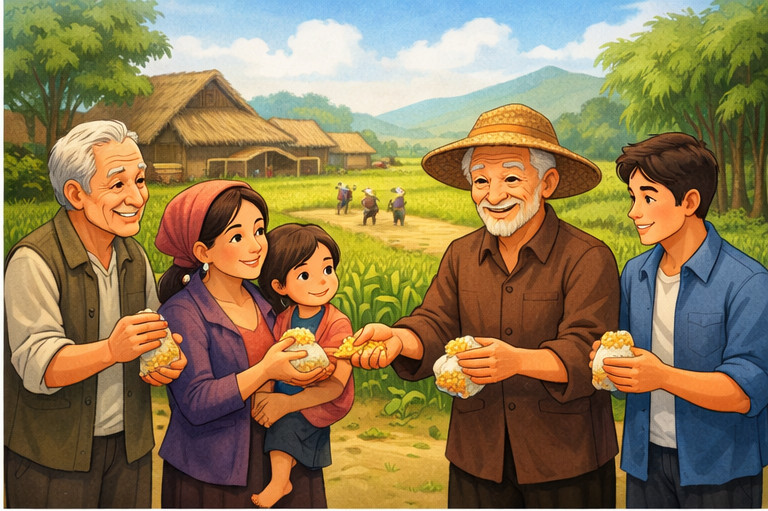
The early summer wind moved gently along the red dirt path leading into Phu Dien village, carrying the earthy scent of fields that had just been turned over. Wide plots of land lay quietly under the morning sun, waiting for human hands to wake them. At the edge of the village, where old bamboo groves whispered all year round, there was a field that everyone talked about. People said that even from the far end of the path, you could see the corn there growing greener and more evenly than anywhere else, as if each plant had been tended with care and affection.
The owner of that field was Mr. Lam.
He was not wealthy in the way people usually imagine. His tile roof house was simple, its lime walls faded by time. In the yard stood a few rainwater jars, an old bicycle, and a trellis of gourds climbing over the walkway. Yet whenever his name came up, villagers would nod with quiet respect. Year after year, he was recognized by the local farming cooperative as the man with the best corn seed in the region.
His corn had plump, golden kernels. When dried in the sun, they made a cheerful crackling sound. Every ear was full and firm, with very little disease. Traders from a town dozens of kilometers away would come early to place orders before harvest.
The strange thing was that he never kept his secret to himself.
Every planting season, people saw him dividing his seeds into small bundles, tied with dried banana fiber, and bringing them to neighboring households. Uncle Bay at the top of the hamlet, Hoa, the widow by the canal, Tín, who had just moved out on his own, he visited them all.
Some people shyly asked the price, and he would wave his hand with a smile.
“Good seed should be planted in many places. That’s when it’s truly joyful,” he would say lightly.
At first, many accepted the seeds with mixed feelings. In the countryside, keeping valuable know-how to oneself was nothing unusual. They wondered if Mr. Lam had some hidden calculation behind his generosity.
One late afternoon at the end of the rainy season, when the rain had just stopped and purple clouds still lingered along the horizon, a stranger came to his house. It was Minh, a reporter from the provincial newspaper. Having heard about the famous corn seed and the story of sharing it, he decided to see for himself.
Mr. Lam welcomed him with a pot of green tea freshly picked from the garden. Steam rose from the cups, carrying a gentle fragrance. They sat on a bamboo platform under a mango tree in the yard.
Minh opened his notebook and asked sincerely,
“Sir, I’ve heard you always share your best corn seeds with your neighbors. Aren’t you afraid they might grow better corn than you and earn more?”
Mr. Lam laughed softly, a sound as gentle as soil after rain.
“Have you looked at the fields around here?” he asked.
Minh nodded. “Yes. They all look quite good.”
Mr. Lam rested his hands on the bamboo platform and gazed out at the vast green fields.
“Corn is pollinated by the wind. Pollen from one field drifts into another. If the corn around me is poor quality, then no matter how good my seed is, bad pollen will still blow in, and my corn will gradually worsen. The best way to keep good seed for myself is to help everyone else have good seed too.”
Minh fell silent for a moment, feeling the answer was both simple and profound.
Mr. Lam poured more tea and continued calmly,
“Farming taught me this long ago. If you want your own field to stay green, you should hope the whole landscape stays green.”
That sentence stayed with Minh all the way home. The article he later wrote did not focus only on farming techniques. It told the story of a farmer who understood the rule of giving and receiving in a deeply human way.
But Mr. Lam’s real story did not begin with awards.
Many years earlier, when he was still young, Phu Dien went through a disastrous season. Pests spread quickly, and unseasonal rains dragged on. Many cornfields turned yellow before the ears could fully form. His family was poor at the time. His wife had just given birth to their first child, and there was almost no grain left in the house.
He had once thought about keeping the few precious ears of good seed for himself for the next crop. But that night, he heard children crying in the house next door. It was Hoa’s home. Her husband had died young, leaving her to raise two small children alone. With the failed harvest, she had almost nothing left.
Mr. Lam stood for a long time in front of his basket of seed corn, torn by hesitation. In the end, he divided it in half and brought one part to her.
Hoa held the basket, eyes brimming with tears.
“Your family is struggling too. Why give me so much?”
He just smiled.
“As long as we can still plant, there’s still hope.”
The next season, Hoa’s field prospered thanks to the good seed. She brought some seeds back to return to him and added a basket of sweet potatoes from her field. From then on, the two families helped each other through many things.
That year, Mr. Lam learned something no book had taught him. When you open your hands, what comes back is not just seed, but neighborly love, and the comfort of knowing that in hard times, someone will stand beside you.
Gradually, sharing seeds became his habit. At first it was only with a few close households, then it spread through the hamlet and eventually the whole village. Some people once doubted him, saying he was only pretending to be kind to gain a good reputation. He heard them, smiled, and quietly continued doing what he believed was right.
As time passed, the cornfields around his home became more and more uniform. Disease decreased because the seeds were stronger. Yields across the area increased. More traders came, and prices improved. Not only Mr. Lam, but the entire village of Phu Dien gradually became better off.
One morning, as the sun rose over the bamboo groves, Mr. Lam took his grandson to visit the field. The boy, eight years old, asked curiously,
“Grandpa, why don’t you keep all the good seeds for our family, so we can be the richest in the village?”
Mr. Lam patted his head.
“If only our field is good while all the others are bad, the wind will still carry bad things here. And tell me, if only our family is rich while our neighbors are poor, would that feel good?”
The boy thought for a moment and shook his head.
Mr. Lam smiled.
“People are like fields. When you treat others well, sooner or later good things come back to you, sometimes in ways you never expect.”
The child did not fully understand, but the image of the vast green cornfields stretching before him stayed in his mind.
Many years later, when Mr. Lam had grown old and no longer went to the fields often, the villagers kept the habit of exchanging seeds. Each planting season, the yard of the village communal house became lively with people bringing their best seeds to share. They no longer clearly remembered who had started it, but everyone knew that because of it, the whole area had an easier life than before.
One late autumn afternoon, Mr. Lam sat in front of his house, looking toward the distant fields that had entered a new season. The wind moved in waves across the green, rolling all the way to the horizon. His heart felt light as a cloud.
He thought about his life, the hungry years, the moments of hesitation between keeping and giving, between fearing loss and daring to trust. Each time he chose to give, he received more than what he had offered.
Not money.
But grateful eyes from neighbors, shared meals with laughter, and people who came to check on him when he was sick. It was the feeling that his life had not been wasted.
The evening wind rustled through the bamboo, carrying its familiar whisper. Mr. Lam gently closed his eyes, breathing in the scent of young corn drifting from the distant fields. Somewhere out there, tiny grains of pollen were flying in the wind, quietly linking one field to another, just as people are connected through simple acts of kindness.
In the end, each person’s life is like a season of sowing. Every thought, every word, every action is a seed placed into the soil. Some grow into joy, others into sorrow. But the earth never betrays those who tend it with a compassionate heart.
And in the vast fields of life, no plot of land truly stands alone.

ARTICLES IN THE SAME CATEGORY
The Lamplighter at the End of the Slope
The Little Bell and Little Hedgehog’s Promise
The Well That Could Hear the Truth
The Seedling That Knew How to Listen
The Bridge That Appears Only When One Knows How to Return
Brown Squirrel’s Raincoat
ARTICLES IN THE SAME GENRE