

 Tiếng Việt
 日本語
日本語 한국어
한국어 中文 (中国)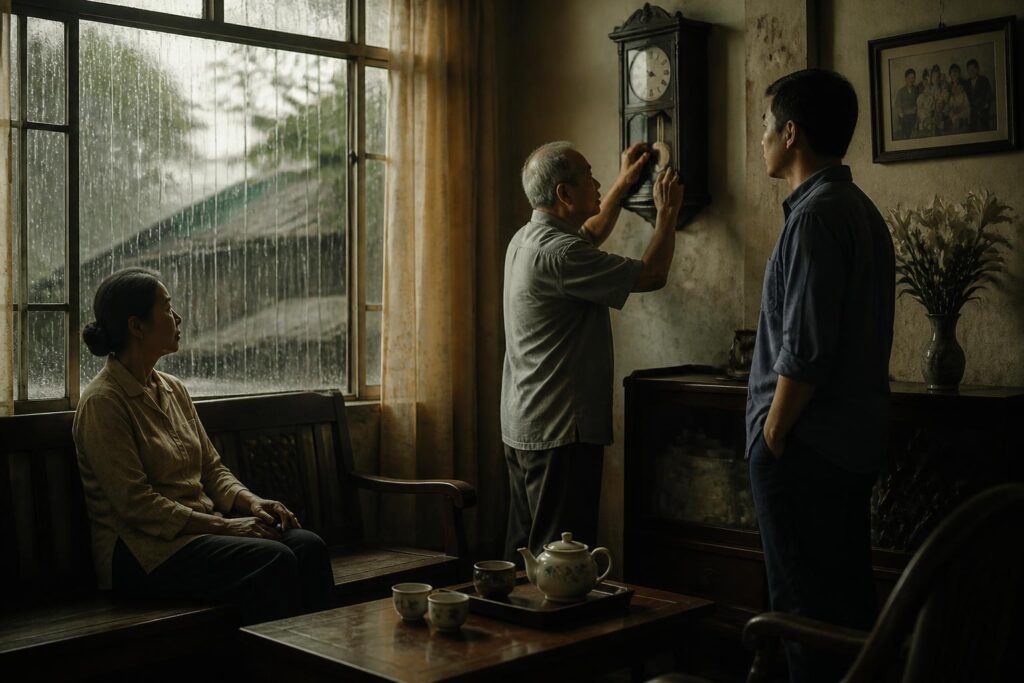
On the day he returned, Minh saw the clock hanging on the living room wall before he had a chance to see his mother. It was still in its old position, above the wooden cabinet that had darkened through many rainy seasons. A thin scratch ran across the glass from the upper-left corner to near the number six. The two hands stood still at eight seventeen.
Minh remembered that moment very clearly. Eight seventeen on an afternoon at the end of July, when rainwater flowed over the doorstep and his father pulled an old suitcase out of the house. It was also the last time Minh saw his father before leaving for the city to attend university. He was only eighteen then, old enough to recognize the tension on an adult’s face but not mature enough to understand how a family could fall so silent that one could hear the sound of the clock’s hands dropping into each empty space.
The clock had stopped working that day. His mother neither had it repaired nor took it down. She merely wiped the dust around it whenever she cleaned the house, as if an object that no longer ran could still continue to hold an important place in the room. Many times Minh asked, and his mother always answered briefly that the clock was old and it was fine to leave it as it was. He did not ask anything more. Matters concerning his father always lay in a place that both mother and son avoided entering.
Years Stored Away in a Drawer
Minh’s father had once repaired clocks at the end of the street, in a small shop with a low awning. The shop was not brightly lit; there was only a yellow bulb hanging overhead and a wooden table covered with screwdrivers, gears, and magnifying glasses. People on the street often said that Minh’s father had patient hands. A clock that seemed to have died could still run for several more years once it passed through his hands.
Minh did not like that shop. He hated the smell of machine oil, the tiny boxes of parts, and the way his father always bent close to the dials instead of looking up to listen to his son talk about school. Whenever Minh wanted to invite his father somewhere, his father would usually say, wait a little longer. His father’s little while could sometimes last an entire afternoon.
But when he grew older, Minh came to understand that his father was not a person who did not know how to love. He simply was not good at expressing it in words. He would quietly put the best piece of fish into his son’s bowl, replace a lightbulb before it burned out, or walk very slowly behind Minh whenever Minh rode his bicycle to the end of the lane. Those things were so small that, as a child, Minh took them for granted. Only after living alone in a cramped rented room did he realize that his father’s thoughtfulness had once covered his childhood like the roof of a house.
His parents began to fall out after a time when the shop ran into difficulties. Some people had owed money for clock repairs for too long, the rent had increased, and his mother wanted his father to find a more stable job. His father did not say much. He simply closed the shop earlier, sat longer at the dining table, and sometimes looked at the clock on the wall as if waiting for it to offer a solution.
At the time, Minh remembered only the arguments behind the door. He heard his mother mention money, heard his father speak of self-respect, heard sentences abandoned halfway through. Then, one rainy afternoon, his father packed a few changes of clothes into a brown suitcase. His mother stood in the kitchen with her back turned. Minh stood by the stairs; no one called him down, and no one told him what he should do.
Before leaving the house, his father stopped beneath the clock. He reached up to adjust the pendulum, even though it had been running slowly for many days. Minh remembered that his father had looked up at the dial for a very long time. He wanted to run downstairs and ask where his father was going and when he would return, but anger and fear held him in place. The door closed at eight seventeen. The dry sound was quieter than the thunder outside, but enough to change the house.
Distance Is Not Measured Only in Kilometers
In the years that followed, his father continued to send money regularly on occasions when it was needed. When Minh enrolled in university, the envelope contained some money and a short note: “Buy another warm coat; it’s cold up there.” His father’s handwriting was neat, the strokes even, like gears placed correctly in position.
Minh did not reply. He thought that money could not replace an explanation. He wanted his father to admit that he had left, that he had left mother and son behind to face difficult days. In Minh’s heart, the brown suitcase was always the clearest evidence of abandonment. He did not know that adults sometimes leave while helpless, not because they do not love those who remain, but because they no longer know another way to keep everything from being hurt further.
His father called Minh on holidays. The two of them usually spoke in very short sentences. His father asked about his studies, and Minh replied that things were fine. His father asked whether his mother was well, and Minh said she was still working. Once, his father wanted to tell him about the shop, but Minh cut him off because he was busy. Once, Minh intended to ask when his father would come home, but when he heard how dry his own voice sounded, he let the question go.
Time passed through incomplete phone calls. Minh graduated, found a job, and moved to another city. His mother grew older, and gray gradually appeared at both her temples. The clock remained stopped at eight seventeen. There were more new household items in the house, but no one wanted to replace it with another clock.
Until one rainy-season morning, his mother called Minh. Her voice was calmer than necessary. She said that his father was ill and was currently in a town several hours away by car. He did not want to trouble anyone, but a neighbor had found his mother’s phone number in an old notebook.
Minh sat for a long time by the window after hearing the news. He had imagined the day his father would return many times, but he had never prepared for the possibility that he himself would have to go find his father. The reproaches he had kept inside suddenly became heavy and clumsy. They were like nails driven too deeply into a door: removing them was impossible without leaving marks.
The Meeting Beneath the Low Awning
Minh’s father lived in a small rented house behind the market. His clock-repair shop was only the size of a single room, with several dozen clocks hanging on the walls, their sounds out of rhythm. Some ran fast, some ran slow, and some were completely silent. When Minh entered, his father was bent over a round dial, holding a slender pair of tweezers.
He looked up and took several seconds to recognize his son. The hair that had once been thick and black was now thin and almost entirely gray. His shoulders were smaller than in Minh’s memory. His father smiled, said that the road had been long, and then asked whether Minh was hungry. It was the same old way of asking, awkward and roundabout, as if the years they had left unnamed had never existed between them.
Minh did not know where to begin. He looked at the clocks around the walls and asked why his father still repaired things that were old. His father was silent for a moment, then said that many people brought clocks in not because they needed to know the time. They wanted to keep an object that belonged to a loved one, or wanted to hear again a sound that had once existed in their home. If it could be repaired, he repaired it; if it could not, he still tried to find the cause.
The answer made Minh think of the clock at home. He asked whether his father still remembered that afternoon years ago. His father put down the tweezers and looked toward the awning, where rainwater was streaming down in rivulets.
His father said that he remembered. He had intended to return after a few days, once he found another job. But everything lasted longer than expected. He had been ashamed that he could not resolve the difficulties at home, and then even more ashamed because every time he returned, he only made Minh’s mother angrier. He still sent money and still asked after them, but he did not know how to step through the door he himself had closed.
Minh listened but did not feel relieved right away. The truth did not always have a beautiful shape. Some explanations could not erase the hurt, but they helped one see it from another angle. His father was not a misunderstood hero, nor was he entirely at fault for everything. He was simply a weak man who had chosen silence for too long because he thought silence would preserve the little dignity he had left.
Minh asked why his father had not told him. His father smiled sadly and said that when his son was still young, he had thought his son needed a strong father. When his son grew older, he had been afraid his son would be disappointed upon learning that he was not as strong as that.
It was the first time Minh had seen his father cry. Not much, only a few drops falling onto the hand resting on his knee. Minh did not hug his father immediately. He sat across from him and let the silence exist for a long while. Then he reached out and placed his hand over his father’s. The fingers that had once repaired thousands of gears now trembled slightly, but they were still warm.
Not Every Clock Needs to Run Again
Minh stayed with his father for three days. He helped clean the shop, sort the broken clocks, and take his father to the doctor. Father and son talked about very small things: the meals Minh’s mother often cooked, the old house, the bicycle Minh had once lost, and the time his father had been kept up all night by a customer because of an antique clock.
They could not tell each other everything in a few days. Some questions still remained, and the wounds had not disappeared. But for the first time in many years, Minh no longer saw his father’s silence as an absolute wall. Behind it were fear, shame, and love that did not know how to be given a name.
Before leaving, Minh placed his father’s old wristwatch on the table. He asked whether he could take it home to repair it. His father said to leave it there and that he would do it when he felt better. Minh did not want to wait for a vague promise, so he said he would come back at the end of the month.
His father looked at him and nodded. This time, the promise was not left unfinished.
When Minh arrived home, he saw his mother wiping dust from the wall clock. She did not ask much about the trip. Minh told her that his father still remembered that she liked sour soup and that he still kept the handkerchief she had sewn long ago. His mother listened while wiping the glass, her hands slowing when she heard that.
She said there had been years when she was so angry that she thought if his father returned, she would not open the door. But anger eventually grew tired as well. At some point, what people needed was no longer to determine who was right or wrong, but to know that the other person was still safe.
Minh stood beneath the clock and looked at the two hands still stopped at eight seventeen. He asked his mother whether she wanted to have it repaired. She shook her head. She said to leave it that way. Some things did not need to return to how they once were; they only needed to be acknowledged for what had happened.
Minh understood. The fact that the clock did not run did not mean his family’s time had stopped. Time continued to pass, carrying away youth, pride, unspoken words, and the opportunity for people to learn to look at one another with compassion instead of only through their first judgments.
A few months later, his father moved back into the old house. He and Minh’s mother did not immediately become the married couple they had once been. They had silent meals, brief arguments, and many afternoons when each sat on one side of the yard. But the door was no longer tightly closed. His father repaired the kitchen shelf, his mother hung clothes out on the porch, and Minh came home to visit every weekend.
The clock remained on the wall. One day, his father took it down, opened the back, and wiped away the layer of dust that had accumulated over many years. He replaced a small gear, applied oil, and set it on the table. When the minute hand moved, the sound of ticking rang through the living room. His mother raised her head, and Minh turned around as well.
No one applauded, and no one said that it was a new beginning. They simply sat and listened to that steady sound. It did not take them back to the afternoon years ago, nor did it erase what had been lost. But it reminded them that an object that seemed to have died could sometimes still move, if someone was patient enough to open it, look directly at its damaged parts, and begin repairing it from the smallest thing.
Minh looked at his father, then at his mother. He thought that perhaps a family was not a place where everything always remained whole. A family was where people could return with their cracks, learn to say what they had once kept hidden, and accept that forgiveness was not the same as forgetting. Sometimes forgiveness was simply refusing to let an old moment continue deciding the whole of the life that remained.

ARTICLES IN THE SAME CATEGORY
The Blue Garment Sewn for the Day of Return
The Keeper of Seeds by the Dry River
The Room Waiting for Sunlight
The Bellmaker and the Silent Monsoon
The Lamplighter at the End of the Slope
The Well That Could Hear the Truth
ARTICLES IN THE SAME GENRE
Brown Squirrel’s Raincoat
The Wind Chime Finds Its Chime Again
Stepmother and Stepchild