

 Tiếng Việt
 日本語
日本語 한국어
한국어 中文 (中国)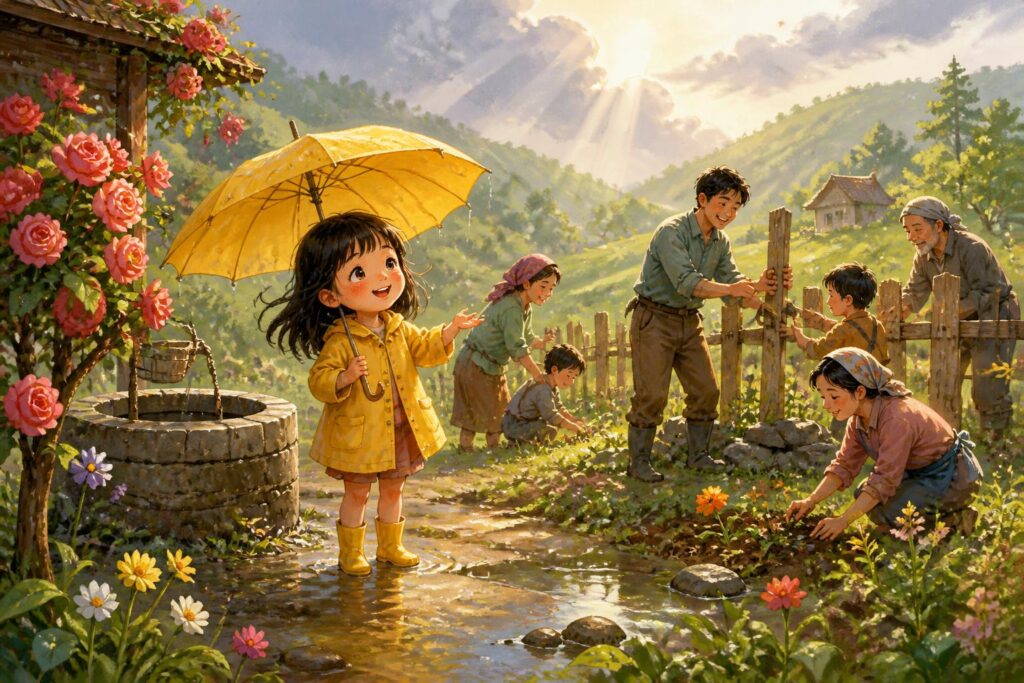
At the end of White Cloud Village, there was a small garden beside the winding road that led up the hill. The garden was not large, just big enough for someone to walk slowly from the gate to the stone well in the middle. And yet, it was always radiant. In spring, yellow chrysanthemums bloomed beside the fence. In summer, the mint bushes spread a cool, refreshing scent. When autumn came, the persimmon tree in front of the well drooped with fruit. In winter, a few small flowers still tried to bloom, like tiny stars that refused to go out.
The person who cared for the garden was a little girl named Na. Na lived with her grandmother in a tiled-roof house at the foot of the hill. Every morning, before going to school, she carried her blue watering can out to the garden. She pulled weeds, gathered dry leaves, propped up branches that the wind had tilted, and chatted with each flower bed. Na believed that plants could listen too; they simply answered in their own way.
“Good morning, chrysanthemums. I have to go to school early today, so we’ll continue our conversation this afternoon,” Na would often whisper.
Whenever her grandmother heard her, she smiled. She never told Na that plants could not talk. She knew that there were things only those who knew how to love could perceive.
The Yellow Umbrella
One afternoon, on her way home from school, Na saw an old umbrella lying beside a banyan tree. The umbrella was pale yellow, with small round dots printed on its fabric like raindrops. One of its ribs was bent, and its handle was scratched, but when Na picked it up, the umbrella suddenly trembled lightly in her hand.
Na looked around. The road was completely deserted, with only a few dry leaves rolling in the wind.
“Someone must have dropped it,” she said. “I’ll take it home. Maybe I can find its owner.”
As soon as she finished speaking, the umbrella gently sprang open. A clear voice rang out, so soft that Na thought it was the sound of a bird in the branches:
“What if you can’t find the owner?”
Na jumped and nearly dropped the umbrella.
“Did you just speak?”
“Yes. But don’t be afraid. I’m only an umbrella that has stood beneath the rain for too long and learned how to listen to every sound of the sky and the earth.”
Na carefully examined the umbrella. She had never met a talking umbrella before, but its voice was kind and a little sad.
“Would you like to come home with me?” Na asked.
“I want to shelter someone,” the umbrella replied. “That is what an umbrella is meant to do.”
Na brought the umbrella home. Her grandmother helped her straighten its rib, sewed a small piece of fabric over the tear, and wiped the handle clean. From that day on, the yellow umbrella became Na’s companion. Every sunny morning, it lay quietly beside the door. Whenever rain fell, it opened above Na’s head and kept the cold raindrops off her.
The Rain That Would Not Stop
That year, White Cloud Village experienced a long dry season. The ground cracked into thin lines. The stream at the foot of the hill was reduced to a few pools of crystal-clear water. The garden also began to wither. The chrysanthemums drooped their petals, the mint no longer gave off its fragrance, and the persimmon tree in front of the well stood silently beneath the sun.
Na carried water up to the garden every day, but the small watering can was not enough to soothe the entire garden. She was so worried that even at night she dreamed of dry leaves blowing all over the yard.
“Don’t be sad,” the yellow umbrella comforted her. “The rain will come.”
“But what if the rain comes too late?” Na asked. “I’m afraid the garden won’t be able to wait.”
The umbrella did not answer. It only gently shook the round dots on its fabric, as if it were thinking.
Exactly three days later, the sky suddenly grew dark. Black clouds rolled in from the mountains, and the wind blew hard, making the branches sway. Then the rain poured down. At first, Na happily ran out onto the porch. But before long, she realized that this was no ordinary rain. Water rushed down the hillside, carrying mud, dry branches, and small stones with it. The flow headed straight toward the garden.
Na hurriedly grabbed the yellow umbrella and ran up the hill. She wanted to close the wooden gate, but the water had already risen to her ankles. The flower beds were flooded. The soil around the persimmon tree’s roots had been eroded into a deep trench. If the water kept flowing, the entire garden might be swept down to the foot of the hill.
“What should I do?” Na cried.
“Call everyone,” said the umbrella. “You can’t protect the garden by yourself.”
Na ran toward the village. She knocked on every door, calling the children and the neighbors. Some people brought hoes, some brought sandbags, and others carried old planks. Everyone went up the hill together and dug a drainage ditch along the fence to divert the flow toward an empty meadow. The children gathered stones and arranged them in rows, while the adults used earth-filled sacks to block the places where the water was surging through most strongly.
The yellow umbrella did more than shelter Na. It tilted one way to cover a baby carrying a rope, then tilted the other way to shield an old woman tying the fence back together. Whenever someone was about to slip, the umbrella sprang up in front of them, drawing their attention to the muddy puddle and helping them regain their footing.
All afternoon, everyone worked in the rain. Na kept encouraging the other children:
“Keep going! Just a little more—the water is already changing direction!”
By the time dusk fell, the water had begun flowing through the newly dug ditch, around the garden, and down into the meadow. The flower beds were still soaking wet, and a few plants had tilted, but the garden had been saved.
What the Umbrella Wanted to Receive
The next morning, the rain stopped. The sun appeared from behind the clouds, casting sparkling streaks of light across the leaves. The villagers returned to the garden to prop up the plants, mound the soil, and gather broken branches. Everyone was astonished to see that the persimmon tree in front of the well was still standing. On a low branch, a red flower bud was beginning to open.
Na picked up the yellow umbrella and realized that one of its ribs had broken completely. Its fabric had also torn in another long split.
“You helped everyone so much,” Na said. “I’ll repair you and make you beautiful again.”
The umbrella was silent for a moment before replying:
“I don’t need to be more beautiful. I only want to know whom I’ll still be able to shelter tomorrow.”
Na hugged the umbrella to her chest. She understood that her little friend did not wish to be kept in a clean box or praised by everyone. The only thing the umbrella wanted was to continue doing something useful.
From then on, Na and her grandmother placed a large hook at the entrance to the garden. Anyone who came to visit could take the yellow umbrella when it rained. One day, it sheltered a mail carrier. Another day, it went along with a lost kitten. On yet another day, it rested on the shoulder of a boy carrying medicine to his mother. Whenever it returned, the umbrella was placed neatly beside the door to await the next person who needed it.
After the rain, the garden grew greener than before. The villagers also joined in caring for it. They dug more small drainage ditches, planted trees to hold the soil in place, and set a water barrel beside the fence for anyone who was thirsty. Na was no longer the only person responsible for the garden. She realized that a place becomes sustainable not because one person does everything, but because many people are willing to contribute their own small share.
A few months later, the persimmon tree in front of the well produced the largest flower it had ever bloomed. Its petals were bright red, its stamens gleamed golden, and its gentle fragrance spread through the wind. Na gave the flower to the yellow umbrella by tying a small ribbon around its handle.
“This is the garden’s thank-you gift,” she said.
The umbrella trembled in the sunlight. No one else could hear it, but Na heard her friend whisper:
“Thank you for giving me a place to return to.”
Na smiled. She knew that the garden was not merely a place where flowers grew. It was also a place where kindness was passed on, where an old umbrella could become a dependable friend, and where one small act could call other hands to join together.
From then on, whenever it rained, the people of White Cloud Village remembered that no one was ever too small to help someone else. An umbrella can shelter one person, but if it opens at the right moment, it can also remind an entire community to stand a little closer together.

ARTICLES IN THE SAME CATEGORY
The Leaf That Knew the Way Home
The Seed That Knows How to Wait
The Boy Who Gathered Laughter for a Wind Chime
The Little Girl Who Sewed a Coat for the Sun
The Little Boy Who Saved Raindrops for the Garden
The Wind Chime That Called Summer Back
ARTICLES IN THE SAME GENRE
The Boy Who Gathered Laughter for a Wind Chime
The Wind Chime That Awakened the Garden
The Button That Went Looking for Someone Who Keeps Their Word
Tam Cam Part 2: The Vengeful Spirits of the Palace
Tam and Cam: The Palace Intrigue and the Original Ending – Part 1
Tam Cam