

 Tiếng Việt
 日本語
 한국어
 中文 (中国)
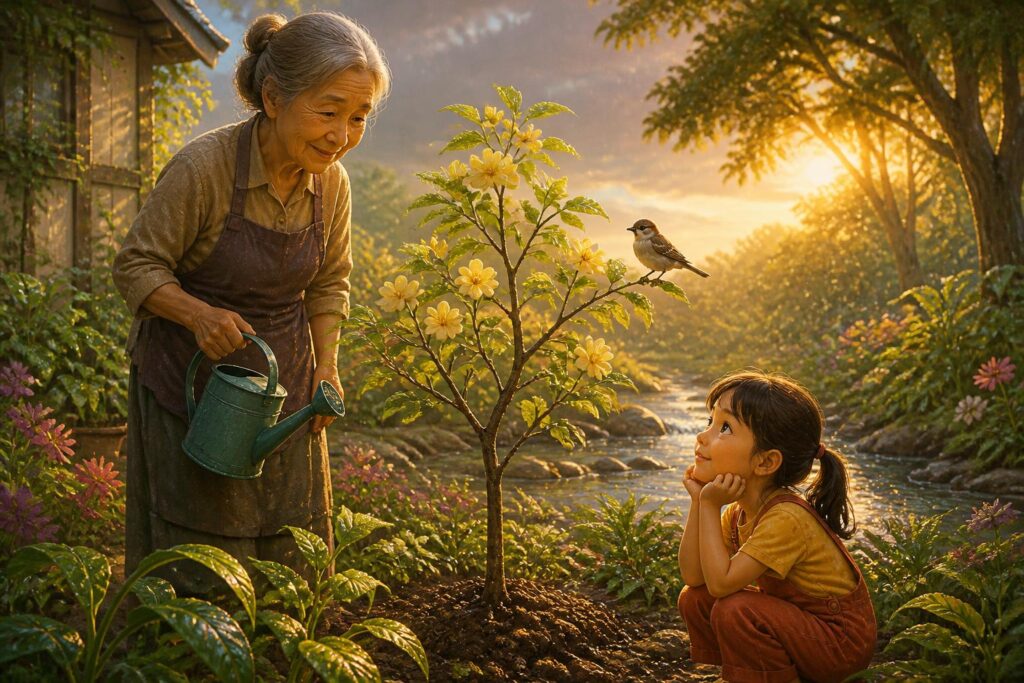
At the edge of White Cloud Village, there was a small garden beside a crystal-clear stream. The garden was not large, but it was green all year round. In spring, purple flowers bloomed beneath the wooden fence. In summer, the plum tree stretched out its branches to shade an entire patch of ground. In autumn, golden leaves covered the pathway, while in winter, the clumps of grass lay still, waiting for warm sunshine to return.
The garden was tended by Grandma Cuc, an old woman whose hands always smelled of earth. Every morning, she watered the plants with a blue metal watering can, pulled weeds around the vegetable beds, and talked to each plant as if speaking to a close friend. She never worked in a hurry. She often said: “Plants have their own rhythm of growth. As long as they are cared for properly, they will know when to wake up and when to bloom.”
One early spring morning, Grandma Cuc sowed a pale brown seed in a bed of soft soil. The seed lay beside some beans, sunflower seeds, and a few small onions. It heard the soil trickle and rustle over its body, heard water seep through every gap in the earth, and began to dream of the day when it could reach upward and see the sky.
“I will grow very tall,” the seed told itself. “Perhaps I will become a great old tree. Birds will build nests in my branches, children will sit beneath my shade, and Grandma Cuc will surely smile with pride.”
The next day, the seed tried to push its shell upward. But the soil was still heavy and dark. It managed to move only a little before becoming too tired and lying still. On the third day, it tried again. This time, a tiny white root poked out of its shell. The seed was so happy that it felt as though the whole earth were trembling.
“I’m about to grow!” it cried.
But that afternoon, when it heard the beans beside it talking about how they had sprouted the day before, the seed suddenly grew impatient.
“Why can’t I see the sky yet?” it asked.
A plump bean replied: “Because you’ve only just begun. The roots need to take hold of the soil first, and then the stem can reach upward.”
“But I want to grow today.”
The bean smiled gently. “Everything takes time.”
The seed did not like that answer. It thought the others were only trying to comfort it. That night, when the garden was bathed in moonlight, it tried very hard to push itself upward. It struggled, twisted, and scratched at the soil with its young root. The earth around it shifted, but the seed only felt more tired.
The next morning, Grandma Cuc discovered that part of the soil bed had been disturbed. She did not scold it. She simply used her finger to mound the soil back around the seed and then sprinkled it with a little water.
“Don’t be impatient,” she said. “Your roots are still weak. If you try too hard, you may hurt yourself.”
The seed heard her but remained sad. It thought Grandma Cuc did not understand what it wanted. It wanted to see the world, welcome the sunshine, and find out whether the wind really felt as cool as the leaves said it did.
Several days passed. The beans had grown into seedlings with two round leaves. The sunflower had also emerged from the soil, its stem slender but perfectly straight. Only the seed remained underground. Whenever it heard the wind shaking the fence, it imagined the other plants playing happily above the ground while it had been forgotten.
One night, heavy rain suddenly arrived. Water from the stream rose, flowed across the pathway, and spilled into the garden. The seedlings trembled in the wind. One bean tilted to the side, while the sunflower was almost buried up to its base. In the darkness, the seed felt water soaking through the soil around it. It was frightened, but it also realized that its tiny roots had taken hold more firmly than before.
The seed tried to hold on to the earth. It could not see what was happening above, but each of its roots reached into the soft patches of soil, clinging to the earth like tiny fingers. It no longer tried to push itself upward. Instead, it focused on holding tightly to where it stood.
Near dawn, the rain eased. The water receded from the garden. Some seedlings had battered leaves, and a few blades of grass lay flattened against the ground. Grandma Cuc came outside as the sky began to brighten. She set the sunflower upright, mounded soil around the beans, and used a small bamboo branch to support the plum tree’s stem.
When she reached the soil bed, she saw a tiny green shoot poking up.
“Ah, you’re ready now,” she said.
The seed was surprised. It had not realized that it had reached upward. After the rain, the soil above it was softer, and warm light slipped through every tiny gap. The seed pushed its stem up a little, then a little more. At last, it broke through the ground and saw the sky for the first time.
The sky was wider than anything it had ever imagined. White clouds drifted slowly across the blue expanse. A sparrow perched on the fence and tilted its head to look at it. Drops of water still resting on the leaves sparkled like tiny glass beads.
“Hello,” said the bean beside it. “You finally came up.”
The seed, now a young shoot, looked up at the friends around it. It was no longer sad that it had sprouted later. It understood that during the days it had lain underground, it had not been standing still at all. It had grown roots, learned how to hold itself against rushing water, and gathered strength for its first day of welcoming the sun.
The Days of Growing Slowly
From that day on, the shoot began to grow little by little. In the morning, Grandma Cuc gave it just enough water. When the sunlight grew too harsh, she placed a thin screen beside it to block some of the light. When tiny insects crawled onto its leaves, she gently brushed them down onto the grass. She did not pull the stem upward to make it grow faster, nor did she force the leaves to open before they were ready.
The shoot gradually understood that caring for something did not mean doing everything in its place. Grandma Cuc only gave it good soil, clean water, and a safe place. The rest, it had to learn for itself. It found the direction with the most light, thickened its stem after each windy day, extended its roots when the soil dried, and folded its leaves when night fell.
The bean beside it grew faster. In a short while, it had produced white flowers. The sunflower also grew taller than Grandma Cuc’s watering can. The seed, now a young tree, sometimes looked at its friends and wondered when it would be able to grow as tall as they were.
But whenever impatience arose, it remembered the rainy night. It remembered the feeling of its tiny roots gripping the soil, and that it had grown stronger during a time when no one could see. Because of this, it was no longer sad about growing slowly. It simply continued to receive sunlight, drink water, and patiently do its part.
By the end of summer, the young tree had a sturdy trunk and lush green foliage. It did not become the great old tree it had once dreamed of right away. Even so, beneath its small shade, a rabbit could rest at noon. A sparrow often stopped by one of its low branches. The children from the village who came to visit the garden also liked sitting beside the tree’s trunk and listening to Grandma Cuc tell stories.
One afternoon, a little girl named An asked Grandma Cuc:
“Grandma, what kind of tree is this?”
Grandma Cuc smiled. “I don’t know yet. The tree needs more time before it can show us its first flowers.”
The young tree gently rustled its leaves when it heard this. For the first time, it did not feel anxious about the unknown. It understood that not every question needed to be answered immediately. Some things could only be understood after many mornings, many rains, and many seasons had passed.
The Lesson Beneath the Green Canopy
At the beginning of autumn, the young tree bloomed with small, pale yellow flowers. They were not as dazzling as the sunflowers or as strongly fragrant as the rosebush in the corner of the garden, but its flowers seemed gentle and resilient. Grandma Cuc bent down and admired them for a long time. An clapped, while the sparrow perched on a branch and chirped merrily.
The young tree looked at the petals trembling in the wind and suddenly remembered the days when it had still been underground. If it had given up then because it could not see the sky, this afternoon would not exist. If it had kept trying to push upward too soon, its young roots might have been damaged. If it had looked only at how quickly the plants beside it were growing, it would never have realized that it, too, was growing in its own way.
It wanted to tell this to the new seeds Grandma Cuc had sown in the soil bed beside it. But the seedling could not speak in words. So every morning, when the wind blew through, it gently shook its leaves. Its shadow moved across the ground like a message:
“Don’t be afraid if you still cannot see the results today. Perhaps, deep inside, you are growing the roots you need most.”
From then on, the garden at the edge of White Cloud Village had another friend who knew how to be patient. The young tree continued to grow slowly, with each season bringing its own beauty. It no longer tried to become a different kind of tree. It simply worked diligently to become the healthiest version of itself.
And Grandma Cuc, whenever she sowed a new seed, would often say:
“Everything beautiful begins with a very small step. Take care of that small step, and time will help you go far.”
The story of the little seed reminds us that growing up is not only about becoming taller, moving faster, or achieving what we want sooner than others. Growing also means learning to persevere through the days when no one can see our efforts, listening to our bodies and emotions, and accepting our own rhythm. For young children, this lesson can begin with something very simple: patiently waiting for a seed to sprout, completing a picture little by little, or trying an exercise again after not succeeding the first time.
Because sometimes, the most important part of the journey is not the moment when we bloom, but the quiet days when we are growing roots.

ARTICLES IN THE SAME CATEGORY
The Little Seed and the Garden That Knew How to Share
The Wind Chime That Knew How to Listen
The Wind Chime That Calls the Dawn
A Letter to Tomorrow
Little Cloud and the Forest That Knew How to Say Thank You
The Seed That Knew How to Listen
ARTICLES IN THE SAME GENRE
Bông the Bunny and the Raindrop That Kept Its Promise
The Wind Chime and Brown Squirrel’s Promise
The Boy Who Gathered Laughter for a Wind Chime
The Wind Chime That Awakened the Garden
The Button That Went Looking for Someone Who Keeps Their Word
Tam Cam Part 2: The Vengeful Spirits of the Palace