
Story Collections · 21 November, 2026
The Wooden Box Beneath the Veranda Step

The day An returned, the village road had just dried after the rain. Small puddles lay still between the two rows of grass, reflecting a patch of pale gray sky. Her family’s old house was still at the end of the slope, tucked behind areca palms that had grown much taller than before. Moss covered the tiled roof, the limewashed walls had faded, and the wooden door was slightly warped at one corner. From the outside, the house seemed smaller than it was in An’s memory, but the damp smell of the brick courtyard and the soft creak of the hinges when she pushed the door open had not changed.
An had left her hometown nearly ten years earlier. At first, she went to the city to study, then stayed to work. Her calls home gradually became less frequent as life grew busier. Her mother often asked whether she was eating properly, whether work was too exhausting, and whether she could come home on the weekend. An always replied with brief answers, promising to make time, then let the months pass without realizing it.
At the beginning of the rainy season that year, her mother called to say that the house needed repairs. The back roof was leaking, several wooden posts had rotted, and the garden was overgrown with weeds. Her mother did not blame An for staying away so long. She only said calmly that, if possible, An should come home at the end of the month to help sort through things. After listening, An looked at the packed work schedule on her desk and suddenly felt tired of the very excuses she had continued to use to postpone returning.
The House Kept the Things She Thought She Had Forgotten
On her first morning in the countryside, An began cleaning the front room. The old bamboo chairs were brought out and dusted, the wooden cabinet that had been closed for a long time gave off a faint smell of mothballs, and the round clock still hung on the wall, though it had stopped at some unknown time. Her mother said there was no need to keep so many things; anything broken should be thrown away to make the house more spacious. An nodded, but each time she picked something up, she hesitated.
There was a chipped blue enamel cup that her father had once used to drink tea. There was a brown wool scarf her mother had started knitting many years earlier. There was a tin box filled with buttons of various colors, with several yellowed photographs underneath. These objects had little material value, but they made the house seem like an old person quietly recounting its story. The moment An touched one, she remembered an afternoon, a call, a meal, or an argument she had once thought she had forgotten.
Nearly noon, as she dragged a dried-out plant pot away from the veranda step, An noticed that one of the bricks seemed loose. She bent down and used her fingertips to brush away the damp soil around it. Beneath the brick was a small wooden box, covered in dust, with a few fine cracks across its lid. The box was not locked. There was no name or date on the wood, only a winding grain that looked like the shape of a tree branch.
An brought the box inside. Her mother was sorting vegetables in the kitchen and, upon seeing it, paused for a moment. She looked at the box, then at her daughter.
“You found it, then?”
An was surprised. She asked her mother whose box it was and why it had been buried beneath the veranda step. Her mother did not answer immediately. She washed her hands, sat down on the chair near the window, and told An to open it. Inside the box were a red plastic hair clip, a blue marble, a bus ticket with faded lettering, a small aluminum spoon, and a piece of paper folded into quarters.
Things That Had No Value but Could Not Be Replaced
An recognized the hair clip first. It was the clip she had worn on the first day of first grade. She had cried because she did not want to let go of her mother’s hand, and her father had to carry her through the school gate. The clip had broken that afternoon when An ran after a butterfly in the yard. She had thrown it into the trash and never thought she would see it again.
The blue marble was something An had found beside the irrigation ditch. At the time, she liked it so much that she placed it beneath her pillow so she could look at it before falling asleep. Once, her father accidentally dropped the marble into a gap between the floorboards. He took up an entire plank to find it, even though her mother complained that he was damaging the floor over a single marble. An remembered hugging her father and laughing so hard that she forgot she had just been crying.
The bus ticket made An fall silent for longer. It was from the first bus that had taken her to the city to enroll in school. Her mother had tucked a packet of hot sticky rice into her bag, while her father stood outside the station repeatedly reminding her to take care of her documents. When the bus began to move, An saw her mother run after it for a short distance. Her father did not run; he simply stood beside her, one hand resting on her shoulder. At the time, An thought her parents were being too calm, but now she understood that perhaps they had merely tried not to let their daughter see that they were sad.
The small aluminum spoon was something An did not remember. Her mother said it was the spoon she had used to feed An porridge when the girl had a fever. The quarter-folded piece of paper was a letter from her father. His handwriting was naturally rough and slanted, but the brief lines were neat:
“An has gone away to school, and the house is quieter. Just focus on your work and don’t worry. Come home whenever you’re tired. The house will still be here.”
An read it again and again. There were no reproaches, nor any question about why she had not come home in so long. Just a few simple words, exactly like the way her father had always spoken when he was alive. He had never been good at expressing affection. Every morning, he repaired An’s bicycle before she went to school. Every cold season, he quietly put more charcoal into the stove. When she was little, An had taken these things for granted; only after growing up did she realize that this was her father’s way of saying he loved her.
“When did Father put this box away?” An asked.
Her mother looked out at the garden behind the house. “Not long before he died. Your father said that if the house was ever repaired, we should leave it beneath the veranda step. He said even small things needed a place where they could be remembered.”
What Was Preserved Was Not in the Box
That afternoon, An and her mother cleaned the garden together. The grass had grown ankle-high, covering the base of the old guava tree. Her mother intended to cut it down because the trunk had begun to lean, but An asked her to keep it. She found a sturdy piece of wood, propped it against the trunk, and tied it in place with a strip of cloth. Her mother watched her work without saying anything. After a while, she went inside and brought out two towels, handing one to An.
That evening, the two of them sat on the veranda shelling beans. Rain drizzled again over the tiled roof. An told her mother about her rented room, the colleague who often brought her coffee every morning, and the times she ate dinner alone in front of her computer screen. Her mother listened attentively, sometimes laughing and sometimes asking another question. For the first time in many years, An realized that she did not need to talk about anything truly important in order to sit beside her mother for a long time. An ordinary day was enough for the two of them to find each other again.
The next morning, An wiped the wooden box clean and placed it on a shelf in the living room. She did not put it back beneath the veranda step. Her mother said it was fine to leave it there, because the memories had reached the time when they should be seen in the light instead of lying still in the darkness. An agreed, but she kept every item inside, including the broken hair clip and the scratched blue marble.
Over the following days, An called a familiar craftsman in the village to repair the roof. She rearranged her work in the city and asked to work remotely for several days each month so she could return home more often. Her mother listened to her daughter and only reminded her not to promise things that would be too difficult to carry out. An smiled and said that this time she was not making a promise; she would begin by coming home the following weekend.
On the day she left, An stood beneath the veranda step for a long time. She looked at the brick that had been put back neatly, at the guava tree propped up beside the fence, and listened to the sound of her mother’s broom sweeping the courtyard. The house was still old, and the garden was still in disarray, but something inside An had changed. She understood that returning did not always mean going back to a place. Sometimes, returning meant looking again at the people who had quietly remained by one’s side and realizing that their love had been present in acts so small that one had never bothered to name them.
The wooden box held only a few odds and ends. It could not contain her father’s voice calling from the yard, her mother’s hand resting on her forehead when she had a fever, or the meals when the whole family sat waiting for one another. But it reminded An that memories did not disappear simply because people went far away. The important things often remain in a hair clip, an old ticket, a small marble, or a house that always keeps its door open, waiting for a loved one to return.
And sometimes, all we need to do is bend down close to the veranda step of our own lives, and we will find a piece of love that we once carelessly left behind.
Related articles
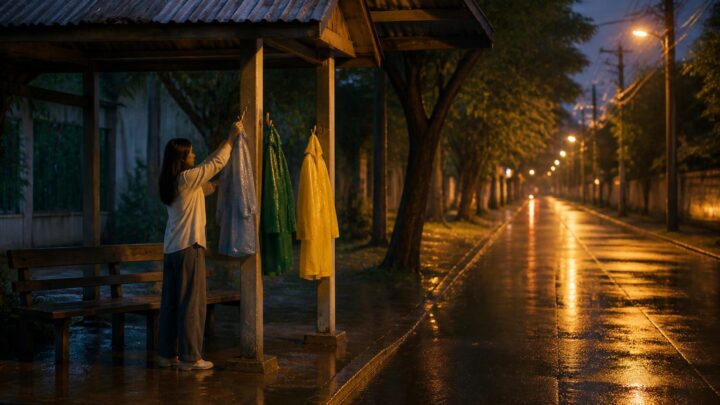
The Raincoat Left Hanging at the Bus Stop at the End of the Street
At the end of the street stood a small bus stop with a low corrugated-metal roof and a wooden bench faded by rain and sun. The bus stop had no electronic sign, no ticket seller, and no drink stall. People only stopped there to wait for a bus, then quickly went on their way. And
Read more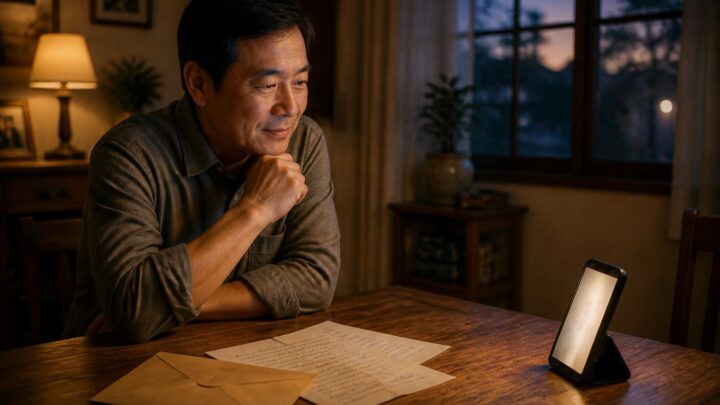
The Unsent Letter and the Day the Father Learned to Listen
In the bottom drawer of the wooden desk, Mr. Minh found a letter that had faded with age. It lay among a few old bills, a lighter that no longer worked, and a notebook with blank pages. There was no recipient’s address on the envelope, only one line written in blue ink: “I want to
Read more
The Last Bus Through Cloud Pass
In the town nestled between two mountain ranges, people called the bus that departed at nine in the evening the last bus. After that hour, the road through Cloud Pass was almost swallowed by darkness. The houses along the road closed their doors, the eateries gradually turned off their lights, and the sound of engines
Read more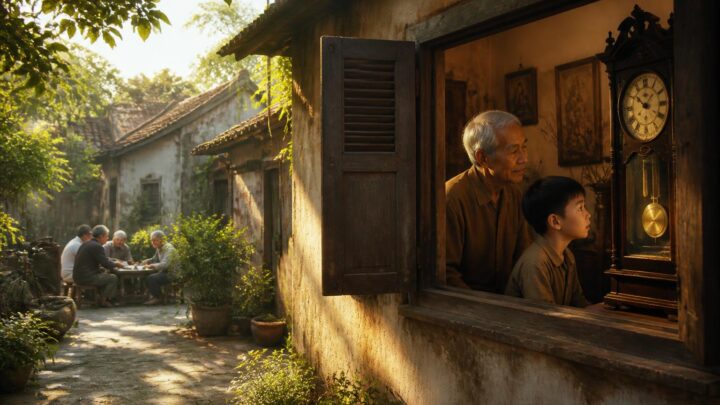
The Keeper of the Last Bell at the End of the Alley
The Bell in the Early Morning At the end of a small alley stood a low, tiled-roof house, with a faded pendulum clock on the front porch. Every morning at exactly six o’clock, the bell inside the house would ring. It was neither clear nor lingering like the church bell across the street. Its sound
Read more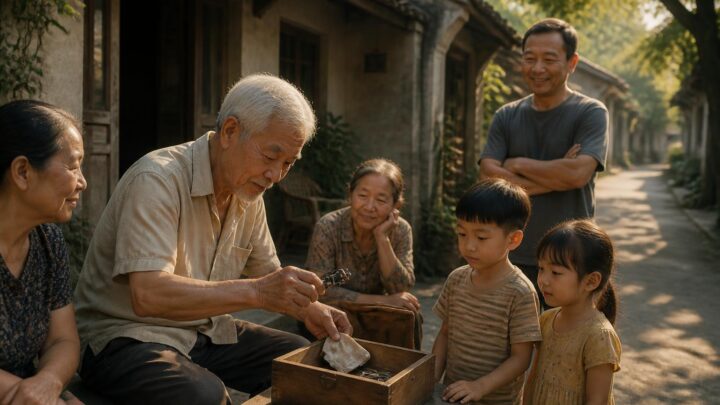
The One Who Collected Forgotten Things
The Wooden Box Beside the Veranda At the end of a small street stood an old tile-roofed house, with a dark-brown wooden box always placed outside its veranda. The box was not large, just big enough to hold a few odds and ends such as keys, buttons, handkerchiefs, hair clips, or crumpled bus tickets. Beside
Read more
The Clock Shop at the Bottom of the Hill and the Day Time Stopped
At the bottom of the hill leading down to the riverbank stood a small clock shop. The wooden sign in front of the door had faded, but the words carved into it could still be read: Repairing the Things That Missed Their Beat. The townspeople called it Mr. Bay’s shop, though no one knew what
Read more