
Story Collections · 22 November, 2026
The Raincoat Left Hanging at the Bus Stop at the End of the Street
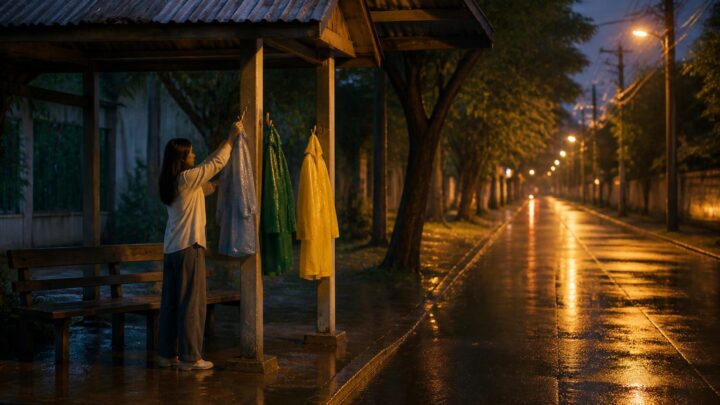
At the end of the street stood a small bus stop with a low corrugated-metal roof and a wooden bench faded by rain and sun. The bus stop had no electronic sign, no ticket seller, and no drink stall. People only stopped there to wait for a bus, then quickly went on their way. And yet, on rainy days, the place often held in people’s hearts a story that no one had intentionally written.
The dark-blue raincoat appeared one afternoon at the beginning of the rainy season. It was hung neatly on a nail beside one of the stop’s posts, next to a signpost whose paint had peeled away. The coat was not new; a few seams showed along the sleeves, but it was still clean and in good condition. There was no note with the name of the person who had left it behind, and no one knew whom it belonged to.
At first, the people waiting for the bus saw it merely as an ownerless item. Some guessed that its owner would return to claim it. Others thought someone had deliberately left it there for someone else to use. Then the bus arrived, everyone boarded, and the raincoat remained where it was, swaying quietly in the wind.
The First Person to Wear the Raincoat
The next day, rain arrived unexpectedly just as people were leaving work and school. The first drops were small and sparse, but only a few minutes later they had turned the road white. The people at the bus stop pressed close beneath the narrow awning. A schoolgirl in uniform hugged her schoolbag to her chest, her sandals soaked through. She looked toward the road, where the bus usually appeared, then at the dark-blue raincoat.
The woman standing beside the girl noticed that look. She was in her fifties, carrying a bag of vegetables and an umbrella with broken ribs. She took down the raincoat, gently brushed a few drops of water from its shoulders, and handed it to the girl.
“Put it on. Is your home far away?”
The girl shook her head, but did not immediately reach out to take it. She looked around as if afraid someone would scold her for taking another person’s belongings. The woman smiled and said that the coat’s owner probably wanted it to help someone on a rainy day.
The girl put it on and pulled the zipper all the way up to her neck. When the bus arrived, she bowed her head in thanks and ran aboard. The woman hung the raincoat back in its old place, carefully smoothing the hood so the wind would not flip it inside out. No one said anything more, but from that day on, people began paying closer attention to the raincoat.
A Small Item and the People Passing By
The raincoat became a familiar object at the bus stop at the end of the street. Anyone caught in the rain without one could use it. Afterward, users usually returned it the next morning or hung it back up as soon as they reached a dry place. One day, a college student wore it while running across the street to deliver medicine to his grandmother. On another day, a delivery worker used it to cover a cardboard box while waiting for the customer to come down and collect the package. Another time, an old man wore the raincoat as he walked all the way to the neighboring alley to return a key he had found to the person who had lost it.
The people who regularly passed the bus stop gradually developed a habit that no one had asked them to form. If they saw that the coat was dirty, they washed it and hung it out to dry. If they noticed a loose button, they found a way to sew it back on. A flower seller nearby even placed an extra plastic hanger beside it so the coat would not be dragged across the ground. No one claimed to be the raincoat’s caretaker. Each person simply did one small thing, just enough for the next person to continue using it.
Among those who often waited for the bus was Minh, a technical employee who lived in an apartment complex on the other side of the bridge. He left for work early in the morning and often returned after dark. Minh rarely spoke with other people. He had a habit of standing in the corner of the bus stop, wearing earphones and watching the traffic go by.
Minh used the raincoat twice. The first time, he wore it while helping an elderly woman cross the street because she could not make her way through the heavy traffic on her own. The second time, he saw an older man standing and shivering in the rain. Minh gave the coat to him, then ran onto the bus himself in a shirt soaked through.
After that, Minh bought a new raincoat and placed it at the bus stop. He did not take the old one away; he simply hung the new one beside it. There was no distinguishing mark on either coat except for their colors: one was dark blue, and the other pale yellow. From then on, the bus stop had two raincoats available for those who needed them.
The Person Who Returned Years Later
Nearly a year later, on an afternoon when heavy rain poured down, a young woman stepped off the last bus on the route. She stood beneath the shelter and looked for a long time at the two raincoats hanging from the post. Her eyes settled on the dark-blue one. She reached out and touched the sleeve, where a seam had been repaired, and suddenly laughed.
The woman’s name was Lan. She had once attended the nearby high school, but after graduating, she had moved to another city. On that first rainy-season afternoon the year before, Lan had been the schoolgirl in uniform who received the raincoat from the woman carrying the bag of vegetables. That day, Lan’s mother had been in the hospital, and Lan had to travel a long way on her own to bring her mother food. Without the raincoat, she might have had to wait until the rain stopped or return home to get something to wear.
Lan remembered the coat, but did not know whom to return it to. She had gone back to the bus stop several times in the days that followed, but never met the woman who had given it to her. Then her family moved, and Lan left the city as well. Many months passed, yet she still remembered what the woman had said: “The coat’s owner probably wanted it to help someone on a rainy day.”
Lan had returned to the old street to visit a teacher who had once taught her. When she saw the raincoat, she recognized the stitching on the sleeve. She could not be sure it was the same coat she had worn, but the feeling of familiarity kept her standing there for a long time.
The flower seller nearby noticed Lan looking at the raincoats. She told Lan how the coat had helped so many people. Lan listened, then opened the bag she had brought and took out a new raincoat, still sealed in its packaging.
“I want to leave this here,” Lan said. “Not to return the old coat. I think I’m simply continuing what the person before me did.”
The flower seller asked nothing more. She accepted the coat and hung it beside the two already there. The bus stop suddenly felt a little more crowded, but everyone waiting that day smiled.
What Remains After a Rainstorm
A few days later, a small plastic basket appeared beside the raincoats. Inside were several dry towels, a pair of sandals, a bottle of water, and a sewing kit. No one knew who had put them there. Whenever the supplies began to run low, someone quietly replenished them. Someone brought an umbrella, someone left a pair of gloves, and someone else simply wiped down the bench before walking away.
The bus stop at the end of the street never became a special place in the way people usually use that word. It was not renovated, there was no plaque acknowledging anyone’s contributions, and no one stepped forward to organize anything. There was only a corrugated-metal roof, a few benches, and items left there for whoever needed them. But in a city where people often passed one another without even having time to see each other’s faces, its existence made many people slow down.
Eventually, the dark-blue raincoat became so worn that it could no longer be used. One morning, it was neatly folded and placed beside a trash bin. No one threw it away coldly. A schoolgirl walking past removed the hanger, wiped it clean, and hung it back on the post. A new raincoat was brought to replace the old one later that same day.
No one knew who had first hung the raincoat at the bus stop. Perhaps it was someone who had once been caught in the rain and understood what it felt like to huddle beneath an awning. Or perhaps it was simply someone who happened to have an extra coat and did not want it to sit unused in a closet. Whatever the reason it began, that small item had opened the way to a gentle act of consideration among strangers.
Sometimes kindness does not need an introduction. It may be nothing more than a freshly washed coat, a button sewn back on, or a hand offering an item to someone who is hesitant. Such acts are often not large enough to become stories told in the newspaper, but they are warm enough to help someone get through a rainy afternoon.
And if one day you pass the bus stop at the end of the street and see a raincoat hanging from the post, remember that it does more than keep out the rain. It also carries the simple belief that the person who comes next will know how to care for the kindness left behind by the person who came before.
Related articles

The Wooden Box Beneath the Veranda Step
The day An returned, the village road had just dried after the rain. Small puddles lay still between the two rows of grass, reflecting a patch of pale gray sky. Her family’s old house was still at the end of the slope, tucked behind areca palms that had grown much taller than before. Moss covered
Read more
The Unsent Letter and the Day the Father Learned to Listen
In the bottom drawer of the wooden desk, Mr. Minh found a letter that had faded with age. It lay among a few old bills, a lighter that no longer worked, and a notebook with blank pages. There was no recipient’s address on the envelope, only one line written in blue ink: “I want to
Read more
The Last Bus Through Cloud Pass
In the town nestled between two mountain ranges, people called the bus that departed at nine in the evening the last bus. After that hour, the road through Cloud Pass was almost swallowed by darkness. The houses along the road closed their doors, the eateries gradually turned off their lights, and the sound of engines
Read more
The Keeper of the Last Bell at the End of the Alley
The Bell in the Early Morning At the end of a small alley stood a low, tiled-roof house, with a faded pendulum clock on the front porch. Every morning at exactly six o’clock, the bell inside the house would ring. It was neither clear nor lingering like the church bell across the street. Its sound
Read more
The One Who Collected Forgotten Things
The Wooden Box Beside the Veranda At the end of a small street stood an old tile-roofed house, with a dark-brown wooden box always placed outside its veranda. The box was not large, just big enough to hold a few odds and ends such as keys, buttons, handkerchiefs, hair clips, or crumpled bus tickets. Beside
Read more
The Clock Shop at the Bottom of the Hill and the Day Time Stopped
At the bottom of the hill leading down to the riverbank stood a small clock shop. The wooden sign in front of the door had faded, but the words carved into it could still be read: Repairing the Things That Missed Their Beat. The townspeople called it Mr. Bay’s shop, though no one knew what
Read more