
Children's Stories · 25 November, 2026
The Little Girl and the Garden That Awakened the Raindrops
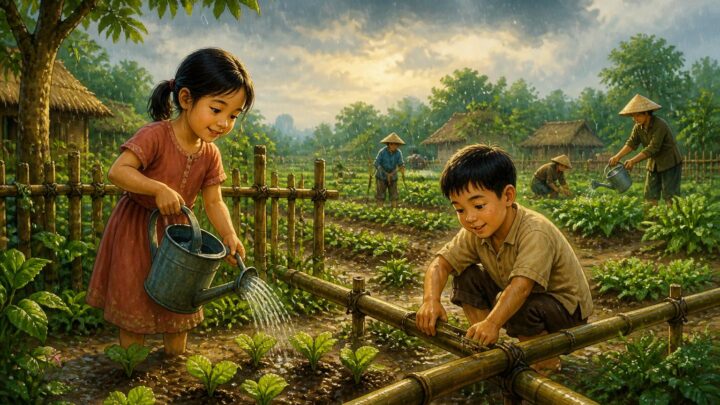
At the edge of White Cloud Village stood a garden that had been neglected for a very long time. All around it was a bamboo fence faded with age, and the wooden gate often creaked whenever the wind blew through. Inside, weeds grew higher than the knee, cracked garden beds lay still beneath the sun, and the stone well in the middle of the garden was so dry that one could see all the way to the bottom.
The adults in the village said that the garden had once been extraordinarily lush. In the old days, whenever the first rain of the season passed through, the plants in the garden would reach upward, flowers would bloom thickly along the paths, and heavily laden gourds would crawl along the fence. But after a prolonged dry season, the gardener left. No one knew where he had gone, and no one wanted to enter that place full of thorns and dust anymore.
Only little An often stood outside the gate and looked in. An was eight years old, with bright eyes and a habit of picking up seeds that had fallen by the roadside and planting them in a small wooden box on the porch. Some seeds grew into plants, while others never sprouted, but An did not give up because of that. She believed that every seed had its own story; it was just that sometimes a story needed more time to begin.
The Key Beneath the Tree
One afternoon, after many weeks without rain, An followed the dirt road to look for green leaves to take home for the rabbits. As she passed the old garden, she heard a very faint clinking sound, like a small object touching stone. An bent down to pick up the dry branches by the fence and saw a brass key lying beneath the fig tree.
The key had no teeth like an ordinary door key. At its top was the shape of a water droplet, and inside the droplet was a small leaf engraved. An tried putting it into the lock of the gate. Strangely, although the lock was old, it sprang open as soon as it touched the key. The bamboo gate slowly opened, revealing a path covered with dry leaves.
An stepped inside with a heart full of both nervousness and curiosity. In the middle of the garden, beside the stone well, stood a crooked wooden sign. The words on it had faded, but An could still read them: “To call the rain back, first awaken the garden.”
She looked around. The garden did not look as if it were sleeping at all. It resembled someone who was so exhausted that they no longer had the strength to move. The dry clumps of grass drooped, the earth was hard as stone, and the bare branches reached toward a blue sky without a single cloud.
“How am I supposed to awaken it?” An wondered aloud.
Just then, a tinkling sound echoed up from the bottom of the well. An peered down and saw a small coconut-shell scoop lying below. Beside the scoop was a stream of crystal-clear water, as thin as a thread but still flowing.
The First Small Task
An ran home and told her mother. After listening, her mother did not laugh or say that it was imaginary. She simply handed An a small earthen jar and said, “If you want to care for the garden, start with something you can do. Don’t wait for something grand before getting to work.”
The next morning, An returned to the garden. Using the coconut-shell scoop, she drew up a little water at a time from the well and watered the thirsty tree roots. Each root received only a few drops, which was nothing compared with the vast stretch of land. Even so, An worked very carefully. She pulled out the thorny plants growing among the garden beds, gathered the dry leaves into small piles, and spread them over the ground to retain what little moisture remained.
On the first day, the garden did not change. The same was true on the second day. By the third day, An’s hands were blistered from holding the hoe, her knees were covered in dirt, and the small jar had a chipped rim. When her friends passed by and saw her, they invited her to go play, but An shook her head.
“I have to water the plants,” she said. “If I don’t do it today, those roots will have to wait one more day.”
That afternoon, a boy named Tung stood outside the fence watching An. Tung loved making things. When he saw An drawing water with the tiny scoop, he had an idea. Tung went home and brought back some old bamboo tubes, joining them into a channel from the well to the garden beds. Although the pipes still leaked in many places, the water could now flow farther than before.
The following day, Na’s sisters came to help as well. The two girls brought along some bean seeds left over from the previous season. A carpenter in the village brought several planks to repair the gate. The shopkeeper gave An a small bag of rice husks and told her to mix them into the soil to make it less dry and hard. No one said that the garden would certainly come back to life. They simply worked quietly on their own part.
The First Raindrops
After a week, the garden had undergone a few very small changes. Beneath the layer of dry leaves, several pale green shoots poked up. A new bud the size of a fingertip appeared on the fig tree’s branch. Birds that had previously only flown past now began perching on the fence because there was a small water trough in the garden that Tung had made.
One night, An came to check the garden beds by herself. The moon had not yet risen, and the sky was deep and dark, with no wind. Just as she set the jar on the ground, a drop of water fell onto the back of her hand. An looked up. Another drop fell on her cheek. Then a few more drops fell onto the young leaves.
An happily ran all around the garden. But the rain lasted only a short while. The ground had barely become wet with a thin layer of water when the sky cleared again. Some people in the village were disappointed, thinking that the garden’s magic was merely a coincidence. Some told An not to waste her efforts, because a few drops of rain could not save the crops.
An was sad too. She sat beside the well, watching the last drops of water slide down the stone wall. Suddenly, she remembered her mother’s words: don’t wait for something grand before getting to work. Perhaps the garden did not need a perfect miracle. Perhaps what it needed was people who would not leave after their first attempt.
The next morning, An shared this thought with everyone. The villagers decided to continue caring for the garden together. They dug small channels to collect water, spread straw over the soil, planted more bushes around the well, and took turns checking the bamboo pipes. The children collected seeds, the adults repaired the fence, and the elderly taught the children how to recognize which plants needed a lot of water and which could withstand the sun.
The garden gradually became a place where everyone gathered each day. People no longer came only to wait for rain. They came to sow seeds, pull weeds, share water, and tell one another about the things they had done. Whenever a shoot appeared, the whole village rejoiced as if they had just received a gift.
When the Garden Truly Awoke
Just as the first flowers bloomed, dark clouds appeared on the horizon. The wind carried the scent of damp earth across the fields. This time, the rain did not fall sporadically but poured steadily throughout the afternoon.
Water spilled over the tiled roofs, drummed on the jars, and flowed along the small channels into the garden. The dry soil drank in mouthful after mouthful of water. The leaves trembled beneath the rain as if they were clapping. The stone well gradually filled as well, reflecting the silvery-gray sky and the radiant faces of the people gathered around it.
An ran to the wooden sign. Beneath the curtain of rain, the words that had seemed faded suddenly became clearer. She read the old saying again: “To call the rain back, first awaken the garden.”
Only then did An understand. The garden had not awakened because of a magic spell or a brass key. It had awakened thanks to small tasks done consistently, thanks to the hands of many people, and thanks to faith that did not disappear simply because results came slowly. When the plants began to come back to life, the garden retained moisture, welcomed birds, and became green enough for everyone to realize that life had always been waiting for a chance to return.
From then on, the villagers called the place Rain Garden. Every year, on the day the first flowers of the season bloomed, the village children brought seeds to plant. They were taught that not every seed sprouted right away, and not every good deed produced immediate results, but that did not make care any less worthwhile.
An still kept the brass key in a wooden box. She did not think of it as a magical object. To An, the key reminded her of the first door that had opened within her heart: the door leading to patience. Whenever she faced something difficult, she would ask herself what small thing she could do first.
And at the edge of White Cloud Village, the once-neglected garden remained green all year round. Whenever rain fell on the leafy canopies, people felt as though they could hear the garden telling a story. It was the story of a little girl who did not wait for a miracle, but began with a small scoop, a few drops of water, and the determination to care for something she loved.
A Lesson for Children
Good things often do not appear overnight. When we patiently do each task within our ability, accept help, and willingly help others as well, we can create changes greater than we imagined. A seedling needs water, soil, and time to grow. Kindness, love for nature, and faith also need to be cared for every day in the same way.
Related articles

The Boy and the Seed of Tomorrow
The Boy Who Wanted to See Tomorrow At the edge of a small village stood a red-tiled house where a boy named An lived with his mother and grandmother. Behind the house was a neat, square patch of land that had not been tended for a long time. The soil was dry, weeds grew sparsely,
Read more
The Boy and the Bridge That Knew How to Listen
At the edge of White Cloud Village, there was a small stream that remained crystal clear all year round. The stream was not wide, but its water rushed quickly over smooth, rounded stones, so the villagers usually crossed to the other bank by way of an old wooden bridge. The bridge had been there for
Read more
The Boy Who Folded Boats Carrying Apologies
At the far end of White Cloud Village, a small stream flowed year-round, murmuring past clusters of fresh green ferns. The villagers called it Silver Stream because whenever the sunlight shone down, its surface glittered as if hundreds of silver coins were drifting along. Beside the stream, in a moss-covered tiled-roof house, a boy named
Read more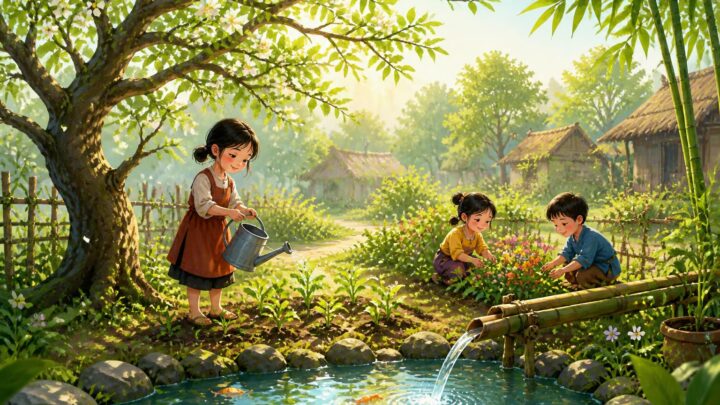
The Little Girl Who Kept the Garden Green
At the end of a winding road, where houses nestled beneath rows of trees, there was a garden that had once stayed green and cool all year round. The villagers called it Cloud Garden because every morning, white mist often settled on the leaves, looking like little clouds asleep on the ground. In the garden
Read more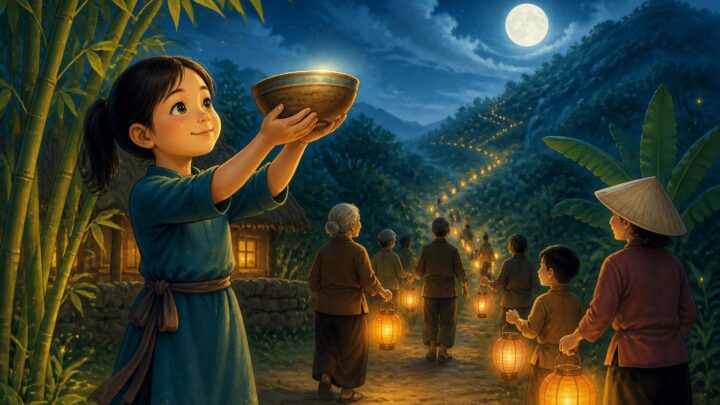
The Little Girl Who Caught Moonlight in a Clay Bowl
Once upon a time, on the edge of a green forest, there was a small village nestled beside a crystal-clear stream. The villagers made their living growing vegetables, weaving cloth, and crafting baked-clay bowls. Every morning, cooking smoke rose from the low-roofed houses, mingling with the scent of freshly cooked rice and wet grass. In
Read more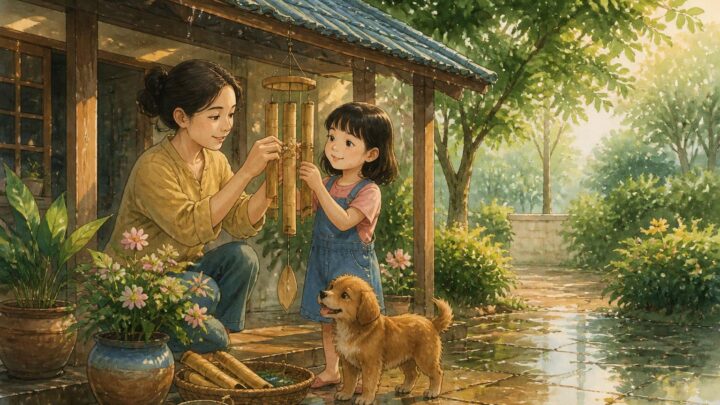
The Wind Chime and the Promise Under the Eaves
At the end of the road stood a house with a blue-tiled roof. A bamboo wind chime hung under the eaves. The chime was old; several bamboo tubes had turned honey-colored, and the string tied above them had become frayed from the sun and rain. Whenever the wind blew through, the chime rang out with
Read more