
Story Collections · 25 November, 2026
The Scent of the Wooden Box
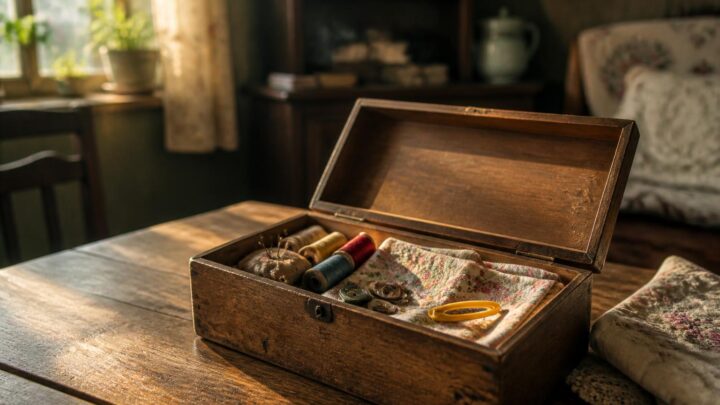
The wooden box lay in the bottom drawer of the low cabinet, where Grandmother often kept things that were no longer used but absolutely must not be thrown away. It was not large, just big enough to hold a spool of thread, a few buttons, and several neatly folded scraps of fabric. The surface of the box had darkened over the years; there was a small crack in the right corner, while the lid carried the familiar scent of dry wood mixed with medicated oil.
On the day Grandmother died, Mother told me to tidy up the old room. I thought the job would take only one morning. But my hands kept stopping before each object: the bamboo fan with one broken slat, the fabric scissors with black handles, the handkerchief embroidered with Grandmother’s initials, and the wooden box lying quietly at the bottom of the drawer. I opened the lid. There was nothing valuable inside, yet only a short while later, I was sitting on the floor, unable to continue sorting.
Small Things Often Hold an Entire Life
My maternal grandmother was not someone who often told stories. She did not keep a diary, save old tickets, or write dates on the backs of photographs. Because of that, my memories of her were not contained in clear milestones. They lived in the soft drag of her slippers across the tiled floor every morning, in the bowl of vegetable soup she always ladled out more generously for her grandchildren, and in the way she would stand outside the gate waiting for me to come home even after dark.
The wooden box was where she kept things so small that other people might have considered them meaningless. A blue button with frayed thread. Three needles pinned to a piece of cardboard. An old elastic band. A scrap of floral fabric cut from a dress my mother had worn when she was young. In one corner of the box, I found a yellow plastic hair clip. It was the clip I had lost in third grade and cried over for an entire afternoon.
I do not remember where Grandmother had found it. Perhaps she had picked it up from under the bed, behind the door, or in the grass beside the fence. She had kept it for many years, while I had forgotten it existed after only a few summers.
People often imagine that memories are made from big events: a distant trip, a special day, an expensive gift. But when we look back, we often remember ordinary things more clearly. A hand pulling up the blanket in the middle of the night. Someone quietly peeling a tangerine in advance. A reminder to bring a raincoat even though the sky was still blue. These things do not change a life in an instant, but they quietly support us through the years.
The Story Behind the Scraps of Fabric
Mother told me that Grandfather had made the box for Grandmother before the two of them were married. At the time, he was only an apprentice carpenter, and his wages were meager. He collected leftover pieces of wood from the workshop and joined them together into a box with a sliding lid. The cuts were not perfectly straight, and the edges had not been completely smoothed, but Grandmother used it until the end of her life.
In that box, she repaired clothes for the whole family. When the seam on Grandfather’s shoulder came undone, she stitched it back together. When Mother’s school trousers became worn at the knees, she sewed an extra piece of fabric on the inside. When it was my turn, every time a button fell off, I only had to leave the shirt on the table and run off to play. When I returned, the button had been sewn neatly back on, the stitches small and firm enough that I never knew it had once come loose.
Grandmother did not only mend clothes. She also mended the things that people in the family usually considered unimportant. One morning, Mother and Grandmother argued about money. Mother left the house with a tense expression. That afternoon, Grandmother asked me to take a bag of oranges to Mother’s house. She did not tell me to apologize on her behalf, nor did she instruct me to explain anything. She only said, “Let her have something to eat first. We can deal with everything else later.”
Many years later, Mother told me that it was that very bag of oranges that had made her burst into tears. Not because of the oranges, but because Grandmother always knew how to place love before questions of right and wrong. She understood that some arguments, if people insisted on deciding who had won and who had lost, could leave a house cold for a very long time.
Distance Is Measured by the Things We Forget
After I began working in the city, I came home less often. At first, I told myself it was because I was busy with work. Later, I used the excuses of the long journey, short holidays, and appointments that had already been arranged. Grandmother still called, but I usually answered in a hurry. She asked whether I had eaten, whether I was getting enough sleep, and whether it was cold where I was. I gave perfunctory answers and then said I still had work to do.
Once, she asked what dishes I liked so she could prepare them. I said anything was fine. She asked again twice, and I began to feel impatient. At the time, I did not realize that her question was not really about food. She only wanted to know whether I still remembered her kitchen, whether I still wanted to sit and eat at the old table.
The distance between family members does not always begin with an argument. It takes shape through the times we do not answer messages, the missed calls, and the plans we keep postponing until the following week. Each instance is very small, so small that we can easily forgive ourselves. But small things repeated over and over can form a wall, and by the time we recognize it, we no longer know when we should have laid down the first brick.
In the innermost compartment of the wooden box, I found a piece of paper folded into quarters. Grandmother’s handwriting was shakier than before, but still recognizable. On the paper was a list of a few things to do: remind Mother to buy medicine, send me some limes, take the wool sweater out to air in the sun, and call to ask whether I would come home for the weekend. The final line had no bullet point. She had written: “If they’re busy, then let it be. Don’t put them in an awkward position.”
I read that sentence over and over. Grandmother had been waiting for a phone call but was afraid of bothering me. She wanted me to come home but was afraid I would have to rearrange my plans. Older people often say “it’s okay” not because they truly need nothing, but because they have grown accustomed to placing other people’s comfort before their own wishes.
Gratitude Should Not Appear Only After a Loss
That evening, I brought the wooden box back to my room. Mother told me to keep it, because Grandmother had once said she wanted to give it to me someday. I asked why she had not told me sooner. Mother smiled sadly. “Because I thought you already knew,” she said.
We often think the people we love know that we love them. Perhaps they truly do. But knowing and hearing it are two different things. A word of thanks spoken at the right time can make a long day feel lighter. A phone call with no purpose other than checking in can help the person on the other end feel that they still have a place in our lives. Coming home once for a meal, even if the meal consists only of boiled vegetables and a bowl of dipping sauce, can sometimes mean far more than a gift bought in haste.
From that day on, I began calling Mother on set evenings each week. I no longer asked a few perfunctory questions and hurried to end the call. I let Mother tell me about the neighbors, the flowerpot in front of the house, and the price of vegetables at the market. There were stories I had heard many times, but this time I tried to listen as if it were the first. Sometimes I went home without telling her in advance. Mother always pretended to scold me for not giving her notice so she could prepare, then quietly went into the kitchen to cook the dishes I liked.
The wooden box still sits on my desk. I place inside it small things that might not matter to anyone else: the ticket from the first movie I took Mother to see, a piece of paper on which my younger sister wrote a birthday wish, and a button that fell from Grandmother’s old shirt. I do not keep them because I am afraid of forgetting. I keep them to remind myself that a life is made up of countless simple things like these.
When Love Continues Through Action
Later, I learned to recognize that love does not exist only in gentle words. It can be patiently listening to a story one has heard many times. It can be remembering that a family member does not like onions. It can be taking the initiative to ask whether they need to see a doctor, need a lightbulb replaced, or simply need someone to sit beside them on a rainy afternoon. Love does not have to be grand, but it needs to be expressed often enough that the person receiving it does not have to guess.
Whenever I open the box, I think of Grandmother’s hands. Those hands had once threaded needles beneath a yellow lamp, carefully snipped away excess thread, and folded clothes for the whole family before bed. She left behind no significant fortune or lessons written into books. She left behind a way of living: do what needs to be done, care for the people beside you, and do not dismiss things that seem very small.
Perhaps that is also how memories continue to exist. Not by keeping every object unchanged, but by bringing the goodness we once received into the way we treat others. One day, I may no longer remember exactly what year the box was made, or when the crack on the lid first appeared. But if I still know to call and check in, still know to bring a bag of oranges before arguing, still know to sit beside my loved ones a little longer, then Grandmother will still be present in my life in another way.
The wooden box rested quietly on the desk, giving off a very faint scent. I closed the lid, then opened it again. Inside were still only small objects. And yet, from that day on, I understood that some things are not at all as light as they appear. A button can hold an entire summer. A scrap of fabric can lead us back to an old kitchen. And a wooden box can remind us not to wait until we have lost someone before beginning to say that we are grateful.
Related articles
The Watchmaker and a Day Without the Hands Moving
The Watch Whose Hands Had Stopped At the end of the street stood a watch-repair shop so small that anyone walking quickly could easily pass it without noticing. The wooden sign above the entrance had faded, with only a few faint strokes of lettering remaining. Inside the shop, hundreds of watches lay still on narrow
Read more
The Ferry Crossing Keeper and the Bell of Promises
At the end of a red dirt road, where rows of bamboo leaned down to gaze at their reflections in the broad river, there was a small ferry crossing that the local people called Cloud Ferry. The name came from summer mornings when mist covered the entire surface of the water, making the passenger ferry
Read more
The Empty Chair at the End of the Alley
At the end of my alley stood an old wooden chair. It sat beneath a star-fruit tree, its back against a wall whose lime coating had almost entirely peeled away. In the dry season, it caught patches of dappled sunlight; in the rainy season, it was sheltered by the low eaves of the neighboring house.
Read more
The Unsent Letter from the Little Attic
The old key lay in An’s palm, cold and light, yet it made her feel as though she were holding a piece of her childhood. The wooden door of the house opened with the harsh sound of dry hinges. The smells of dust, damp wood, and old sunlight blended together, creating a familiar scent she
Read more
The Watchmaker and the Morning Without Bells
The Silent Morning At the end of the old street stood a small shop called Kim Gio. The wooden sign had faded, with only a few traces of blue paint clinging around the letters. Inside the shop, dozens of clocks hung on the walls, sat on shelves, or lay in narrow drawers. Each one had
Read more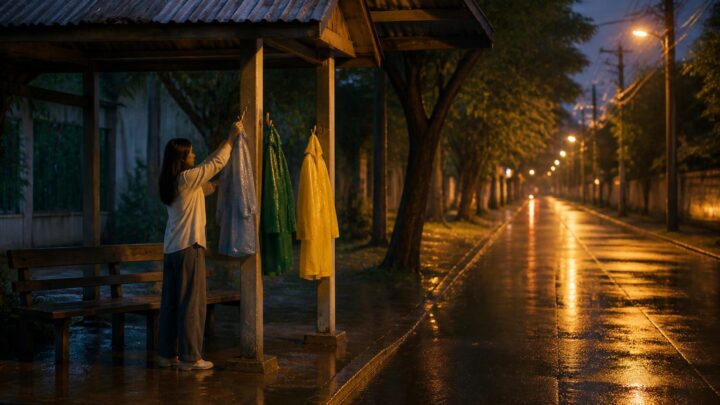
The Raincoat Left Hanging at the Bus Stop at the End of the Street
At the end of the street stood a small bus stop with a low corrugated-metal roof and a wooden bench faded by rain and sun. The bus stop had no electronic sign, no ticket seller, and no drink stall. People only stopped there to wait for a bus, then quickly went on their way. And
Read more