
Story Collections · 25 November, 2026
The Watchmaker and a Day Without the Hands Moving
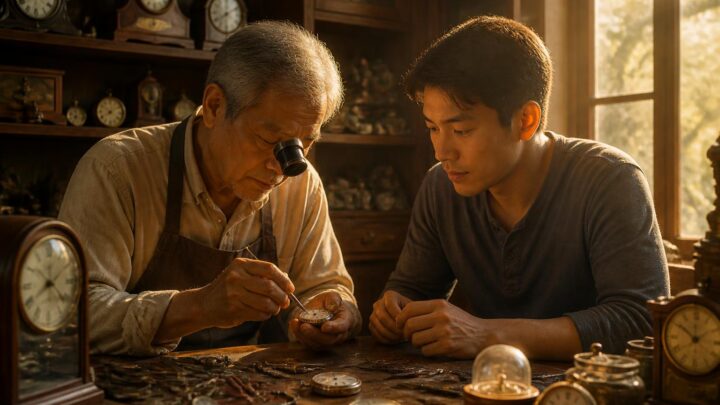
The Watch Whose Hands Had Stopped
At the end of the street stood a watch-repair shop so small that anyone walking quickly could easily pass it without noticing. The wooden sign above the entrance had faded, with only a few faint strokes of lettering remaining. Inside the shop, hundreds of watches lay still on narrow shelves, in drawers, beneath the worktable, and even inside old tin boxes. Some gleamed as though they had been bought only yesterday; others were covered with a thin layer of dust, their leather straps hardened by time.
The shop’s owner was Mr. Lam, a man in his sixties who sat every day behind a low wooden table with a magnifying glass mounted in front of his eye. He repaired watches with hands that were slow but steady. A tiny spring, a gear misaligned by half a millimeter, or a tangled hairspring could not escape his notice.
People on the street often said that Mr. Lam could make any watch run again. As long as there were enough parts left and the mechanism was not completely shattered, he would patiently find a way to save it. But there was one watch he never repaired, even though it sat on the highest wooden shelf, where the afternoon sunlight often fell.
It was a silver pocket watch, its glass cracked by a thin line. Its two hands had stopped at eight seventeen.
A Promise from Many Years Ago
That watch had belonged to Mr. Lam’s only son, Duy. When he was young, Duy often sat beside his father, watching him remove each screw and wipe each gear with a soft cloth. He did not like watch repair as his father did, but he loved the stories behind every object brought into the shop.
Some people brought in the watch of a mother who had passed away. Some brought a wedding watch because they wanted to give it back to their spouse on a special occasion. Some simply wanted to repair an old object even though it was worth very little, because it was the last gift from a loved one.
Duy would often ask:
“Do you repair watches so they can keep running, or so people can remember the person who gave them the watch?”
At the time, Mr. Lam would only smile and say that a watch was a machine, while remembering was something people did. But in his heart, he understood that some objects were brought in not because they were still useful, but because people were not yet ready to give up the story attached to them.
When Duy grew up, father and son began to have disagreements. Duy wanted to leave the neighborhood, find a different job, and live somewhere no one knew about the old watch-repair shop. Mr. Lam did not stop him, but the way he remained silent made Duy think that his father did not believe in him.
One morning, Duy said he would leave at the end of the week. Mr. Lam continued to bend over the watch he was repairing and replied briefly:
“Go, but remember to take care of your health.”
Duy waited for something else. Perhaps a question, a word of encouragement, or simply the words “I’ll miss you.” But Mr. Lam said nothing. Duy left home with a backpack and a smoldering resentment, convinced that his father had never truly needed him by his side.
That afternoon, Mr. Lam received a phone call. Duy said that he had arrived safely. The two of them spoke for less than a minute. Before hanging up, Duy asked whether his father wanted him to take his mother’s pocket watch with him. Mr. Lam looked at the silver watch lying in a drawer, then said to leave it at home.
That was the last time they spoke for a very long while.
The Years That Passed in Silence
Duy worked in another city. At first, he sent home a few postcards and called every month. Mr. Lam was not good at expressing himself, and usually asked only familiar questions, such as whether work was going well, how Duy was eating, and whether he had enough money. Duy wished his father would ask more, while Mr. Lam thought his son was grown and no longer needed his awkward expressions of concern.
The calls grew less frequent. Whenever something unpleasant happened, Duy became even more reluctant to share it. Whenever he missed his son, Mr. Lam became even less certain how to begin a conversation. The distance between them was not created by one great argument, but by countless words held back and moments of waiting that neither of them knew about.
One rainy day, Mr. Lam received word that Duy was coming home. Not to stay, and not for a happy occasion. Duy was returning to arrange the house and take his father to live with him. The watch shop had grown quiet, Mr. Lam’s health was no longer as good as before, and the old street was preparing to change its appearance.
That evening, Duy entered the shop. He looked at the watches on the shelves, the darkened toolboxes, and the wooden chair where he had once sat as a child. Mr. Lam was polishing the silver pocket watch.
“You still haven’t repaired it?” Duy asked.
“Not yet.”
“Is it badly damaged?”
“No. I just haven’t wanted to repair it.”
Duy picked up the watch. When he shook it gently, he heard a very faint sound from inside. He remembered that his mother had worn that watch during the final days before her death. She had given it to Duy and told him that when he went away someday, he should take it with him to remember the way home.
But on the day Duy left home, the watch had remained in the drawer. He had thought his father kept it because he did not want to give him anything important.
“You once wanted to give it to me, didn’t you?” Duy asked.
Mr. Lam was silent for a long time. Then he said that he had intended to give Duy the watch on the day he left. He had even cleaned the glass, replaced the strap, and put a small piece of paper inside the box. But when he saw his son hurriedly pulling his suitcase toward the door, he thought Duy did not want to accept anything from his father.
The piece of paper was still in the box, yellowed with age.
What Had Been Forgotten Was Not Time
Duy opened the box. The piece of paper contained only one short line, written in stiff, slightly slanted handwriting: “When you feel tired, remember that home always has a light waiting for you to return.”
Duy finished reading but said nothing. He turned toward the door so his father would not see his eyes redden. All those years, he had believed that his father did not care. Meanwhile, Mr. Lam had believed that his silence was a way of respecting his son’s choice.
Neither of them had intended to hurt the other. But the things left unsaid could still form a very thick wall.
That night, Duy did not mention selling the shop. He asked his father why the watch had stopped at eight seventeen. Mr. Lam explained that it was the time Duy’s mother had died. After that day, he had opened the watch, removed the mechanism, and put it back together many times, but whenever it approached that moment, he no longer wanted to continue. He was afraid that if the watch started running again, part of his memory of his wife would be pushed too far away.
Duy said that perhaps his mother would not want him to hold on forever to a painful moment. Perhaps she wanted him to let time move forward—not in order to forget, but so that the people who were still alive could move forward together.
Mr. Lam did not answer immediately. The next morning, he took out his tools and repaired the watch. Duy sat beside him, watching his father work for the first time in many years. He realized that those seemingly slow movements held a concentration and patience he had never understood before.
The mechanism was not completely broken. A small gear had worn down, the hairspring was misaligned, and the old oil had kept the parts from moving smoothly. Mr. Lam cleaned each component and replaced the gear with a part he had kept for a long time. Duy helped his father hold the lamp and arrange the tiny screws on a sheet of white paper.
By afternoon, the watch gave its first tick. The sound was very quiet, but in the silent shop, it rang out clearly like a signal.
The two hands passed eight seventeen.
Another Way to Return
Duy still took Mr. Lam to live with him in the city, but he did not sell the shop right away. He hired someone to look after it for the time being, while arranging to visit his father every month. Later, Duy learned how to repair simple problems and began accepting a few watches from friends for repair.
He did not become a watchmaker like his father. Duy still had his own job and his own life. What changed was that he no longer saw the watch shop as a place that pulled him back into the past. He understood that it was where his father had quietly preserved other people’s stories, just as he had silently held on to a part of Duy’s childhood.
Mr. Lam also learned to say the things he had previously hidden behind his calm demeanor. He said that he missed his son, that he had been afraid when Duy left home, and that many times he had picked up the phone without knowing what to say. Duy did not blame his father for those words coming late. He only said that late was better than never saying them.
Duy took the pocket watch with him when he returned to the city. Its hands no longer stood still, but it did not run exactly either. Each day, it lost a few minutes. Mr. Lam said that was normal for an old mechanism. Duy thought instead that perhaps objects that had passed through so much loss did not need to be perfect to have meaning.
In life, many relationships are like watches that have not been serviced for a long time. They do not necessarily break because of one major event. Sometimes it is simply the questions of concern that were forgotten, the apologies that were never spoken, the times someone wanted to call but waited for the other person to make the first move. Over time, the dust of silence settles on every part, making closeness no longer move as easily as it once did.
But a mechanism that has stopped does not mean it can never work again. It may take patience, a little honesty, and the courage to open the covers over things that have been sealed away. After being repaired, it may no longer run perfectly. A relationship after being hurt is the same. What matters is not making the past disappear, but allowing the present to continue through the hours that remain.
On an early winter morning, Mr. Lam called Duy simply to ask whether it was cold that day. Duy laughed and said the question sounded exactly like the ones from when he was little. Mr. Lam laughed too. At the other end of the line, the old watch ticked steadily.
This time, neither of them hurried to hang up.
Related articles
The Scent of the Wooden Box
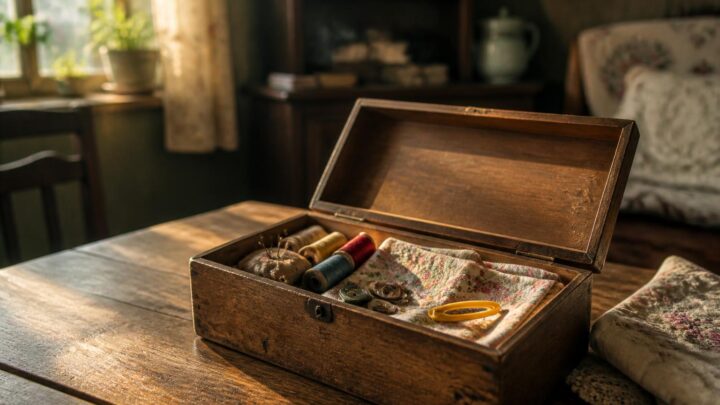
The wooden box lay in the bottom drawer of the low cabinet, where Grandmother often kept things that were no longer used but absolutely must not be thrown away. It was not large, just big enough to hold a spool of thread, a few buttons, and several neatly folded scraps of fabric. The surface of
Read more
The Ferry Crossing Keeper and the Bell of Promises
At the end of a red dirt road, where rows of bamboo leaned down to gaze at their reflections in the broad river, there was a small ferry crossing that the local people called Cloud Ferry. The name came from summer mornings when mist covered the entire surface of the water, making the passenger ferry
Read more
The Empty Chair at the End of the Alley
At the end of my alley stood an old wooden chair. It sat beneath a star-fruit tree, its back against a wall whose lime coating had almost entirely peeled away. In the dry season, it caught patches of dappled sunlight; in the rainy season, it was sheltered by the low eaves of the neighboring house.
Read more
The Unsent Letter from the Little Attic
The old key lay in An’s palm, cold and light, yet it made her feel as though she were holding a piece of her childhood. The wooden door of the house opened with the harsh sound of dry hinges. The smells of dust, damp wood, and old sunlight blended together, creating a familiar scent she
Read more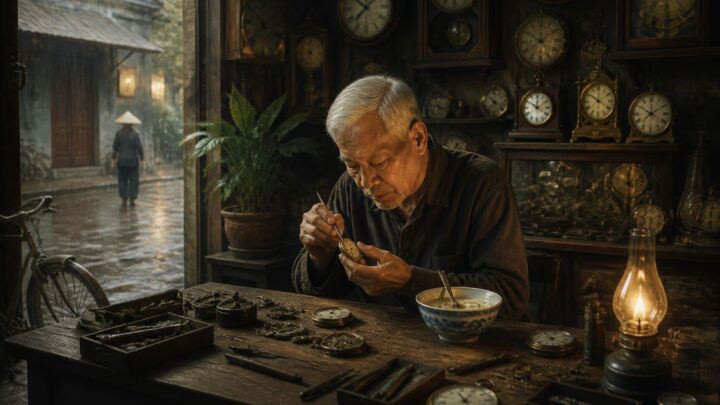
The Watchmaker and the Morning Without Bells
The Silent Morning At the end of the old street stood a small shop called Kim Gio. The wooden sign had faded, with only a few traces of blue paint clinging around the letters. Inside the shop, dozens of clocks hung on the walls, sat on shelves, or lay in narrow drawers. Each one had
Read more
The Raincoat Left Hanging at the Bus Stop at the End of the Street
At the end of the street stood a small bus stop with a low corrugated-metal roof and a wooden bench faded by rain and sun. The bus stop had no electronic sign, no ticket seller, and no drink stall. People only stopped there to wait for a bus, then quickly went on their way. And
Read more