

 Tiếng Việt
 日本語
日本語 한국어
한국어 中文 (中国)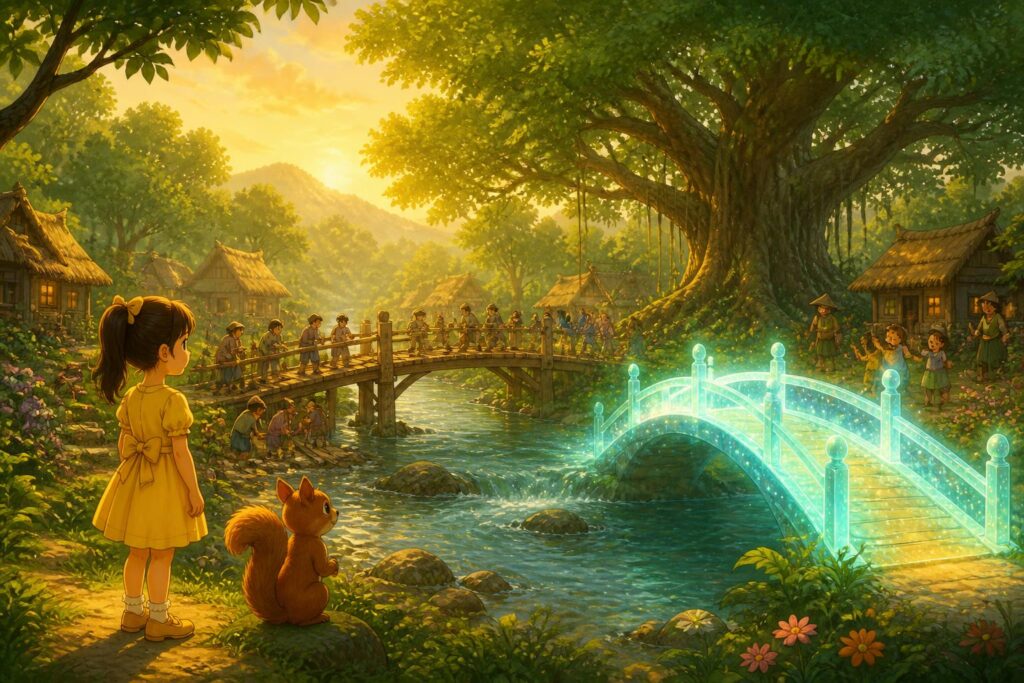
Once upon a time, at the end of a green valley, there was a small village called Streamside Village. A stream flowed around the village all year round, its water so clear that people could see the colorful pebbles lying on the bottom. On one side of the stream were houses with brown-tiled roofs; on the other side were wide rice fields and a forest filled with birdsong.
Long ago, the villagers had a wooden bridge spanning the stream. The bridge was not large but was very sturdy. Children crossed it on their way to school every morning, adults carried vegetables to the market, and the women often stopped in the middle of the bridge to exchange a few words and ask how one another was doing. Then, over time, the planks on the bridge gradually rotted. One night, heavy rain caused the water to rise and sweep away the bridge, leaving only two banks of the stream separated by a distance that was not very far, yet no one could step across.
The villagers discussed many times how to build a new bridge. Some said they had to wait for a skilled craftsman from the town. Others said they needed a great deal of wood. Still others thought it would be too much work and that people could simply take the road around the mountain. Each person had a different opinion, and no one was willing to listen to anyone else. In the end, the bridge was still not rebuilt.
In the village lived an eight-year-old girl named An, who lived with her mother in a small house beside a row of areca palms. An loved crossing the stream to visit her grandmother on the side of the fields. But ever since the bridge had been swept away, whenever she wanted to visit her grandmother, An had to take a very long detour. On some days, the scorching sun made her little legs ache terribly. On rainy days, mud clung all over the hem of her skirt.
One afternoon, on her way home, An sat beside the stream and watched the water shimmer beneath the setting sun. The little girl sighed:
“If only there were a new bridge.”
Suddenly, a rustling sound came from the fern bushes behind her. A brown-furred squirrel jumped out, holding an acorn larger than its own head.
“A bridge does not simply appear on its own,” said the squirrel.
An looked around in surprise and asked:
“Did you just speak to me?”
“In this forest, if someone truly wants to listen, they can hear our voices,” replied the squirrel. “My name is Brown. I know something about the village’s old bridge.”
An sat up straighter. Brown told her that long ago, beneath the roots of an ancient banyan tree in the forest, there had been a special bridge. It was made neither of wood nor stone. It was woven from strands of light as thin as spider silk. The bridge appeared only when the people of the village spoke kind and sincere words together and genuinely wanted to help one another.
“If the bridge is magical, why don’t the villagers call it forth?” An asked.
The squirrel raised the acorn, took a bite, and shook his head.
“Because their words often come before their kindness. They say they want to build a bridge, but then they wait for someone else to do it. They say they care about the children, but whenever someone suggests that they contribute their efforts, they look for excuses to avoid it.”
An looked at the stream. She thought of her mother, her grandmother, and the little children who had to take the mountain road every day. The little girl decided to try to find the bridge of light.
The Road to the Ancient Banyan Tree
The next morning, An brought a small bag of cakes and went into the forest with the squirrel Brown. The path was covered with dry leaves, and tall tree trunks rose on both sides. Red-whiskered bulbuls hopped from branch to branch, while yellow butterflies fluttered over bushes of purple flowers. After walking for a while, An met a hedgehog trying to push a pinecone that was stuck between two rocks.
An put down her bag, used a small branch, and pried the pinecone loose. The hedgehog happily thanked the girl. An broke off a piece of cake and gave it to the hedgehog, but the hedgehog accepted only half and said:
“You should keep the rest for yourself. Good people also need strength for the journey.”
After walking a little farther, An saw a baby bird that had fallen from its nest. The little girl climbed onto a low tree trunk and gently returned the bird to the nest on the branch. The mother bird flew around, chirping without end. Brown looked at An and said:
“Every good deed is like a strand of thread. One strand is very thin, but many strands woven together will become something strong.”
At noon, they arrived beneath the ancient banyan tree. Its great roots hung down like curtains. Among the roots was a round stone slab, with the image of a bridge carved into its surface. Brown told An to place her hand on the stone slab and say what she wished for.
An closed her eyes:
“I wish for everyone in the village to be able to cross the stream safely. I wish for everyone to know how to listen and work together to do something useful.”
The stone slab glowed faintly, then immediately went dark.
“That is not enough,” said Brown. “You cannot build a bridge for the whole village by yourself. You must help everyone remember that kind words must go together with action.”
The Words That Changed the Village
An returned to the village and began with the smallest tasks. In the morning, she saw the carpenter sitting in front of his house. An politely greeted him and said:
“Sir, the planks you make are very beautiful. If the village builds a bridge someday, I hope you will show everyone how to make it truly strong.”
The carpenter was usually rather gruff. He was about to tell An to go play somewhere else, but then he saw the clarity in the little girl’s eyes and softened his voice:
“If everyone truly wants to do it, I will contribute my efforts.”
At noon, An saw the vegetable seller arguing with the old goatherd over a basket that had been put in the wrong place. Instead of running away, An picked up the basket, handed it to the vegetable seller, and said:
“Please don’t be sad. Perhaps he did not mean to. Sir, next time, let’s put the basket a little farther over so that everyone can see it more easily.”
The vegetable seller fell silent, while the old goatherd nodded. A little while later, the vegetable seller took the initiative to apologize for speaking too loudly. The old man also apologized for not paying attention.
That afternoon, An invited the children in the village to gather branches, bits of stone, and trash around both banks of the stream. At first, a few children laughed at her:
“Picking up these things won’t make the bridge appear!”
An was not angry. As she worked, she replied:
“Maybe there won’t be a bridge today. But if we don’t begin, nothing will change tomorrow either.”
Hearing that, a boy named Ti bent down to pick up an old basket caught in the grass. Then another child joined in. Before long, the whole group had cleaned a section of the streambank. Adults passing by saw them; some smiled, while others quietly went back to get hoes and shovels.
That evening, the villagers gathered again in the communal courtyard. This time, before discussing money, wood, or stone, An asked to speak. The little girl told them about the bridge of light beneath the ancient banyan tree, but no one laughed at her. Everyone had seen the small things An had done throughout the day.
An said:
“I don’t know whether the magical bridge really exists. But I do know that if everyone only waits for someone else to begin, no bridge can ever be built. The carpenter can contribute his labor, Uncle Lam’s family has bamboo, and Aunt Hanh has rattan cord. Those who have no materials can help cook, carry things, or look after the children. We only need to work together.”
The courtyard fell silent for a moment. Then the carpenter stood up and said that he would take care of the bridge’s frame. Uncle Lam offered bamboo. Aunt Hanh said she would invite the village women to weave the cords. The people who had still been arguing the day before began, one after another, to offer what they could do.
The Bridge Appears
The next day, the whole village got to work. Some people cut bamboo, some shaped wood, and others transported stones. The children swept the path clean and brought water to the adults. Whenever someone grew tired, someone else offered words of encouragement. If something was not done correctly, people gave gentle suggestions instead of blaming one another.
By afternoon, just as the carpenter placed the final plank onto the bridge frame, a clear sound like wind chimes echoed from the forest. An raised her head and looked toward the ancient banyan tree. Between the tree trunks, a pale blue ribbon of light was slowly stretching across the stream.
The bridge of light appeared right beside the new wooden bridge. It was delicate but radiant; each footstep placed upon it sent out gentle rings of light. The villagers stood silently before the wondrous sight. The elders were moved, while the children cheered with delight.
The squirrel Brown sat on a tree branch looking down. Only An could hear him say:
“The bridge was not created by beautiful words. It was created by the good deeds that those words awakened.”
From then on, the villagers took great care of the wooden bridge. They repaired it together whenever a plank became loose, and they cleaned the banks of the stream together after rainy days. The bridge of light appeared only on special occasions, when the whole village worked together with sincere hearts. Once, it appeared when everyone rescued a herd of goats that had become lost in the forest. Another time, it appeared when they joined forces to rebuild the roof of a family’s home after a storm.
An grew up, but she still often went beneath the ancient banyan tree to visit the squirrel Brown. Whenever a child asked why the bridge shone, An did not say that she had been the one to find it. She simply smiled and said:
“Because when we know how to speak kind words, know how to listen, and truly reach out to help one another, there is always a path to cross between places that are far apart.”
A Lesson for You
Kind words can make others feel happier, but words become meaningful only when they are accompanied by action. A word of thanks, an apology, an act of yielding, or a helping hand can all bring people who are far apart closer together. When each person contributes one small deed with sincerity, something that seems impossible can gradually become reality.

ARTICLES IN THE SAME CATEGORY
The Seed That Knew How to Listen
The Wind Chime That Awakened the Garden
The Seed Asleep Beneath the Fig Tree
Brown Squirrel’s Leaf Bridge
The Little Bell and Little Hedgehog’s Promise
The Seedling That Knew How to Listen
ARTICLES IN THE SAME GENRE
Stepmother and Stepchild