
Children's Stories · 21 November, 2026
The Little Sprout and the Garden That Knew How to Listen
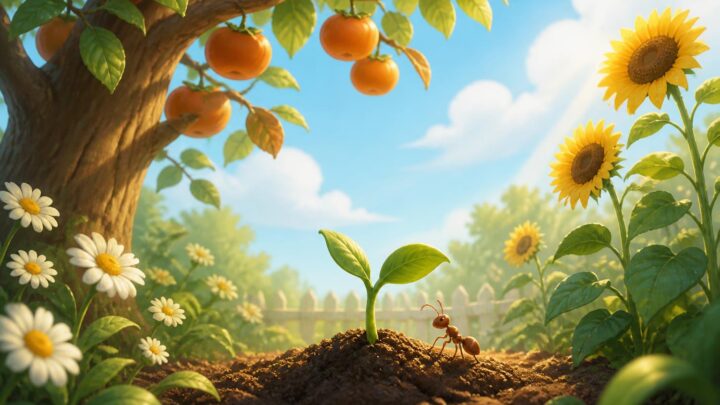
At the far end of a large garden, there was a small patch of soil beside a wooden fence. Every morning, the sunlight visited it before scattering golden streaks across the path. In the afternoon, the wind from the fields carried the scent of young grass and the sound of birds calling to one another as they searched for places to sleep. In that patch of soil, beneath a layer of soft earth, a little sprout was waiting for the day it would awaken.
The sprout did not know what kind of plant it belonged to. It only knew that there were other seeds beside it—some round, some long, and some tiny, like little brown specks of dust. Whenever it heard the larger roots shifting in the earth, the sprout would feel nervous. It wondered what it would look like when it emerged from the ground.
“Perhaps I’ll have very large leaves,” the sprout thought. “Or perhaps I’ll grow all the way up to the fence. Maybe sparrows will even build their nests on my branches.”
But then another thought arose, making the sprout draw in on itself.
“What if I can’t grow?”
Aboveground, the garden was always lively. Clusters of daisies swayed in the wind. The old rosebush had a rough, uneven trunk and produced brilliant red flowers every season. In one corner of the garden, the sunflower stretched high into the air, turning its face toward the sun every day. The sprout heard them talking and felt even smaller.
“The rosebush is so lucky,” the sprout thought sadly. “It has known who it was for a long time. I’m just a seed lying still in the darkness.”
The First Sound Beneath the Earth
One night, rain began to fall. Water seeped through the soil and slipped into the tiny spaces around the sprout. The earth became cooler and softer. The sprout heard many sounds it had never noticed before: the gentle patter of water falling on leaves, the sound of earthworms slowly digging tunnels, and the roots of the old rosebush shifting silently.
“Can you hear me?” a warm, deep voice called out.
The sprout started. “Who is that?”
“It’s the earth. I’ve been holding you for a long time.”
The sprout shyly asked, “Earth, do you know when I’ll grow?”
“I don’t know the exact day,” the earth replied. “But I do know that every seed has its own time. Some seeds awaken after the first rain of the season. Some wait through many sunny days. Some need to lie still for a long time so that everything inside them can become strong enough.”
“If I wait longer than the other seeds, does that mean I’m weaker?”
The earth smiled, though no one could see that smile. “No. Being slow does not mean being weak. Sometimes, being slow simply means that you are preparing more carefully.”
The sprout fell silent. The earth’s words were as gentle as the warmth surrounding it. For the first time, the darkness did not seem as frightening as before. In that darkness, it had the earth as a friend, water coming to visit, and roots very close by.
The Lesson of the Drop of Water
The next morning, the sun appeared from behind the clouds. A small drop of water still remained in the soil. It slid through the earth and stopped beside the sprout.
“Where did you come from?” the sprout asked.
“From a cloud,” the drop of water replied. “But before that, I was in a stream, in a leaf, in a puddle by the road, and even in the mist on a blade of grass.”
“You’ve been to so many places?”
“That’s right. I’m always changing where I live, but each time I carry something necessary for life.”
The drop of water seeped into the sprout’s outer shell. The sprout felt a tiny movement inside. A white root began to emerge, winding downward.
“What am I doing?” the sprout asked in surprise.
“You’re finding your way,” said the drop of water. “Not every path appears in advance. Some paths only appear when you begin to move.”
The sprout tried to push its root forward. The soil was a little hard, but it did not stop. It pushed a little farther, then a little farther still. Each time it came across a pebble, it went around it. Each time the earth pressed tightly against it, it waited for a drop of water to soften the space.
Above the ground, no one knew that the sprout was trying so hard. The sunflower still welcomed the sunlight. The daisies still swayed. The old rosebush quietly held its young leaves. But below, the sprout was carrying out the most important work of its life.
The Encounter with the Lost Ant
A few days later, a small tunnel passed through the place where the sprout was growing its roots. A black ant appeared. On its back, it carried a piece of dry leaf larger than its own body.
“Hello,” the sprout said softly.
The ant looked around in surprise. “Who just spoke?”
“It’s me. I’m right beneath you.”
The ant bent down and examined the soil closely. “Oh, a sprout! How much have you grown?”
“I don’t know yet. I only have one little root.”
“One root is a good beginning,” said the ant. “But I’m lost. Which way is the nest?”
The sprout listened. It heard the footsteps of other ants echoing from the left. It also heard the earth trembling very slightly in that direction.
“Try following the sound on the left,” the sprout suggested.
The ant did as it was told and found the way home. Before leaving, it turned back and said, “Thank you. You have very keen ears.”
The sprout was surprised. Until then, it had only thought that it had nothing special. It had never considered that the ability to listen could also be a gift.
That evening, the sprout heard the garden more clearly. It realized that every place had its own sound. Young grass rustled when the wind passed through. The daisies trembled softly. The old rosebush made a crackling sound as its new branches stretched longer. Farther away, a cricket was playing a slow melody in the grass.
The garden was not silent at all. The sprout simply had not known how to listen before.
The Day the Sprout Saw the Sky
After many days, the sprout’s root had firmly taken hold in the soil. Inside its shell, a small stem began to curve upward. The sprout felt a strange pull above it, like a gentle call from somewhere far away.
“That is light,” said the earth.
“What is light?”
“It is what makes you want to reach upward.”
The sprout gathered all its courage and pushed its stem through the soil. The earth held it back for a moment, as if wanting to give it one last hug, then gently made way. The little stem rose above the ground.
The first light touched it.
The sprout squinted. The sky was wider than anything it had ever imagined. White clouds drifted slowly by. Green leaves swayed. The wooden fence was not tall enough to touch the sky as it had imagined, but it was still sturdy enough to block the wind. The whole garden appeared before it, full of colors and sounds.
“I did it!” the sprout cried.
The sunflower bent its head to look down. “Hello, little one. You grew later than we did, but you look very healthy.”
The daisies fluttered their petals. “Would you like to listen to the wind with us?”
The sprout smiled. It no longer wanted to grow quickly just to get everyone’s attention. It only wanted to open its first leaves, welcome the sunlight, drink water, and continue growing in its own way.
The next day, a strong wind blew through the garden. The sprout leaned to one side. It was so frightened that it wanted to lie flat against the ground. But its roots had already sunk deep. The earth beneath it supported its stem. The old rosebush blocked some of the wind with its large branches, while the sunflower stood nearby and kept the soil from being blown away.
“You don’t have to face everything on your own,” said the old rosebush. “Growing also means knowing how to accept help when you need it.”
The sprout remembered those words.
The Garden Needed Someone Who Knew How to Listen
Summer arrived. The sprout had more leaves now. It was still not as tall as the sunflower, not as dazzling as the rosebush, and did not give off a fragrance like the other flower clusters. Yet it had a special ability that the whole garden gradually began to notice: it knew how to listen.
When a daisy leaf was nibbled by a caterpillar, the sprout heard the unusual rustling of the leaf and alerted the birds. When a stone blocked the flow of water, it heard the sound of the cracking dry soil and called the ants to help. When a young plant near the fence felt sad because it was covered in shade, the sprout showed it a patch of soil with more sunlight.
The sprout did not do grand things. It simply paid attention to what was often overlooked. Because of this, the garden became more harmonious. The larger plants no longer forgot about the young sprouts. The animals knew to seek one another out when they needed help. And the little sprout grew steadier each day.
One morning, the earth called the sprout by a new name:
“Listening Tree, what do you want to become today?”
The sprout looked up at the sky. A green leaf trembled gently in the wind.
“I don’t know yet,” it replied. “Perhaps I’ll become a very tall tree. I might even have flowers or fruit. But today, I only want to keep growing, care for my roots, and listen to the garden.”
The earth said happily, “That is a very good answer.”
From then on, the sprout no longer compared itself with the other plants. It understood that every seed had its own journey. Some needed more sunlight, while others needed more rain. Some reached upward very quickly, while others quietly took deep root. What mattered was not who grew first, but whether each one knew how to care for the goodness sprouting inside.
That afternoon, the wind passed through the garden again. The sprout bowed to greet it, listening to the sounds of grass, leaves, and birds blending together. Suddenly, it realized that the garden was listening to it, too. Beneath the earth, its roots continued to spread. Above, its leaves continued to open wider.
And in the middle of the vast garden, a little plant began to grow—calmly, steadily, and in its own way.
Something for Children to Remember
Everyone grows at a different pace. Sometimes we feel small or slower than our friends, but that does not mean we are inferior. Be patient with yourself, pay close attention to the people around you, and do not be afraid to accept help when you need it. Good things often begin very small, like a sprout resting beneath the earth and finding its way toward the light day by day.
Related articles
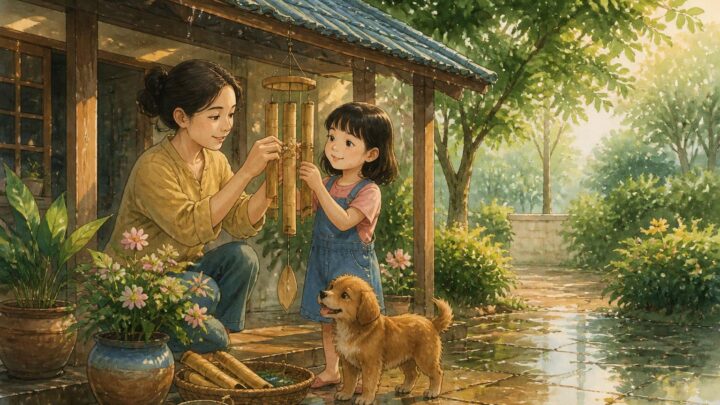
The Wind Chime and the Promise Under the Eaves
At the end of the road stood a house with a blue-tiled roof. A bamboo wind chime hung under the eaves. The chime was old; several bamboo tubes had turned honey-colored, and the string tied above them had become frayed from the sun and rain. Whenever the wind blew through, the chime rang out with
Read more
The Boy Who Counted Stars with a Bamboo Basket
Once upon a time, in a small village nestled between rice fields and a river that ran crystal-clear all year round, there lived a boy named Tí. Tí lived with his mother in a thatched-roof house. They were poor, but there was always a bed of green vegetables in front of the house, a sweet
Read more
The Bridge Made of Kind Words
At the edge of Moc Mien Village, there was a small stream that ran crystal clear all year round. Its water flowed over smooth, round stones, slipped beneath the ferns, and emptied into the wide rice fields. In summer, the children often invited one another to the streambank to float leaves like boats. In autumn,
Read more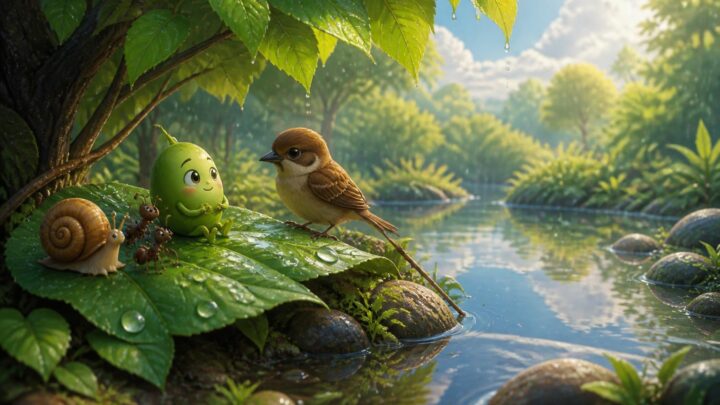
The Little Bean Who Wanted to Hear the Rain
At the far end of a small garden, beneath the canopy of an old star-fruit tree, there was a bed of green beans that always rustled whenever the wind blew through. The bean plants grew up together, winding their soft tendrils around the bamboo fence and lifting their heads to greet the sunshine. Among them
Read more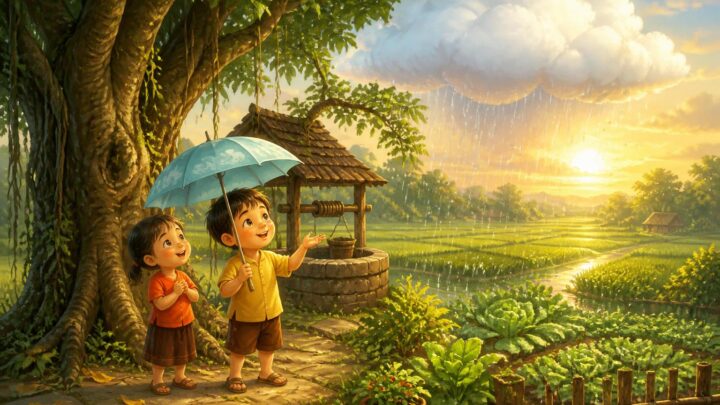
The Cloud’s Umbrella and the Boy Who Kept His Promise
At the end of a winding road, where houses nestled beside the rice fields, there was a small village called Gio Noi. The village was famous for its cool afternoons. The wind from the river blew through the bamboo groves, carrying the scent of fresh straw and pomelo blossoms. Yet that year, summer arrived earlier
Read more
A Small Lamp Beside the Stream
A Small Lamp Beside the Stream At the edge of a village nestled among green hills, a crystal-clear stream flowed over rounded stones. During the day, the stream sparkled in the sunlight and was a place where the children often gathered to play. They floated leaf boats, searched for pebbles with strange shapes, and then
Read more