

 Tiếng Việt
 日本語
日本語 한국어
한국어 中文 (中国)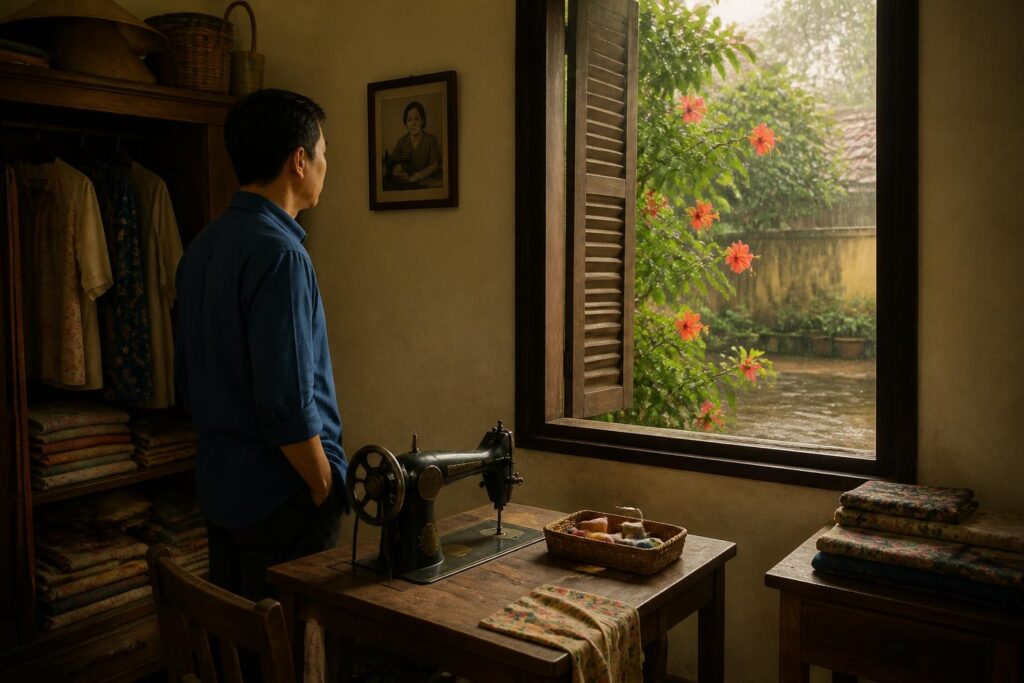
Minh returned to the village on a drizzly afternoon. The road leading into the hamlet had been paved with concrete long ago, but the two rows of hibiscus along the roadside were still there, their red flowers appearing faintly behind the thin veil of rain. The car stopped in front of the old tiled-roof house, where his mother had lived alone for nearly ten years. A layer of green moss covered the iron gate. On the doorstep, the chipped basin still sat beside the pair of brown plastic sandals she usually wore whenever she went to the well.
Minh’s mother had died at the beginning of summer, after a prolonged illness. He had returned for the funeral, stayed for three days, and then had to go back to the city because of an unfinished project. The neighbors helped him lock up the house and told him to come back for his belongings whenever he could arrange it. Four months passed before Minh was finally able to organize a proper trip. In truth, he had not been so busy that he could not come. He simply did not know how to step into a house where he would no longer hear his mother calling from behind him.
The Room That Smelled of Old Fabric
Minh opened the door with the key Aunt Tu, the neighbor, had returned to him. The damp smell of a house that had been unoccupied for a long time flowed out, mixed with the smells of wood, camphor, and another very familiar scent that he could not put a name to. Perhaps it was the smell of the medicated oil his mother often rubbed on her temples. Or perhaps it was the smell of new fabric from the sewing room at the end of the hall.
The room was still almost exactly as it had been. The treadle sewing machine stood by the window, covered with a faded floral cloth. Spools of thread were arranged in an old tin box. On the wall hung a tape measure, scissors, tailor’s chalk, and several pieces of fabric neatly held in place by wooden clips. Minh’s mother had once taken in sewing for the entire hamlet. She was not wealthy, but her hands were always busy. People brought her a shirt with a split seam, a pair of trousers with a loose waistband, or a uniform that needed urgent alterations for a child going to school the next day. His mother had never asked whether a customer could pay in full before accepting the clothes.
When he was little, Minh often sat on the doorstep watching his mother work. The steady sound of the machine at noon made him sleepy. Whenever a needle broke or the thread tangled, she would bend close and patiently untangle each small loop. He once asked why she did not buy a new machine. She smiled and said that this machine had gone through the most difficult years with her; getting rid of it would be wrong.
Minh did not understand what she meant then. To him, an old machine was simply an old machine. At eighteen, he left his hometown to study in the city. His mother sold part of the garden behind the house to pay her son’s tuition. Minh learned about it from Aunt Tu, not from his mother. When he asked, she merely brushed it aside, saying that land left unused did nothing anyway, and that even after selling part of it, the garden was still spacious.
In the years that followed, Minh worked in the city, changed companies several times, moved through a few rented rooms, and eventually rented a small apartment. He sent money home regularly, called once a week, and sometimes, when he was too busy, sent a few lines by text. His mother often asked how he was eating, whether work was going well, and whether he would come home on the weekend. Minh usually answered hurriedly: “I’m fine, Mom. Don’t worry.” He thought that was enough to put her at ease.
The Blue Fabric
While opening the drawers, Minh found a small wooden box beneath the table. Inside were pieces of fabric folded carefully. There was a pale yellow piece, a moss-green one, one covered in tiny flowers, and a soft, cool piece of blue fabric. On top of the blue fabric lay a slip of paper that had yellowed with age. His mother’s handwriting appeared slowly before him: “Sew for Minh, when he returns.”
Minh sat down on the wooden chair. Outside in the yard, rain continued to fall on the banana leaves. He turned the slip of paper over, but there was nothing else. No date, no explanation. Just one short sentence that suddenly made the room feel cramped.
He tried to remember whether his mother had ever mentioned that blue garment. Perhaps she had said something during one of their phone calls, while Minh was driving and listening, so he had only given a careless reply. Perhaps the fabric had been bought during a trip to the market and then lain untouched in the box for years. It was also possible that his mother had intended to sew the garment for him long ago but never had the chance.
Minh pulled open the drawer beneath the sewing machine. Inside was a brown notebook. The first pages recorded customers’ names, measurements, and the dates their clothes had been received. Farther in, the handwriting grew sparser. Many pages contained only a name and a small dot. Some villagers had moved away, some had died, and some no longer needed their clothes altered because his mother’s eyesight had grown weak.
In the middle of the notebook was a separate entry: “Minh’s shirt, stand-up collar, long sleeves, blue. Remember to leave a little extra room at the shoulders.” Beneath it was a smaller line: “He has grown so thin.”
Minh reached out and touched the page. Those words reminded him of the last time he and his mother had seen each other before she was hospitalized. She had stood on the veranda, watching him carry his suitcase to the car. She told him he had grown thin, and he laughed and said it was because he had been working too much. She wanted to pack a few guavas for him, but he said he would take them next time. She asked when next time would be, and he said he did not know yet; work was piling up.
Minh had not known that it was the last time his mother would stand on the veranda to see him off.
The Things Left Unspoken
That afternoon, Aunt Tu brought over a pot of black bean sweet soup. She placed it on the table and then sat down in the chair opposite Minh, as though the house were still occupied and the two of them were simply waiting for his mother to return from the market.
“How long ago did she sew that garment?” Minh asked.
Aunt Tu looked at the piece of blue fabric in his hand and smiled sadly. “A long time ago. Back when you had just been hired at your first job in the city.”
Minh looked up. He did not remember ever telling his mother about that. On the day he got the job, he had sent only a short message: “I’ve found a job.”
“Your mother was so happy,” Aunt Tu said. “She walked back and forth for several days, saying she had to sew you a proper shirt. She said that when you came home, you would wear it to dinner.”
“Why didn’t she tell me?”
“There are things old people don’t say. If they say them, they’re afraid you’ll be busy, afraid you’ll feel you have to come home because of a shirt.”
Minh lowered his head. He suddenly realized that his mother had never demanded that he return. She only asked when he would be free, what he wanted to eat, and whether it was cold where he was. She never reproached him for missed calls or mentioned the many times he had promised to come home and then failed to. Perhaps she understood that her son’s life was elsewhere. Or perhaps she had grown accustomed to loving without making the person she loved feel indebted.
Aunt Tu told him that Minh’s mother had taken out the fabric many times to measure it. She laid it over one of his old shirts, marked it with chalk, and then put it away again. On some days, when her eyes were blurry, she had to ask a neighbor to thread the needle. On some days, her back hurt so much that she could sit beside the sewing machine for an entire afternoon without being able to press the pedal with her foot. But whenever she felt a little better, she continued working.
“Near the end, she still told me that if Minh came home, I should give him the shirt. Even if it didn’t fit, he had to keep it. She said a shirt sewn for someone who traveled far had to have strong stitches, because you never knew when that person would wear it again.”
Minh listened without answering. Inside him was a hollow space he had long thought was caused by work, by the city, by the choices of adulthood. Now he understood that the emptiness had been formed by very small things: one time he did not come home, one phone call ended too soon, one question left unasked.
The Final Stitch
The next day, Minh called a tailor in town. He brought the blue fabric, the notebook, and one of his old shirts to ask the tailor to finish the garment his mother had left unfinished. The tailor examined it for a long time, then said that the cutting had been done, but only half of the body had been assembled. The stitches at the collar were slightly crooked, probably because the person sewing it had developed weak eyesight.
“Should I redo the whole thing?” the tailor asked.
Minh looked at the small, even stitches on the sleeve. Each stitch resembled a slow step, an effort that never gave up. He shook his head.
“Keep my mother’s stitches. Just alter it so the shirt can be worn.”
Three days later, the shirt was finished. It was not perfectly made. The collar was slightly too high, and the left shoulder was a little wider than the right. But when Minh tried it on, it fit him with a strange exactness. The blue softened his face, while the smooth fabric embraced his shoulders like a hand that had been accustomed to resting there since he was a child.
He wore the shirt home and stood before the old mirror in his mother’s room. Reflected in it was a man in his thirties, with a few gray hairs and a face bearing features he had once seen on his mother’s face whenever she was tired. Minh suddenly remembered that when he was little and had a fever, his mother would sit beside his bed all night. In the morning, she would still turn on the sewing machine, her eyes red from lack of sleep. He had never asked whether she was tired. He had been cared for so consistently that he assumed it was simply natural.
Minh took off the shirt, folded it, and placed it on the table. He did not want to keep it locked away in a closet as a keepsake. He decided he would wear it on the days he returned to his hometown, in the moments when he needed to remember where he had come from, and that there had been someone who quietly measured his shoulders again even though she knew her son might never realize it.
Returning Is More Than Passing Through the Gate
Minh stayed in the house for another week. He cleaned the windows, repaired the veranda roof, and put the usable spools of thread into a box. The old sewing machine was cleaned, oiled, and placed back where it belonged. A little neighbor girl came over and, seeing the machine, asked curiously whether she could learn to sew. Minh did not know how to sew, but he took out his mother’s notebook and called Aunt Tu over to show the girl how to thread a needle.
When the day came for him to return to the city, Minh asked someone to renovate the sewing room into a small place that the women in the hamlet could share. Anyone who needed to alter clothes could do it themselves, and those who did not know how could learn from one another. Minh did not think he was continuing his mother’s work. He only wanted the room to retain the sound of the machine running, the smell of new fabric, and the ordinary conversations that passed through the afternoon.
Before closing the door, Minh stood for a long time on the doorstep. He did not say goodbye to his mother, because he realized that some people, though no longer physically present, remain in the way we live. His mother was there in the way he patiently listened to Aunt Tu’s stories. She was there in his decision not to throw away the old machine. She was there in the blue shirt whose stitches were slightly crooked but strong and enduring.
Minh locked the gate and turned back to look at the house one last time. This time, he did not see it as empty. The rain had stopped. On the hibiscus hedge, clear drops of water rested at the tips of the leaves, reflecting a patch of sky that was gradually brightening.
People often think that returning means retracing a stretch of road. But sometimes, returning means learning how to look again at the things that were once taken for granted. A hot meal, a question asked with care, a shirt sewn slowly over many years. Such love is not loud, nor does it demand an immediate response. It simply lies quietly in a corner of life, like the piece of blue fabric in the wooden box, waiting for the day a person becomes mature enough to understand how deeply they have been loved.

ARTICLES IN THE SAME CATEGORY
The Clock That Did Not Run Through the Rainy Season
The Keeper of Seeds by the Dry River
The Room Waiting for Sunlight
The Bellmaker and the Silent Monsoon
The Lamplighter at the End of the Slope
The Well That Could Hear the Truth
ARTICLES IN THE SAME GENRE
Brown Squirrel’s Raincoat
The Wind Chime Finds Its Chime Again
Stepmother and Stepchild