

 Tiếng Việt
 日本語
日本語 한국어
한국어 中文 (中国)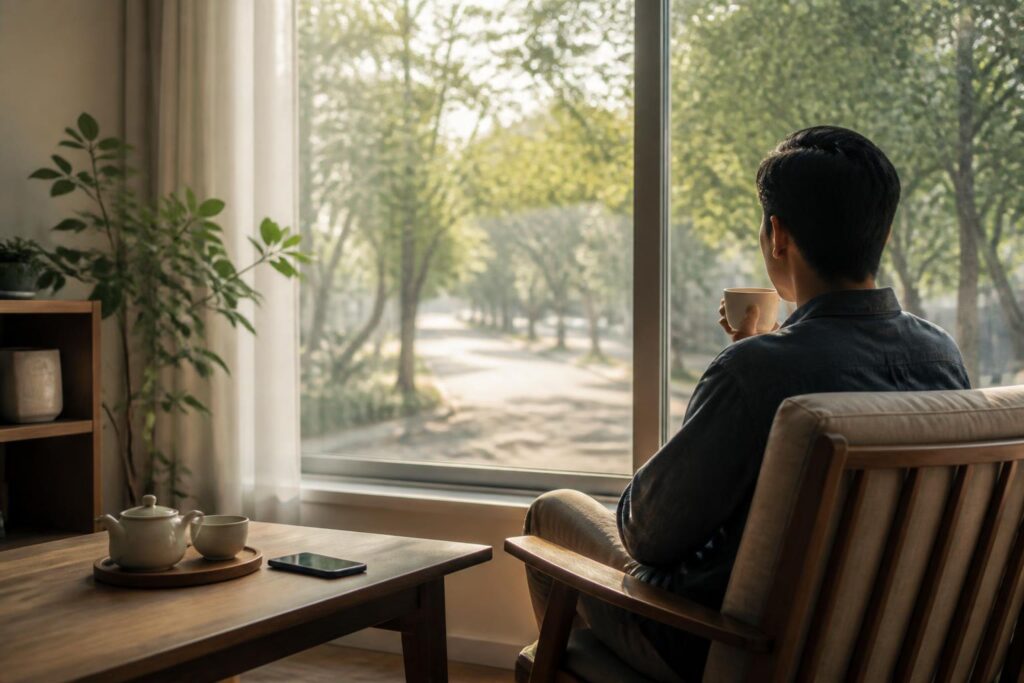
There are days when we wake to the sound of an alarm, step into a stream of messages, work, appointments, and tasks to be completed before we have even realized that we are tired. The pace of modern life often turns haste into an invisible measure. Those who reply quickly are seen as considerate, those who multitask are considered productive, and those who are always busy easily create the impression that they are moving forward. Yet not every movement is progress. Sometimes, what is most necessary is not to run faster, but to know when to stop.
The silence between two moments of haste does not necessarily have to be a distant trip, a long vacation, or a perfectly arranged meditation session. It could be a few minutes spent sitting quietly by the window before starting the day, a walk during which we do not hold our phones, or an evening that we do not try to fill with noise. That time allows us to return to things that are often obscured by crowded schedules: an unnamed emotion, a forgotten sadness, a genuine desire, or a question we have repeatedly avoided.
Why are we often afraid of silence?
Silence can sometimes make people uncomfortable because it does not provide ready-made answers. When we are busy, we can temporarily forget unpleasant things by moving from one task to another. A new conversation covers up loneliness, a stream of videos soothes a sense of emptiness, while one plan after another keeps us from facing the question of whether we are living in accordance with what we truly want.
Silence is different. It does not make anxiety disappear immediately; instead, it places that anxiety in front of us. It reminds us that behind an outburst of anger there may be exhaustion, behind an indifferent attitude there may be an unresolved wound, and behind the desire to control everything there may be a fear of losing something important. For this reason, many people fill their time not necessarily because they like noise, but because they do not yet know what to do when they hear the voice within themselves.
However, avoidance does not make those emotions disappear. They usually only take another form. Fatigue can become impatience. Disappointment can turn into words that hurt loved ones. The feeling of being unacknowledged can lead us to seek validation in places that are not truly suitable. A brief pause, though uncomfortable at first, can help us recognize a problem before it grows large enough to force us to stop through a crisis.
Stopping does not mean giving up
Many people are reluctant to rest because they fear being seen as slow or lacking ambition. They are accustomed to evaluating themselves by the amount of work completed, the goals achieved, and the degree of usefulness they provide to others. In this way of thinking, a day that produces no obvious results is easily regarded as wasted. But people are not machines that can maintain performance simply by operating continuously. The ability to think, feel, and make decisions also needs to be restored.
Stopping at the right time is a way of protecting one’s direction, not abandoning it. Someone walking through fog needs to stand still and observe rather than continue forward simply out of fear of wasting time. Someone arguing in anger needs to pause so that a minor disagreement does not become a lasting wound. Someone facing an important choice needs to take time to distinguish between what they truly want and what they are merely trying to prove to others.
A pause also allows us to distinguish meaningful busyness from busyness driven by inertia. Some things are worth making an effort for, but there are also things we continue doing simply because we started them long ago. Some relationships need to be nurtured, while others exist primarily because of a fear of change. When we are no longer swept along by a familiar pace, we have the opportunity to ask again: Is this truly necessary? What value does it serve, and is the price we pay appropriate for what we receive?
Small forms of a healthy pause
There is no need to turn stillness into another task on a list of things to complete. If rest is also turned into a race, it will lose its original meaning. What matters is creating pauses that are manageable and suited to real life.
We can begin by not picking up our phones during the first few minutes after waking. Instead of immediately taking in the news and other people’s demands, let ourselves notice what state we are in today. A glass of water, a few stretches, the light outside the balcony, or a breakfast eaten more slowly can all become signals that the new day does not necessarily have to begin in a frenzy.
At work, a short break between two tasks helps the mind close out the first task before moving on to the next. We can stand up and walk around, look into the distance, take deep breaths, or write down whatever is distracting us. This approach cannot resolve every pressure, but it helps us avoid carrying the disorder of one task into another. When we return, we often see the problem more clearly because the mind has had a chance to reorganize the information.
In relationships, a pause can mean listening without rushing to offer advice. Sometimes loved ones do not need an immediate answer; they need to feel that their emotions are being received. A fully present silence is entirely different from indifference. It includes eye contact, patience, and a sincere willingness to understand the other person before defending one’s own position.
We can also set aside a fixed period each week to look back on what has happened. Not to judge ourselves by a record of achievements, but to recognize what has brought us relief, what has drained our energy, and what has been postponed for too long. A few honest lines of writing can help us see recurring patterns in our lives: always saying yes even when overloaded, always remaining silent about what hurts us, or always waiting until we are exhausted before allowing ourselves to rest.
A pause helps us live more deliberately
When every reaction happens too quickly, people can easily mistake a passing emotion for an enduring truth. A remark that hurts our pride may make us want to respond immediately. An attractive opportunity may make us agree before considering our own capacity. A small failure may lead us to conclude that we are not good enough. A pause creates just enough distance between what happens and how we respond. Within that distance, the power to choose opens up.
This does not mean that we must become cold, calculating, or delay every decision. On the contrary, people who know how to pause can often act more decisively because they understand the reasons behind their actions. They apologize because they genuinely recognize their mistake, not merely because they want to end the argument. They refuse because they know their own limits, not because they want to disappoint others. They change jobs, homes, or habits not because of a passing impulse, but after listening to signals they have ignored for a long time.
In a family, a pause before replying can preserve gentleness in a sentence. In friendship, a pause before judging can open an opportunity to understand each other’s circumstances. With ourselves, a pause before self-blame can remind us that mistakes need to be corrected, but do not always need to become a verdict on our entire person.
Do not wait until you are exhausted to stop
People often recognize the value of rest only after their bodies and minds have sent out strong signals. By then, stopping is no longer a gentle choice but a necessity. We do not need to wait for a major event before beginning to care about the pace of our lives. Small signs such as frequent irritability, losing interest in things we once loved, waking up still tired, or being unable to enjoy an ordinary conversation all deserve to be heard.
Self-care does not mean withdrawing from every responsibility. It means recognizing our limits so that we can continue living and working in a more sustainable way. People who know how to rest are not necessarily trying less than others. They simply understand that energy, concentration, and patience all have limits, and therefore need to be used consciously.
Every day, between two moments of haste, there can always be a small pause. We do not need to make it especially remarkable. We only need to sit still long enough to realize that we are breathing, listen to an entire story without interrupting, walk along a stretch of road without chasing after a screen, or honestly admit that we are not okay today. These simple actions will not change our lives in an instant, but they help us return to life with a more alert frame of mind.
Ultimately, the value of a pause does not lie in making us completely peaceful. Afterwards, the work may still remain, conflicts may still need to be resolved, and difficult choices may still be waiting ahead. But once we have stopped, we no longer continue simply because we are being pushed along by habit, pressure, or fear. We know what we are carrying, what we need to let go of, and where we want to go. Sometimes, that is the slowest way to take the right path.

ARTICLES IN THE SAME CATEGORY
When Old Things Remind Us That We’ve Grown Up
The Basket Weaver by the Old Riverbank
The Bell Keeper and the Season of Low Water
The House with a Door Opening into Dawn
The Blue Garment Sewn for the Day of Return
The Clock That Did Not Run Through the Rainy Season
ARTICLES IN THE SAME GENRE
Listen to Understand, Not to Respond, in Difficult Conversations
Forgiveness Does Not Mean Reopening a Closed Door
When Attention Is Fragmented: How to Regain the Ability to Focus in a Distracted Life
Knowing What Is Right Is Still Not Enough: Why It Is Difficult for People to Change Their Habits
Familiarity Is Not the Truth: Recognizing Reasoning Traps in Everyday Life
Greenland and the Great Test of the World Order