

 Tiếng Việt
 日本語
日本語 한국어
한국어 中文 (中国)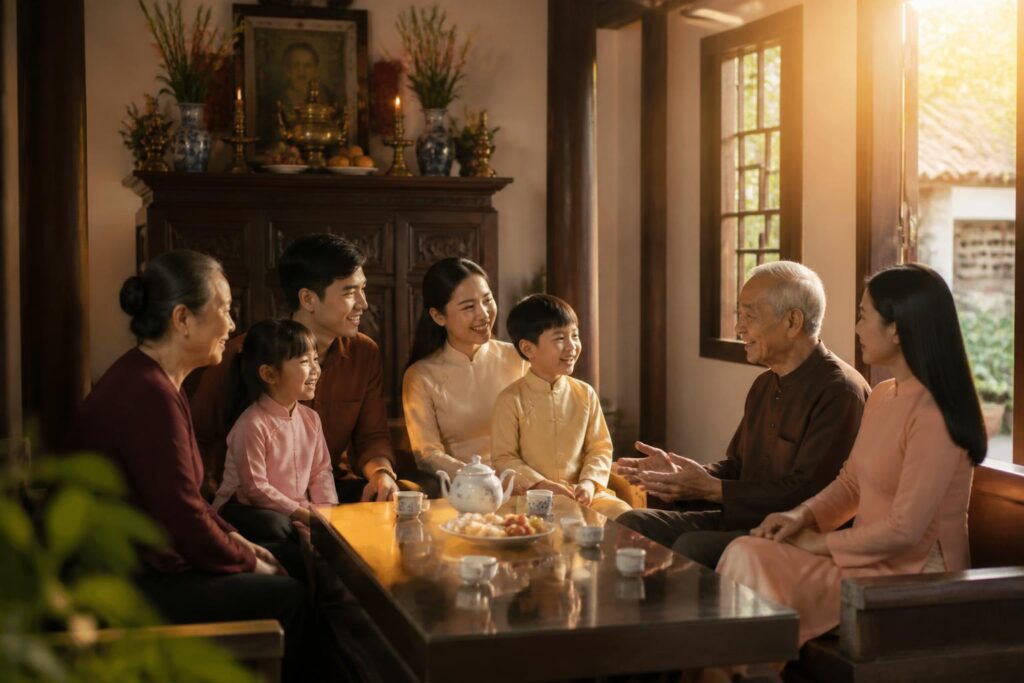
In a tử vi chart, there are palaces that are often mentioned when people want to learn about work, money, or relationships. However, a person’s life is not shaped only by what can be seen on the outside. A sense of peace, mental resilience, the influence of family patterns, and the way a person faces upheaval also play equally important roles. The Phúc Đức Palace is often approached from this perspective.
According to traditional interpretations, the Phúc Đức Palace evokes associations with spiritual foundations, family blessings, inner life, and values passed down through many generations. It is not a fixed “sentence” determining happiness or unhappiness. Rather, this palace can be viewed as a symbol that encourages readers to reflect on what supports them, what makes them uneasy, and which habits need to be adjusted so that life can become more balanced.
How is the Phúc Đức Palace commonly understood?
In the language of tử vi, the word “phúc” does not mean only unexpected good fortune. Phúc can also be understood as the foundation that enables a person to get through difficulties without easily collapsing, the ability to receive love, a way of life that considers others, and good values cultivated over time. The word “đức,” meanwhile, is associated with one’s way of living, choices, and attitude toward benefits, power, hurt, or temptation.
Therefore, when learning about the Phúc Đức Palace, one should not ask only whether one has “much blessing” or “little blessing.” A more useful question is: Where does my spiritual foundation come from, what beliefs has my family passed down, what am I continuing, and what can I change? Framing the issue this way allows tử vi to become a means of self-observation rather than merely a predictive tool.
The Phúc Đức Palace is also often associated with the atmosphere of one’s family and lineage. A person who grows up in an environment that values trust, responsibility, and compassion may develop a different sense of security from someone who frequently witnesses conflict, silence, or instability. However, family influence is not the sole factor determining personality. Education, personal experience, friends, social circumstances, and the choices made in adulthood can all change how a person receives and engages with their spiritual heritage.
Reading the Phúc Đức Palace through inner life
One of the more thought-provoking meanings of the Phúc Đức Palace is its connection with the ability to find inner stability. Some people possess many favorable conditions but always feel deprived, fearful, or compelled to prove their worth. Conversely, some people go through many difficult periods yet retain faith, calmness, and the ability to begin again. Traditional tử vi may use different symbols to describe this state, but in real life, it is also the result of psychological practice and the development of a system of values.
Inner life is not an unchanging quality. The ability to remain calm can be nurtured by recognizing emotions, maintaining regular sleep and rest, sustaining healthy relationships, and learning to limit sources of stress. A person who constantly compares themselves with others can focus more on their own progress. Someone who is always worried about the future can divide a large problem into small tasks that can be carried out during the day. Such changes may not create an immediate feeling of “changing one’s fate,” but they contribute to building a lasting spiritual foundation.
From this perspective, the Phúc Đức Palace may raise an important question: What makes us feel that we belong? It could be family, a community, meaningful work, a spiritual life, or principles that we willingly choose to follow. When the answer becomes clearer, people are often better able to make choices that suit them and less likely to be swept along by judgments from outside.
The influence of family patterns and what is passed down
Every family has stories, unspoken rules, and ways of behaving that are repeated over many years. Some families value education, some emphasize stability, and some always encourage their children to be independent. There are also families that rarely talk about emotions, are accustomed to enduring things alone, or view sacrifice as the only way to express love. These things form an invisible “heritage” that influences how each person loves, works, raises children, and resolves conflicts.
Viewing the Phúc Đức Palace from this perspective helps readers realize that families pass down more than property or surnames. Families also pass down views about money, success, responsibility, and happiness. Some beliefs may once have helped earlier generations overcome difficult circumstances but may no longer fit present-day life. For example, the belief that one must always endure and yield may once have helped preserve harmony, but if applied absolutely, it can leave a person unable to protect their personal boundaries.
Recognizing the influence of family patterns does not mean blaming those who came before. The purpose is to distinguish which values should be preserved and which responses have become automatic. A person can cherish filial respect while still learning to say “no” when demands exceed their capacity. They can maintain close ties with their family without allowing every personal decision to be completely controlled by relatives’ expectations. Maturity often begins with the ability to receive tradition selectively and consciously.
Symbols in a chart should be viewed as a whole
When analyzing a palace in tử vi, isolating a single position and drawing absolute conclusions from it can easily lead to misunderstanding. The Phúc Đức Palace should be considered in relation to the entire chart, the other palaces, and the specific context of the person being examined. Factors such as living environment, age, family circumstances, and practical choices all mean that the same symbol may be interpreted in different ways.
Even within the traditional tử vi system, a sign considered favorable does not mean that a person will always live free of worry. What is called “blessing” may appear through family support, a mindset of contentment, the ability to encounter people who offer help, or the strength to overcome adversity. Conversely, a factor viewed as challenging does not mean that everything will be unfavorable. It may point to a need for healing, rebuilding trust, or proactively creating a better living environment.
For this reason, definitive predictions about life expectancy, disasters, or the future of an entire family lineage should all be approached with caution. No method of interpretation should replace personal responsibility, health care, communication within the family, or decisions based on real-world information. If used in moderation, tử vi is better suited to the role of opening up questions than delivering a final verdict.
Nurturing “blessing” through everyday actions
If the Phúc Đức Palace is seen as a reminder of spiritual foundations, each person can begin with very concrete actions. First is building a family space based on respect. Respect does not mean that everyone always agrees with one another; it means knowing how to listen, avoiding insults, and not using old wounds to win arguments.
Next is keeping promises in small matters. A promise fulfilled at the right time creates a sense of trust, while repeatedly breaking promises can weaken a relationship even without major conflict. For those who have families of their own, sharing caregiving responsibilities, being transparent about important decisions, and setting aside time for conversations free from the distraction of phones are also ways to create a foundation of peace.
Blessing can also be nurtured through mindful gratitude. Gratitude does not mean denying difficulties or forcing oneself to be cheerful while suffering. It is the ability to recognize the people, opportunities, and acts of kindness that have helped us remain standing. When gratitude is accompanied by action, it can become a motivation for a person to live more responsibly toward their family and community.
In addition, one needs to learn how to end harmful cycles. A person cannot change everything that happened in the past, but they can prevent themselves from repeating ways of behaving that once hurt others. If there is distance within a family, taking the initiative to talk step by step may open up an opportunity for reconciliation. If a conflict is too deep, seeking appropriate support from someone trustworthy or a mental health professional may be a more practical choice than trying to endure in silence.
The value of self-reflection
The greatest value in learning about the Phúc Đức Palace does not lie in finding a beautiful or unpleasant conclusion, but in the opportunity to observe the connection between the past, present, and future. We can ask ourselves what fears we are carrying from our family, which good values we benefit from, and what we want to leave for the next generation. These questions help people live more proactively, because blessing is not only something received but also something created.
A life with a strong spiritual foundation does not necessarily have to be free of upheaval. Even people with inner strength can feel sad, disappointed, lost, or in need of help. The difference lies in their ability to recognize problems, seek support, and return to their core values after each period of instability. This is a more practical and humane way of understanding the word phúc.
The Phúc Đức Palace in a tử vi chart can therefore be read as an invitation to return to the basics: how we treat our loved ones, how we care for our inner lives, and how we turn what has been passed down to us into conscious choices. Whether one believes a great deal or very little in tử vi, everyone can still draw a useful lesson from it: peace does not come only from favorable circumstances; it is also cultivated through every word, action, and relationship in daily life.

ARTICLES IN THE SAME CATEGORY
The Career Palace in a Tử Vi Chart: Career Direction and Ways to Make the Most of Your Strengths
The Wealth Palace in a Tử Vi Chart: Understanding Money to Live More Proactively
The Quan Lộc Palace in a Tử Vi Chart: Rethinking the Career Path Through a Proactive Mindset
Phúc Đức Palace in a Tử Vi Chart: The Spiritual Foundation and How to Cultivate Peace
The Wealth Palace in a Tử Vi Chart: Understanding How You Create and Use Money
The Career Palace in a Zi Wei chart: Taking an Active Approach to One’s Career Path
ARTICLES IN THE SAME GENRE
Living Mindfully in an Age of Information Overload
From Knowing a Lot to Understanding Deeply: How to Build Systematic Thinking
Setting Boundaries in Digital Life to Regain Focus
The Art of Slowing Down in a World That Is Always Urging Us On
Listen to Understand, Not to Respond, in Difficult Conversations
Forgiveness Does Not Mean Reopening a Closed Door