

 Tiếng Việt
 日本語
日本語 한국어
한국어 中文 (中国)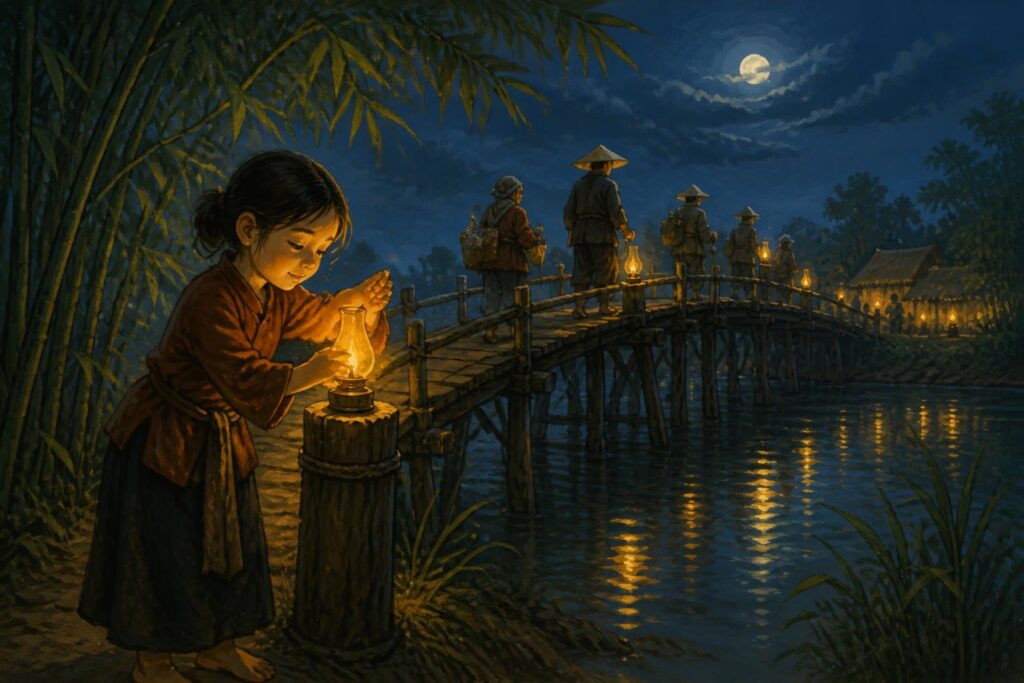
Once upon a time, at the end of a winding river, there was a small village called Bai Lau. The river was not very wide, but every rainy season, its surface spread out like a silver mirror, dividing the village into two banks. On one side were houses nestled beneath bamboo groves; on the other were rice fields and the road leading to the district market. The villagers who wanted to cross the river had to use an old wooden bridge or hire the ferry belonging to Mr. Lam, a ferryman who had been devoted to the landing for more than half his life.
The wooden bridge had been built a very long time ago. Every plank bore the marks of sun and rain; some were warped upward, while others were split by long cracks. During the day, people could still cross, though everyone had to walk very slowly. But when night fell, the bridge became dark and dangerous. If a gust of wind blew out the oil lamp hanging at the entrance, anyone crossing could slip and fall into the cold water below.
In the village lived a little girl named An, who shared a thatched-roof house near the riverside landing with her grandmother. An’s parents had gone away to work when she was still very young, so her grandmother cared for her while also weaving baskets and trays to sell at the market. An had no beautiful toys and no new clothes, but she had bright eyes and a special habit. Every afternoon, after helping her grandmother sweep the yard, she would go to the riverbank and sit listening to the sound of the water.
An said that the river knew how to tell stories. When the water flowed gently, it told stories about seasons of ripened rice. When the water rose high, it told stories about the rains far upstream. But on nights when the moon was a crescent, the river remained silent, as if it were keeping something secret.
The Forgotten Lamp
One night near the end of the rainy season, An and her grandmother were returning after selling all their baskets and trays at the market. There was no moon, and dark clouds covered the sky. The wind blowing up from the river made the bamboo stalks rustle against one another. When the two of them reached the entrance to the bridge, the familiar oil lamp had already gone out.
Grandmother took An’s hand and was about to turn back to find Mr. Lam and ask him to take them across by boat. Just then, an anxious call came from the other side of the bridge. A woman was trying to lead her young child across, but because she could not see the path clearly, she had stopped in the middle of the slippery planks.
An looked at the darkness before her, then at the cold oil lamp. The little girl took off the cloth scarf wrapped around her shoulders, used it to shield her hand from the wind, and bent down to light the lamp. The first match went out immediately. The second only flared briefly before disappearing. With the third match, the tiny flame finally caught the wick.
The weak light spread out, illuminating only a few steps, but the woman on the other side of the bridge saw it. She led her child forward one slow step at a time. When they reached the bank, she bent down to thank An, while the child hugged her mother tightly.
“How can such a small lamp illuminate the whole bridge?” Grandmother asked as she wiped the drops of water from An’s forehead.
An looked at the flame flickering in the wind and replied:
“It doesn’t need to illuminate the whole bridge, Grandma. It only needs to light the next step.”
Grandmother retold those words to a few neighbors. But most of the villagers merely listened and dismissed them. Everyone thought that the bridge was old and the lamp was broken, and that it was the responsibility of the village chief and those in charge. They only needed to be more careful when crossing.
Footsteps in the Night
From that day on, An took it upon herself to care for the lamp. Every afternoon, she asked her grandmother for a little oil, cleaned the glass, and checked the wick. When the wind was strong, she used a piece of old tin to shield the outside so the flame would not go out. On days when there was not enough oil, An collected leftover candle pieces from houses in the neighborhood, melted them, and mixed them with cotton fibers to make a temporary fuel.
At first, the villagers still paid no attention. They crossed the bridge, saw the light, and kept going. Some even thought An’s efforts were pointless. Mr. Tu, the fish seller, said that the little girl was merely playing with fire. The owner of the teahouse said that such matters should be left to adults.
Then, one night, Mr. Lam came down with a severe fever. The ferry could not leave the landing, while on the other side of the river, a family needed to take a sick person to the clinic. The man’s son had no choice but to help his father across the bridge. It was dark, and the river was rising quickly, but thanks to An’s lamp, they noticed a broken plank in the middle of the bridge and found a way around it. Without that light, the two of them might have fallen into the swift-running water.
The next morning, the news spread throughout Bai Lau. Those who had once thought the lamp unimportant began to look at it differently. One person brought a small bottle of oil. Another brought an undamaged pane of glass. Mr. Tu, the fish seller, rebuilt the wind guard around the lamp. The teahouse owner contributed several candles and told An to come and get more whenever she ran out of oil.
An was very happy, but she did not think she had done anything remarkable. She simply saw that the bridge was dark and lit the lamp; saw that others were afraid and waited for them; saw that a plank was loose and warned those behind her. These acts were so small that no one needed to mention the name of the person who performed them. Yet when many small acts were placed side by side, the riverside landing began to change.
The Village’s Bridge
A few weeks later, the village chief organized a meeting beneath the banyan tree. He said that the bridge could not remain in its old condition forever. If they waited until they had a great deal of money to repair it, an accident might happen first. Each family in the village was asked to contribute some effort. Families with bamboo would contribute bamboo, those with wood would contribute wood, the strong would help remove the old planks, and the skilled would weave ropes and build railings.
Some people still complained that they were poor and could not contribute money. The village chief said that not everyone had to contribute money. A day’s labor, a bundle of bamboo, a handful of nails, or a meal for those repairing the bridge was all equally valuable if given willingly.
Although he was still weak, Mr. Lam went down to the landing with a walking stick. He showed everyone where the currents swirled most strongly and how to place stakes so the bridge would not be swept away. An’s grandmother and the village elders cooked meals. The children collected fallen nails, bundled ropes, and carried water to the adults. Even those who had once laughed at An came to lend a hand.
The bridge repairs lasted many days. During that time, the lamp was still lit every evening at the entrance to the landing. An no longer had to do it alone. At dusk, someone always brought oil or sat beside her to tend the flame. On nights when the rain was especially heavy, people took turns standing beneath a makeshift roof to shield the lamp. They gradually realized that what mattered was not only that the bridge was repaired, but that the villagers had remembered how to care together for something that belonged to everyone.
When the new bridge was completed, Bai Lau held a simple meal beside the river. The bridge was still made of wood and still trembled slightly when someone crossed it, but both sides now had sturdy railings. The planks were fitted tightly together, and a small roof had been built at the entrance to protect it from the rain. The old lamp was placed inside a new glass box and shone more brightly than before.
The village chief wanted to name the bridge after someone who had made an important contribution. He suggested calling it An Bridge, but the little girl immediately shook her head.
“If it were only because of me, the bridge could not stand,” An said. “It should bear everyone’s name.”
Everyone looked at one another. After discussing it for a while, they called it the Common Bridge. The name sounded plain, but everyone felt that it suited the bridge perfectly.
Light Belongs to No One Alone
Many years passed, and An grew up. She left Bai Lau to learn a trade in town, then returned and opened a class teaching young children to read beside the river. The bridge from those days was replaced by a sturdier one, but the old lamp was kept in the community house. Whenever someone asked why the villagers did not throw it away, An’s grandmother, now elderly, would smile and retell the story of the moonless night.
She would say that the first light had been only a very small flame. It could not drive away the darkness over the entire river, stop the water from flowing, or repair a bridge by itself. But it helped one person see the next step. From that step, people saw one another. Once they had seen one another, they were no longer so willing to turn away and leave each other unattended.
The story of the lamp by the riverside landing was passed down from one generation to the next. All the children in the village grew up knowing that not every good deed begins with strength or money. Often, it begins when one person bends down to pick up a piece of wood, wipes a pane of glass, tends a flame, or waits for someone else to cross a dangerous place.
And whenever night fell, the lamp by the riverside landing was still lit. It did not promise to make life free of darkness. It simply reminded everyone quietly that on any night, even a small light can open a path for strangers to find one another.

ARTICLES IN THE SAME CATEGORY
The Empty Chair Beside the Veranda
The Stone Path Through the Flood Season
The Map of Things Left Unsaid
The Empty Chair Beside the Veranda
The Lamplighter and the Road Without Darkness
A Small Promise Can Keep a Family’s Warmth Alive
ARTICLES IN THE SAME GENRE
Stepmother and Stepchild