

 Tiếng Việt
 日本語
日本語 한국어
한국어 中文 (中国)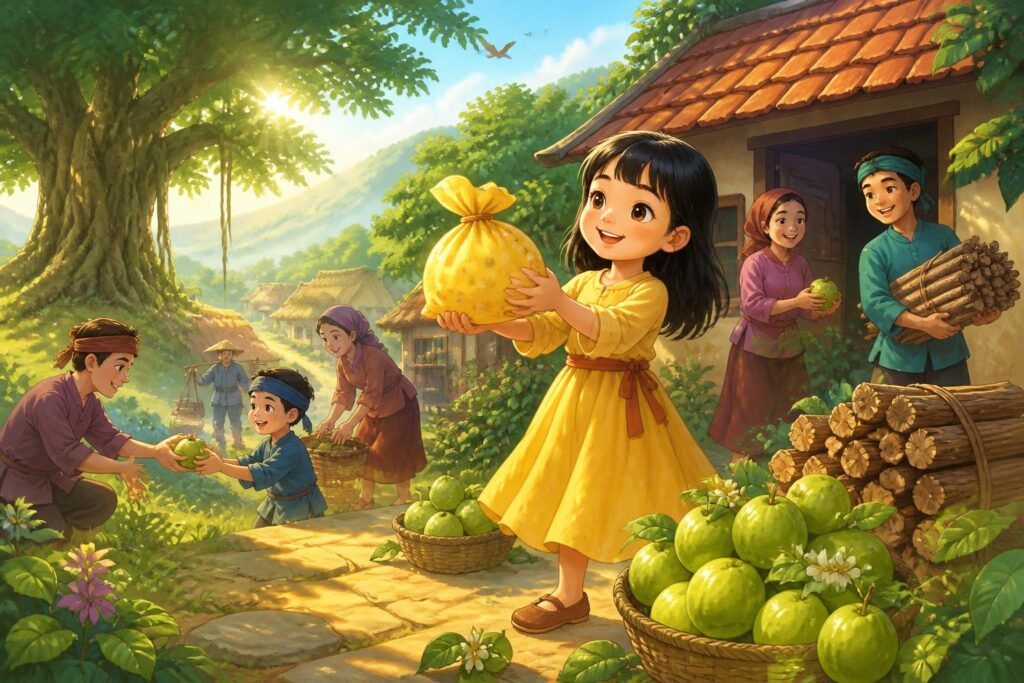
The Little Girl Who Lived Beside the Hillside
Once upon a time, in a small village at the foot of a green hill, there lived a little girl named May. May lived with her grandmother in an old tiled-roof house. In front of the house was a bougainvillea trellis and a water jar that was always cool and refreshing. May’s parents worked far away and came home to visit only a few times a year, so her grandmother was the one who cared for her, told her stories, and taught her everything about life.
May had bright eyes, soft black hair, and a smile that easily made other people happy. She liked collecting pebbles with unusual shapes, listening to birds calling to one another in the treetops, and helping her grandmother dry bundles of medicinal leaves by the porch. However, there was also something that often made May sad. She always thought that she had nothing precious to give to other people.
Whenever her friends showed off a fresh cake, a beautiful kite, or a toy their parents had bought at the district market, May would simply stand quietly beside them. She had no sweets, no colorful paper kite, and certainly no expensive gifts. Her grandmother often told her that asking after someone was also a gift, and that a helping hand could warm another person’s heart, but May still did not truly believe it.
The Bag Beneath the Banyan Tree
One afternoon after a rainstorm, May went up the hill to gather large leaves to repair the roof of the chicken coop. As she passed an old banyan tree, she saw a small yellow cloth bag lying among the wet grass. The bag was just large enough to hold a few plums, and a blue cord ran around its opening. May picked it up, brushed off the dirt, and looked around, but she saw no one searching for it.
She brought the bag home. Her grandmother examined it carefully and said that it might be a strange bag, because small stars had been embroidered on its fabric in a way that no ordinary needle could have made. She told May that if they met the person who had lost it, they must return it, but until its owner was found, May could take very good care of it.
That evening, May placed her favorite white pebble inside the bag. The next morning, when she opened it, she was astonished to find two identical pebbles inside. She tried placing a ripe plum in it. The following day, there were two plums in the bag. May ran to tell her grandmother, but the old woman only smiled kindly.
Her grandmother said that the bag did not create food or objects. It only doubled things that were given with a pure heart. If the person putting something inside was motivated by greed, the bag would become empty. If someone used it to harm others, whatever they received in return would bring no joy either.
The First Joy That Was Shared
May did not yet fully understand her grandmother’s words, but she wanted to try using the bag to help people. The next morning, May picked six of the most fragrant guavas in the garden. She kept two for her grandmother, then placed one in the bag. In an instant, the bag contained another guava. May took the two guavas to the little boy Ti, who was resting at home because he had a cold.
Ti was delighted. He loved guavas, but his mother had been busy caring for the younger children and had not been able to go to the market. Ti accepted the guava, thanked May, and beamed. On the way home, May suddenly felt lighthearted. She realized that she did not need to have a grand gift. As long as she remembered someone who needed care, she could make that person happy.
From that day on, May began using the bag to share simple things. A handful of beans became two portions for two families whose vegetable gardens had just been planted. A small bundle of firewood became two bundles, enough for the old woman at the end of the village to cook during the rainy days. A corn cake was doubled, so that the blacksmith’s two children would not have to fight over the best piece.
The strange thing was that each time May shared something, she saw more than just the recipient’s happiness. She also noticed that the people around her began helping one another more. The person who was given vegetables brought eggs in return to a neighbor. The person who received firewood repaired the old woman’s leaning fence. Joy seemed not to stop with a single gift but to continue traveling from one person to another.
When Greed Came Knocking
There was a cloth merchant in the village named Loc. Mr. Loc heard the children talking about the strange bag, so he went to May’s house. He brought a heavy bag of money and offered to trade it for the bag. May shook her head and said that it belonged to someone who had not yet been found, so she could not sell it.
Mr. Loc did not give up. He told May that she only had to lend him the bag for one day, and in return she would receive plenty of cakes and toys. May remembered her grandmother’s advice and still refused. That night, Mr. Loc secretly entered the yard, took the bag, placed it beside his sack of money, and hurried home.
The next morning, Mr. Loc opened the bag with great anticipation. He put one coin inside, but when he took it out, there was only a piece of dry leaf inside. He put in another coin, but the bag remained empty. The more money he tried to put in, the more worthless things he received in return, such as wet sand, pieces of bark, and blades of grass.
Angry, Mr. Loc returned the bag to May. On the way, he saw a little girl crying beside the well because she had dropped her mother’s scarf. He had intended to walk past, but then he remembered the empty bag in his hand. For the first time in many years, he stopped to ask what was wrong. He helped the girl find the scarf caught on a low branch and then escorted her home.
When he returned, Mr. Loc told May what had happened. May did not blame him. She only said that perhaps the bag did not hate money; it simply could not fill a heart that did not yet know what to give. Mr. Loc was silent for a very long time. From that day on, he began measuring cloth more generously for his customers, allowing struggling families to pay later, and no longer trying to keep all the profit for himself.
The Secret of the Former Owner
Several months passed, and May continued waiting for the person who had lost the bag to come and claim it. One early morning, while she was sweeping leaves from the front yard, an old woman leaning on a walking stick passed by. When she saw the bag hanging beside the window, she stopped, and her eyes suddenly lit up.
The old woman said that many years earlier, she had owned a bag exactly like it. She had used it to share seeds, food, and cloth with the villagers during a season of crop failure. But later, a mischievous child had taken the bag up the hill and dropped it. She had searched for it for a long time without finding it and had thought that the bag had disappeared.
May handed the bag to the old woman. The old woman took it, but did not leave at once. She asked May how she had used it. When she heard the little girl’s stories about Ti, the old woman, the families in the village, and even Mr. Loc, she smiled and said that the bag had found someone worthy to care for it.
The old woman told May to continue keeping the bag. Not because May was luckier than other people, but because she had understood the most important thing: the value of a precious object does not lie in its ability to create more, but in how people use it to make life better. If it were kept only for oneself, the bag would have no meaning.
What May Carried with Her All Her Life
From then on, May and her grandmother used the bag carefully. They did not let it become a reason for people to grow lazy or simply wait to be helped. Whenever someone in the village was in difficulty, everyone worked together. The bag only supplied the small part that was missing; the work, patience, and love still had to be offered by each person.
Many years later, May became a young woman whom everyone trusted and loved. She still made a habit of asking after her neighbors, sharing portions of cake with children, and listening to anyone who was sad. The yellow bag gradually grew old, and the stars on its fabric faded more than before, but it never became useless. For in that village, more and more people came to understand that joy was not something to be hidden away in a box.
Joy is like sunlight on a hillside. When one person opens their heart to receive it and then passes it on to someone else, the light does not diminish; it spreads farther. And sometimes, the most beautiful gift is not what is doubled inside a magical bag, but the kindness that makes many hearts smile together.

ARTICLES IN THE SAME CATEGORY
The Little Bean Searching for Sunshine for the Garden
The Wind Chime and Brown Squirrel’s Promise
The Little Umbrella That Welcomed the Rain
The Leaf That Knew the Way Home
The Seed That Knows How to Wait
The Boy Who Gathered Laughter for a Wind Chime
ARTICLES IN THE SAME GENRE
Stepmother and Stepchild