
Children's Stories · 18 November, 2026
A Small Lamp Beside the Stream
A Small Lamp Beside the Stream
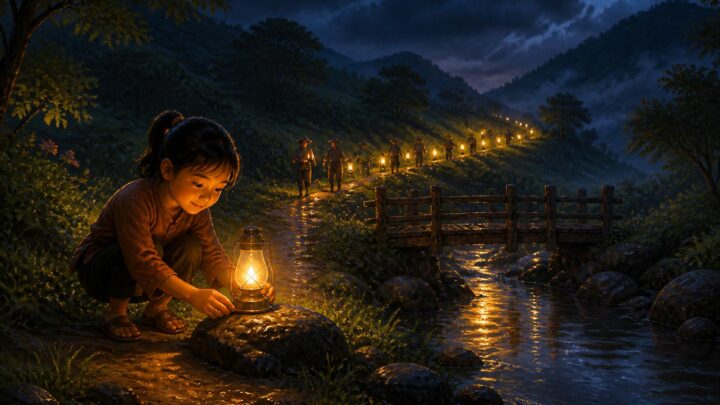
At the edge of a village nestled among green hills, a crystal-clear stream flowed over rounded stones. During the day, the stream sparkled in the sunlight and was a place where the children often gathered to play. They floated leaf boats, searched for pebbles with strange shapes, and then sat listening to the sound of the rippling water as it told stories.
But when night fell, the path leading to the stream became deserted. Tall bushes grew on both sides of the path, occasionally swaying in the wind. The adults in the village often warned the children not to go there alone at night—not because there were monsters below, but because the dark path had many slippery spots and it was easy to get lost.
In a small house near the foot of the hill lived a little girl named Na. Na loved light. Every evening, she would sit by the window and look at the oil lamp on the table, watching its gentle yellow light spill across the pages of her book. Na once asked her grandmother:
“Grandma, how can such a small lamp make the whole room bright?”
Her grandmother smiled, rearranging some towels as she said:
“Because it does not wait for the room to be bright before it shines. It simply does its part, even if its light is only enough to illuminate a small area.”
Na remembered those words for a long time, although she did not yet fully understand their meaning.
A Cloudy Evening
One day, after a heavy rain, clouds gathered and covered the entire sky. The moon did not appear, and the stars also disappeared behind the thick layer of clouds. The wind blew across the roof, making a whistling sound. Just then, the village chief discovered that the small wooden bridge over the stream had lost one of its planks, which had been swept away by the water.
The bridge was no longer safe to cross, but several families on the other side of the stream needed medicine. Na’s mother knew how to care for the health of everyone in the village. The village chief brought the medicine to Na’s house and, together with several adults, tried to find a way to take it to the other bank by a detour along the hillside.
The detour was farther and very dark. The adults carried lamps as they walked ahead, but the strong wind suddenly blew out one of them. Another flickered, and then its light gradually grew weaker. Everyone had to turn back to get more oil.
Na stood by the door and looked outside. She saw that the path leading toward the stream was pitch-black. At that moment, Na suddenly thought of her grandmother’s words: The lamp does not wait for the room to be bright before it shines.
She ran to her grandmother and asked:
“Grandma, if we put a lamp at the beginning of the path, will everyone be able to see the way?”
Her grandmother looked at Na, then at the small oil lamp on the table. It was the lamp she used every evening to read. She did not answer right away, but asked:
“Do you know the way to the stream?”
“Yes, I do. I won’t go alone. I’ll ask Tung to come with me.”
Tung was Na’s neighbor, a few years older than her. He was helping the adults repair the fence after the rain. When he heard Na explain her idea, Tung thought for a moment and then ran to call the village chief. After listening, the village chief nodded and agreed to let the two children carry the lamp and place it on a dry section of the path, a safe distance from the stream.
Light on the Dark Path
Na held the lamp very carefully. Tung carried a long pole to test the puddles ahead. The two children walked with the village chief and another adult. They did not walk quickly, nor did they separate from one another. Whenever the wind blew strongly, Tung used his hand to shield the flame so it would not go out.
At a bend in the path, the village chief found a flat rock beside the road. He placed the lamp on it, then used a few other stones to brace the base of the lamp. The small yellow light spread out, clearly illuminating the twisted tree roots and the muddy puddles lying in the middle of the path.
“It still isn’t very bright,” Na said softly.
“But it is brighter than it was before,” the village chief replied. “What matters is that people know where to place their feet.”
They continued on. A little while later, several more lights appeared from the direction of the village. Other people brought lamps and placed them at intervals. No single lamp was strong enough to light the entire path, but together they formed a chain of light stretching from the villagers’ homes to the detour along the hillside.
Thanks to this, the medicine was safely taken to the other bank. The families waiting for it also sent adults out to meet them. When everything was finished, everyone gradually returned to the village. Na’s grandmother’s small lamp was still burning beside the rock, although its flame was lower than before.
Na sat beside her grandmother and looked at the light. She suddenly understood that the lamp did not make the darkness disappear completely. It only illuminated one stretch of the path, just enough to keep travelers from stepping in the wrong place. But if everyone contributed a little light, a long path would become much easier to travel.
The Lesson of the Lamp
The next morning, the villagers worked together to repair the bridge. One person brought wood, another found rope for tying, and someone else cooked rice for those who were working. Na and Tung were not allowed to use heavy tools, so they were given the tasks of picking up small nails and passing rope to the adults.
By afternoon, the bridge had been temporarily repaired so that people could cross one at a time. The village chief placed the oil lamp on a wooden shelf at the end of the bridge. He said that from then on, whenever there was heavy rain or thick fog, the villagers would light the lamp there to remind everyone to walk slowly and carefully.
Na asked:
“Is this lamp the most important lamp in the village?”
The village chief shook his head:
“No lamp is more important than all the others. The light we had last night was possible because many people worked together. The person who carried a lamp, the person who shielded it from the wind, the people who repaired the bridge and delivered the medicine, and even those who patiently waited—all of them made the path safer.”
Na smiled when she heard this. She thought about the very small things she could do each day: giving a friend a seat, helping pick up something that had fallen, saying sorry when she had hurt someone, or staying beside a person who was worried. These things might not change the whole world immediately, but they were like small lamps, helping to make someone else’s stretch of the path a little less dark.
From that day on, Na continued to read by the window every evening. Her grandmother had cleaned the lamp on the table, and the wick had been trimmed neatly so that the flame would burn evenly. From time to time, Na looked toward the stream. At the end of the bridge, the small lamp continued to shine quietly.
Na no longer thought that a lamp had to be very large to be useful. She knew that as long as it was lit at the right time, in a place that needed light, even something small could become something precious.
A Message for Little Ones
In life, there are times when we face a big problem and feel that we are too small to help. At those times, you do not need to do something extraordinary. Start with something within your ability, and do it carefully and kindly. A small action may not solve everything, but it can help someone feel less sad, make a path less dangerous, or make a day a little easier.
Just like the lamp beside the stream, what matters is not how great your light is, but whether you are willing to light it.
Related articles

The Little Bean and the Garden That Knew How to Wait
At the edge of a small village, there was a garden beside a crystal-clear stream. The garden was not very large, but all year round it was filled with gentle colors: lush green vegetable beds, clusters of yellow flowers swaying in the breeze, and plump red tomatoes nestled beneath the leaves. The garden’s caretaker was
Read more
The Boy Who Kept His Promises and His Umbrella
At the end of a small street stood a house with a blue-tiled roof, where a boy named Tí lived with his mother and grandmother. Tí was an energetic boy who loved running around and was always curious about everything happening around him. He could sit for hours watching ants carry food, listening to the
Read more
Little Ti and the Wind Chime That Kept Promises
The Chime by the Front Porch At the end of a small road stood a house with a blue-tiled roof, where a little boy named Ti lived with his grandmother. The house was not large, but a mature star fruit tree in front of the porch cast shade all year round. Whenever the wind blew
Read more
Little May and the Garden That Knew How to Listen
At the end of a winding road stood a house with a green-tiled roof, where a little girl named May lived with her grandmother. The house was not large, but it was always warm and welcoming. In front was a flower-filled garden, behind it was a gourd trellis that provided shade, and along the side
Read more
The Singing Garden and Na’s Seed
The Seed Beneath the Dry Leaf Once upon a time, in a small village nestled on the side of a green hill, there lived a little girl named Na. Na lived with her mother in a house with a brown wooden fence and a large garden behind it. The garden did not have the tallest
Read more
The Little Lamp That Guided the Way Through the Rainy Night
The Little Lamp That Guided the Way Through the Rainy Night At the end of a winding dirt road stood a house with a green-tiled roof, where little An lived with his mother and grandmother. Behind the house was a small garden filled with all kinds of plants: four-o’clock flowers, a gourd trellis, an old
Read more