
Children's Stories · 21 November, 2026
The Boy Who Counted Stars with a Bamboo Basket
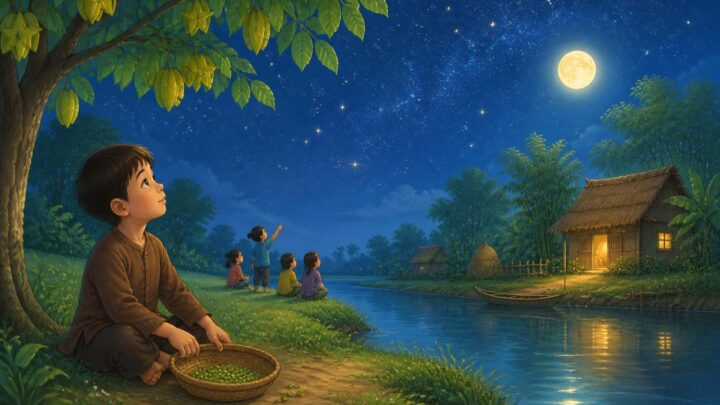
Once upon a time, in a small village nestled between rice fields and a river that ran crystal-clear all year round, there lived a boy named Tí. Tí lived with his mother in a thatched-roof house. They were poor, but there was always a bed of green vegetables in front of the house, a sweet star fruit tree behind it, and the soft sound of Tí’s mother humming by the porch.
Tí was a lively, curious boy who loved to ask questions. He asked why crabs walked sideways, why the moon was sometimes full and sometimes crescent-shaped, and why dewdrops rested on leaves in the morning but disappeared by noon. His mother would often smile and say:
“There are many things in life that take time to understand. Don’t be in too much of a hurry.”
But Tí thought differently. He believed that anything could be done quickly if he tried hard enough. Weeding had to be faster than the wind, carrying water had to be faster than Sister Mây at the head of the village, and herding buffalo had to be finished before the evening bell rang.
One night, after clearing away the dinner tray, Tí went out into the yard and looked up at the sky. The night was clear, and thousands of stars glittered against the deep blue. Tí gazed at them for a long time, and then a strange idea occurred to him.
“If I can count all the stars, I’ll become the smartest person in the village.”
He ran into the kitchen and took an old bamboo basket, the kind his mother used to wash rice. Tí placed the basket in the yard, tilted his head back to look at the sky, and began counting.
“One, two, three, four, five…”
But when he had counted to seventeen, a cloud drifted across the sky and hid several stars. Tí waited for the cloud to pass, but when the sky grew clear again, he no longer knew where he had left off. Frustrated, he started counting over from the beginning.
This time, a mosquito buzzed by his ear. Tí swatted at it and forgot the number. The third time, the wind blew the basket all the way to the gate. The fourth time, a barking dog startled him. Near midnight, Tí was so tired that he sat with his back against the star fruit tree and fell asleep.
The next morning, he told his mother what had happened. She did not laugh. She simply handed Tí the bamboo basket and said:
“Perhaps you’re trying to use the basket to hold things that cannot be held.”
“But I’ll think of a way,” Tí replied. “I have to count the stars.”
That day, Tí met a strange old woman by the riverbank. She was sitting and weaving a basket from thin strands of rattan. Her hair was white as reeds, and her eyes were bright and kind.
“Where are you going with that basket?” she asked.
“I want to count the stars. Do you have any way to help me?”
The old woman looked at the basket, then up at the sky, even though it was still daytime.
“If you want to count the stars, first you must learn how to look at one star for a very long time.”
Tí did not understand. He had expected her to show him some kind of magic, perhaps to recite a spell or sprinkle silver dust over the basket. Instead, she merely told him:
“Tonight, choose one star. Don’t count any of the others. Sit still and watch it until you hear something you have never heard before.”
“Do stars talk?” Tí asked.
“Perhaps they do. But only those who know how to listen can recognize it.”
That night, Tí did exactly as the old woman had told him. He placed the bamboo basket beside him, sat beneath the star fruit tree, and chose the brightest star. At first, he found it very difficult to sit still. His feet wanted to run, his eyes wanted to look at another star, and his mind kept returning to the business of counting stars.
Tí tried not to move. After a while, he heard the star fruit leaves rustling against one another. Then he heard insects chirping in the grass, the gentle splash of oars on the river, and his mother’s soft cough in the kitchen.
He had never noticed before that the night held so many sounds.
Near dawn, the star Tí had chosen gradually faded behind the first streak of sunlight. He still had not heard the star say anything, but suddenly he felt an extraordinary peace inside.
The next morning, Tí went back to the riverbank to look for the old woman. She was still sitting in the same place, weaving her basket.
“What did you hear?” she asked.
“I heard so many things. But I didn’t hear the star.”
The old woman smiled:
“Perhaps the star does not speak with words. Perhaps it simply taught you how to sit still.”
Tí still did not completely understand, but he began to follow her advice. Every night, he no longer tried to count. He chose one star, watched it for a long time, and remembered its position. The following night, he searched for that same star. Once he had memorized several stars, Tí used dried beans in the basket as markers. Each bean represented a star he had recognized.
But the task was not easy at all. Some nights, clouds gathered. On some nights, rain pattered on the roof. Sometimes the moon was so bright that the smaller stars could not be seen. Tí grew discouraged many times. He wanted to throw the basket to the ground and go inside to sleep.
Whenever that happened, his mother would place a bowl of warm water beside him and say:
“The sky is not the same every day. People are the same way. Some days we can see clearly; some days we need to rest. Slowing down does not mean you are losing.”
Tí listened to his mother and stopped forcing himself to finish everything in a single night. He learned to wait for the clouds to clear, to distinguish bright stars by their colors and positions, and to remember a little at a time. He also realized that the bamboo basket could not hold the stars, but it could hold beans representing the things he had learned.
One late-season afternoon, the villagers prepared for the Moon Festival by the river. The children were assigned to make paper lanterns, while the adults repaired the bamboo bridge and cooked pots of sweet, fragrant pudding. Tí brought his basket of beans to show his friends.
“I’ve memorized more than a hundred stars,” he said.
The other children stared in amazement. A boy named Sửu asked:
“Can you show me the brightest star?”
Tí looked up. The sky was still pale blue, and a few clouds drifted lazily by. He could not point it out right away. In the past, Tí might have become annoyed and said that they would have to wait. But this time, he sat down by the grassy bank.
“Let’s wait until night. I’ll show you each star.”
When darkness fell, Tí did not show his friends only the brightest star. He also pointed out the constellation near the bamboo grove, the star that often appeared above the communal house, and a tiny star that could be seen only after their eyes had grown accustomed to the darkness. His friends listened attentively. Some saw the stars right away, while others had to wait longer. Tí patiently pointed them out again without becoming irritated.
Just then, the old woman from the riverbank appeared. No one knew when she had arrived. She placed a small golden seed in Tí’s basket.
“Have you understood the important lesson?” she asked.
Tí thought for a moment, then replied:
“To see many things, you must first know how to stop. And what you learn becomes more meaningful when you share it with others.”
The old woman nodded. Suddenly, a gentle breeze blew past. When Tí blinked, she had disappeared. On the riverbank, only rippling circles and the sound of grass swaying in the night remained.
Tí took the seed home and planted it beside the porch. His mother helped him water it every morning. After many days, the seed sprouted into a small plant with glossy green leaves. The following season, it bloomed with pale yellow flowers, each one resembling a tiny star bowing down to look at the earth.
From then on, Tí no longer wanted to become the smartest person in the village. He simply wanted to become someone who could patiently learn and help others see the beauty around them. The old bamboo basket was still kept by the porch. There were no stars in it, only beans, a few dried leaves, and scraps of paper on which Tí wrote down the things he had discovered.
Later, whenever the children in the village asked why there were so many stars in the sky, Tí would lead them to the riverbank. He did not rush to answer. He told them to sit down, look up at the sky, and listen to the darkness.
For Tí knew that some lessons cannot be conveyed in a single sentence. They must be looked at for a long time, listened to carefully, and felt for oneself. Like a small star in the vast sky, something precious sometimes reveals itself only to those patient enough to wait.
Related articles
The Wind Chime and the Promise Under the Eaves
At the end of the road stood a house with a blue-tiled roof. A bamboo wind chime hung under the eaves. The chime was old; several bamboo tubes had turned honey-colored, and the string tied above them had become frayed from the sun and rain. Whenever the wind blew through, the chime rang out with
Read more
The Little Sprout and the Garden That Knew How to Listen
At the far end of a large garden, there was a small patch of soil beside a wooden fence. Every morning, the sunlight visited it before scattering golden streaks across the path. In the afternoon, the wind from the fields carried the scent of young grass and the sound of birds calling to one another
Read more
The Bridge Made of Kind Words
At the edge of Moc Mien Village, there was a small stream that ran crystal clear all year round. Its water flowed over smooth, round stones, slipped beneath the ferns, and emptied into the wide rice fields. In summer, the children often invited one another to the streambank to float leaves like boats. In autumn,
Read more
The Little Bean Who Wanted to Hear the Rain
At the far end of a small garden, beneath the canopy of an old star-fruit tree, there was a bed of green beans that always rustled whenever the wind blew through. The bean plants grew up together, winding their soft tendrils around the bamboo fence and lifting their heads to greet the sunshine. Among them
Read more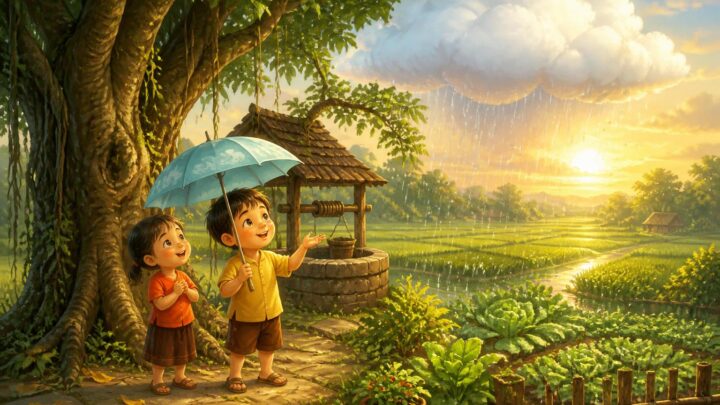
The Cloud’s Umbrella and the Boy Who Kept His Promise
At the end of a winding road, where houses nestled beside the rice fields, there was a small village called Gio Noi. The village was famous for its cool afternoons. The wind from the river blew through the bamboo groves, carrying the scent of fresh straw and pomelo blossoms. Yet that year, summer arrived earlier
Read more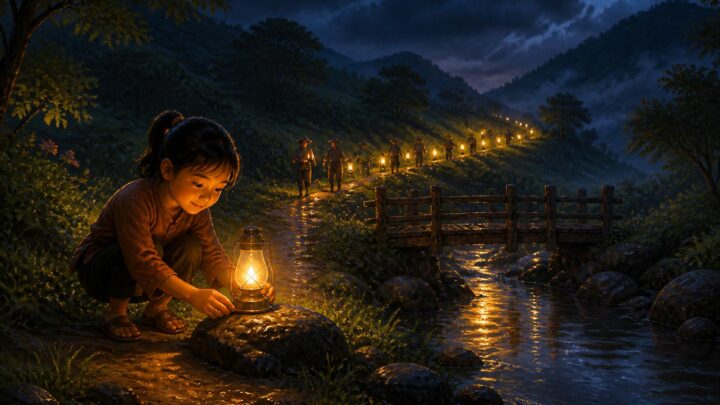
A Small Lamp Beside the Stream
A Small Lamp Beside the Stream At the edge of a village nestled among green hills, a crystal-clear stream flowed over rounded stones. During the day, the stream sparkled in the sunlight and was a place where the children often gathered to play. They floated leaf boats, searched for pebbles with strange shapes, and then
Read more