
Children's Stories · 23 November, 2026
The Little Girl Who Caught Moonlight in a Clay Bowl
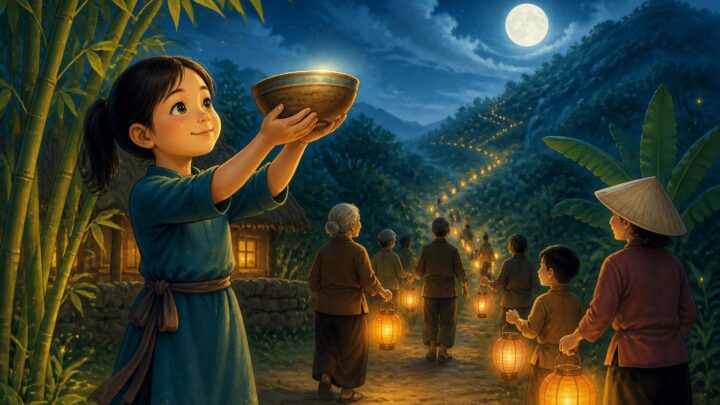
Once upon a time, on the edge of a green forest, there was a small village nestled beside a crystal-clear stream. The villagers made their living growing vegetables, weaving cloth, and crafting baked-clay bowls. Every morning, cooking smoke rose from the low-roofed houses, mingling with the scent of freshly cooked rice and wet grass. In the evenings, the children often sat on the porches listening to their grandparents tell stories, while the adults mended nets, wove baskets, or watched the moon rise behind the bamboo grove.
In the last house in the village lived a little girl named An with her grandmother. An had bright eyes and black hair that was always neatly tied with a blue cloth ribbon. She loved collecting small, lovely things along the stream, such as round pebbles, heart-shaped leaves, or soft bird feathers. Her grandmother often said that An had hands capable of finding beauty in things other people might easily overlook.
One day, after a heavy rain, the stream rose and swept away many objects from the village. The next morning, when the water had receded, An went to the streambank to gather dry firewood. Beneath a clump of grass, she saw an old clay bowl. The bowl had no patterns, a small piece was chipped from its rim, and its body was covered in mud. Yet when An washed it clean, she noticed a silvery streak shimmering on the bottom of the bowl like moonlight.
An brought the bowl home. Her grandmother held it up and examined it for a long time before smiling.
“Perhaps this was the bowl of some potter,” she said. “If you like it, keep it. Old things sometimes have stories of their own.”
An wiped the bowl until it was spotless and placed it on the windowsill. That night, just as the moon rose above the bamboo, a thin beam of light fell into the courtyard. Strangely, the beam slipped across the windowsill and settled perfectly inside the clay bowl. The bowl suddenly began to glow softly—not brightly enough to hurt the eyes, but brightly enough to illuminate An’s fingers.
An called her grandmother in surprise. The two of them looked at the bowl together. There was no water and no precious stone inside, only a silver halo, as though a small piece of the moon were resting there.
The following night, An tried placing the bowl outside on the porch. When the moonlight shone down, the bowl caught part of it again. An carried it inside and used its light to mend her grandmother’s torn shirt. The next night, she placed the bowl beside her bed so she could finish reading a story. The light in the bowl was gentle enough not to wake her grandmother.
From then on, An treasured the bowl dearly. She wiped it every day, kept it in a dry place, and did not let anyone touch it. When the village children asked about it, An only said that it was an old bowl. She was afraid that if she revealed its secret, someone would take it away.
Light Kept Safe
At the beginning of winter, a cold wind swept in. Gray clouds covered the sky for many days, plunging the entire village into early twilight. The children could not go outside to play in the meadow. The elderly had to sit close beside the fire. At the weaver’s house in the middle of the village, a baby fell ill, but the small room lacked light, making it very difficult for the baby’s mother to care for him.
That evening, An heard the baby’s mother sighing outside the gate. The woman had come to ask her grandmother for some medicinal leaves. Her grandmother gave her the medicine and asked about the baby. It turned out that the baby had had a fever for several days, while his mother had to strain to catch bits of firelight just to see her child’s face. An stood behind the door and heard the whole story. Suddenly, she remembered the bowl on the windowsill.
An picked up the bowl, then set it down again. She thought about taking the light to the weaver’s house, but worry filled her heart. What if the bowl did not come back? What if someone dropped it? What if the moonlight inside the bowl disappeared?
Her grandmother saw how troubled she was and gently asked:
“What are you holding in your hands?”
An lowered her head and told her grandmother about the bowl that caught moonlight. Her grandmother was not surprised; she only stroked An’s hair.
“A precious gift can make people happy when they look at it,” she said. “But that gift becomes even more meaningful when it helps someone get through a difficult night. You do not have to give the bowl to someone else to keep. You can bring the light to them and then bring it home again.”
An hugged the bowl and ran to the weaver’s house. The small room was dim, with only an oil lamp that was nearly out. When An placed the bowl beside the bed, silver light spread across the blanket. The mother could clearly see her child’s face, change his warm cloth, and give him his medicine. The crying baby gradually fell asleep.
That night, An sat by the window and waited until the mother said that the baby’s fever had gone down. Then she carefully carried the bowl home. For the first time, An felt that sharing the light made her happier than using it to read alone at night.
The next day, An told her friends about it. Some did not believe her, while others wanted to see it immediately. An was not angry. She simply waited until night, when the moon appeared behind the clouds, and placed the bowl in the middle of the courtyard. The gentle light appeared before everyone’s eyes.
From that day on, the villagers called it the Moon-Catching Bowl. Every family could borrow it when needed. People used its light to look for a missing calf, mend a blanket for an elderly person, take a child with a stomachache to the midwife’s house, or light the way for someone returning late. An was always the one who carried the bowl out and brought it back. She still handled it with care, but she no longer kept it only for herself.
The Night Without a Moon
A year later, the village endured a fierce rainy season. The sky remained pitch-black for many nights, and not a single star appeared. The stream churned with muddy water, the wind bent the banana trees, and the thatched roofs of many houses lost part of their roofing. Even when the clay bowl was placed outside on the porch, it could not catch any moonlight.
Just then, a boy named Ti got lost in the forest behind the village. Ti had gone with his father to look for their goats, but he became distracted chasing a kid and fell behind. The village adults carried torches and split up to search for him, but the rain kept putting out the flames. The paths in the forest were slippery and so dark that no one could clearly see the footprints.
An hugged the bowl and ran to the village chief’s house. She looked into the empty bowl and said sadly:
“There is no moonlight in the bowl. Perhaps it cannot help us this time.”
Her grandmother, walking beside her, suddenly pointed at the people standing around the courtyard. One person carried an oil lamp, another held a bundle of torches, someone else shielded himself with a raincoat, and another prepared a length of rope. Her grandmother said:
“Some nights, light does not come from the sky.”
An looked closely. A farmer handed his lamp to the person walking in front. An older girl took off her red scarf and tied it to a tree branch to mark the path. The children who stayed home struck a bronze pot together and called Ti’s name so he could hear them. The light from the lamps was small, but when they stood beside one another, they formed a long path.
An suddenly had an idea. She placed the clay bowl in the middle of the courtyard and asked everyone to bring their lamps close to it one by one. The light from the lamps reflected off the old glaze, making the silver streak at the bottom of the bowl glow. An carried the bowl at the front of the search party. It did not give off moonlight, but it reflected the flames around it, helping those behind her recognize one another through the rain.
The group went deep into the forest. They called Ti’s name, listened for sounds, and marked each tree trunk. After a long while, a faint cry came from the direction of a rocky ravine. They found Ti huddled beneath a fallen tree. His knee was scraped, but he was still alert. His father pulled him into his arms, and the entire group cheered with relief.
When they returned to the village, it was still raining. Ti looked at the bowl in An’s hands and asked:
“The bowl did not catch any moonlight tonight, so why is it still shining?”
An thought for a moment, then replied:
“Perhaps it is because everyone lit it together.”
The Bowl and An’s Lesson
A few days later, the stream receded. The villagers repaired their roofs, rebuilt their fences, and cleared away the broken branches. When the old potter heard about the bowl, he came to An’s house. He looked at it for a long time and said that he had made it when he was young. Because of a small crack, he had thought the bowl had been swept away in a flood many years earlier.
He offered to exchange it for a newer, more beautiful bowl decorated with swallows and a green rim. An liked the new bowl, but she did not want to give up the old one. She asked whether he could repair the chipped rim.
The potter smiled. He filled the chipped place with fresh clay, fired the bowl again, and painted a small circle around the repaired spot. When he finished, the bowl was no longer as flawless as it had once been, but the chip had become a distinctive mark. The potter said:
“Some things gather more precious marks the more they are used to help others.”
From then on, the bowl was kept in the village’s communal house. Anyone who needed light could borrow it, but they had to promise to return it after using it. Children were taught to lift the bowl with both hands. The adults reminded one another that the light in the bowl could come from the moon, from a lamp, or from everyone’s kindness.
As An grew older, she continued to find beauty in simple things. She was no longer afraid that her gifts would diminish when she shared them. She understood that light was not like a cake, which became smaller the more it was divided. Sometimes, light passed from one person to another made the entire path shine more clearly.
And the clay bowl remained there through many moon seasons. Whenever the moon was full, it caught a gentle silver halo. Whenever the sky was filled with clouds, it reflected the lamps of people standing together. And whenever a child asked why the old bowl was so dearly loved, the villagers would tell the story of the little girl An, of a rainy night, and of the lesson that goodness truly shines only when it is given away.
In the end, An understood that hands capable of taking care are precious, but hands that know when to open can warm even more hearts. The moonlight in the bowl never belonged to just one person. It was a gentle reminder that on the darkest nights, if each person contributed a little light, the whole village would find its way home.
Related articles

The Little Girl Who Kept the Garden Green
At the end of a winding road, where houses nestled beneath rows of trees, there was a garden that had once stayed green and cool all year round. The villagers called it Cloud Garden because every morning, white mist often settled on the leaves, looking like little clouds asleep on the ground. In the garden
Read more
The Wind Chime and the Promise Under the Eaves
At the end of the road stood a house with a blue-tiled roof. A bamboo wind chime hung under the eaves. The chime was old; several bamboo tubes had turned honey-colored, and the string tied above them had become frayed from the sun and rain. Whenever the wind blew through, the chime rang out with
Read more
The Boy Who Counted Stars with a Bamboo Basket
Once upon a time, in a small village nestled between rice fields and a river that ran crystal-clear all year round, there lived a boy named Tí. Tí lived with his mother in a thatched-roof house. They were poor, but there was always a bed of green vegetables in front of the house, a sweet
Read more
The Little Sprout and the Garden That Knew How to Listen
At the far end of a large garden, there was a small patch of soil beside a wooden fence. Every morning, the sunlight visited it before scattering golden streaks across the path. In the afternoon, the wind from the fields carried the scent of young grass and the sound of birds calling to one another
Read more
The Bridge Made of Kind Words
At the edge of Moc Mien Village, there was a small stream that ran crystal clear all year round. Its water flowed over smooth, round stones, slipped beneath the ferns, and emptied into the wide rice fields. In summer, the children often invited one another to the streambank to float leaves like boats. In autumn,
Read more
The Little Bean Who Wanted to Hear the Rain
At the far end of a small garden, beneath the canopy of an old star-fruit tree, there was a bed of green beans that always rustled whenever the wind blew through. The bean plants grew up together, winding their soft tendrils around the bamboo fence and lifting their heads to greet the sunshine. Among them
Read more