
Children's Stories · 23 November, 2026
The Little Girl Who Kept the Garden Green
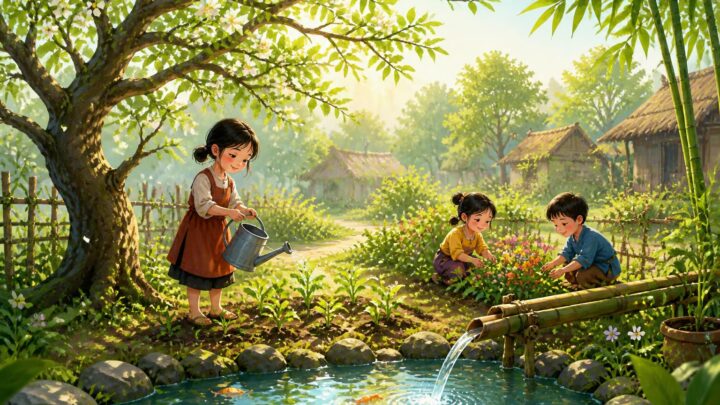
At the end of a winding road, where houses nestled beneath rows of trees, there was a garden that had once stayed green and cool all year round. The villagers called it Cloud Garden because every morning, white mist often settled on the leaves, looking like little clouds asleep on the ground. In the garden stood an old plum tree, a climbing bean trellis, bushes of yellow chrysanthemums, and a round pond large enough for a school of tiny fish to swim in circles.
But then, one summer, the garden began to change. The leaves were no longer as green as before. The soil cracked into fine lines. The water in the pond gradually sank, while the chrysanthemums bloomed only a few flowers before drooping. The adults in the village passed by with regret, but everyone was busy with their own work. Some thought the garden had grown old; others believed there was nothing anyone could do in the face of a hot, dry summer.
An was a little girl who lived in the small house beside the garden gate. She often helped her grandmother sweep the yard, pick vegetables, and carry water. Every afternoon, after finishing her chores, An sat beneath the old plum tree and read books. She remembered the garden as it had been before, when she only had to reach out her hand to touch a wonderfully cool leaf. That was why she did not want to watch the place quietly turn into a barren patch of dry land.
A Message Beneath the Plum Tree
One morning, while gathering withered leaves, An saw a pale blue stone beneath the plum tree. The stone was not large, just the right size to fit in her palm, but on its surface was a thin line of light like a thread. An picked it up, brushed off the dirt, and then heard a very soft voice.
“If you want the garden to become green again, find what people often forget.”
An looked around in surprise. There was no one there except a sparrow tilting its head on a branch. She asked:
“Who just said that?”
The sparrow flapped its wings and flew away. The plum tree remained silent. Only the blue stone lay in An’s hand, the light on its surface blinking once before going out.
An told her grandmother what had happened. After listening, her grandmother neither laughed nor appeared surprised. She simply poured An a bowl of warm water and said:
“Some things only appear when people are willing to observe for a long time. Try listening to the garden before you try to fix it.”
That day, An did not hurry to pick up a hoe or run off to ask for seeds. She sat quietly beneath the plum tree. At first, she heard only the wind blowing through the dry branches. Then she heard the soil cracking in the heat, insects crawling beneath the layer of leaves, and water dripping very steadily somewhere near the pond bank.
An followed the sound. Behind a dense clump of grass, she discovered an old bamboo pipe carrying water from a small stream on the hill down into the garden. A broken branch had blocked the bamboo pipe, causing the water to trickle out only one drop at a time. Perhaps no one had noticed it for a long while.
Small Deeds Begin with One Pair of Hands
An ran home to get her grandmother’s small knife, but her grandmother stopped her. She told An to call some adults because the branch was too heavy. An went throughout the village, telling everyone about the blocked bamboo pipe. A few people shook their heads, thinking it was not worth losing time over. A carpenter said that repairing the entire pipe would require a great deal of work. A woman who sold cakes told An to wait until it rained; the water would naturally fill up again.
An felt a little sad but did not give up. She returned to the garden and used a small stick to clear the dry leaves around the mouth of the pipe. She scooped water from the pond to water the nearest plants. The sparrow flew along with her, occasionally landing to pick up worms from the vegetable beds. By noon, An’s hands were covered in dirt and the back of her shirt was soaked with sweat, but the water in the bamboo pipe was flowing a little faster.
The next day, An invited two friends, Ti and Na, to help. Ti brought a small bucket, while Na brought an old broom to sweep away the leaves. The three children divided up the work. Ti cleared away the dry branches, Na gathered the leaves into piles, and An loosened the soil around the waterway. They worked slowly but carefully because they did not want to break the bamboo pipe.
While they were working, Na suddenly pointed at the ground:
“Look, everyone, there are so many seeds here!”
Small brown seeds lay mixed in with the soil. Perhaps they had fallen from the old flowers and lain still, waiting for a rainstorm. The three children did not pick them all up. They simply piled soil around the places where the seeds lay and then covered them with a thin layer of leaves to retain moisture.
That afternoon, a farmer passing by saw the children working. He stood watching for a long while, then walked into the garden. Using his strength, he pulled the large branch out of the bamboo pipe. Water immediately flowed in a clear stream, winding through the soil channel before pouring into the pond. The surface of the pond rippled, and the little fish swam faster, as though they had just woken up.
The Garden Finds Its Green Again
From that day on, the garden was no longer neglected. Everyone in the village contributed something. Some people repaired the cracked sections of bamboo pipe. Others used stones to rebuild the pond bank. Some brought compost made from dry leaves to fertilize the soil. The children took turns watering the plant beds early in the morning, before the sun grew harsh. An’s grandmother hung a coconut shell scoop beside the well and told everyone to take only as much water as they needed, without wasting any.
The garden did not change noticeably every day. On some days, strong winds knocked down the bean trellis. On others, a herd of goats wandered in and ate the tender shoots that had just emerged. One sudden rainstorm even washed away an entire bed of newly sown flowers. Each time this happened, An felt discouraged. She asked her grandmother whether everyone should stop.
Her grandmother placed a hand on her shoulder:
“A garden does not turn green again after just one afternoon. What matters is whether, when things go wrong, we still remember why we began.”
An listened to her grandmother and then sowed again with her friends the seeds that had been washed away. This time, the children made small channels so that rainwater would not carry off the soil. They built a low fence around the plant beds and placed a wooden sign at the garden gate. The sign had no words on it; it showed only a hand holding up a sprout. Anyone who passed by understood that the garden needed to be cared for gently.
A few weeks later, the first shoots poked through the soil. They were so tiny that people could walk past without seeing them unless they bent down very close. But each day, the shoots grew a little taller. Then young leaves opened, clear and delicate. The seeds beneath the plum tree also sprouted, growing into a small band of flowers around the trunk.
The pond gradually filled with water. The fish glimmered as they swam beneath the sunlight. The old plum tree was no longer bare, as new leaves covered its canopy in a gentle green. When summer passed, Cloud Garden had not returned to exactly what it had once been, but it had gained a life of its own. Some flower beds were still sparse, and a few sections of fence were still crooked, yet everyone in the village knew that the place was growing day by day.
What the Stone Wanted to Say
One morning, An found the blue stone beneath the plum tree. The line of light appeared on its surface again. The familiar voice rang out:
“What people often forget is not water, seeds, or soil. It is care.”
An looked around. Beside her, Ti was repairing the coconut shell scoop. Na bent down to shade a flower sprout from the sun. The carpenter was replacing a wooden slat at the garden gate. An’s grandmother was bringing a basket of dry leaves to spread around the base of a tree.
An understood that the garden had not been saved by a single miracle. The stone had only helped her notice something that had always been there: every good deed, no matter how small, can become the starting point for another good deed. One person picked up a leaf, a second cleared the waterway, and a third sowed the seeds again. When many hands work together, even land that seems on the verge of withering can come back to life.
An placed the stone back beneath the plum tree. She did not want to keep it for herself. From then on, whenever a child asked why the garden was greener, An would simply smile and invite the child to do one very small act of care with her. One child watered the plants, another picked up litter, and another sat quietly observing what the garden bed needed.
And strangely enough, whenever someone bent down to work with patience, the line of light on the stone glittered beneath the soil. No one knew whether it was the stone’s magic or sunlight filtering through the canopy. But everyone knew one thing: the garden’s green was preserved not by grand promises, but by small actions repeated day after day.
As for Cloud Garden, from then on it became a place the village children often visited. They learned how to sow seeds, listen to the sound of running water, and understand that nature is not a gift meant only to be admired. It is a friend that needs to be listened to, cared for, and appreciated.
Related articles
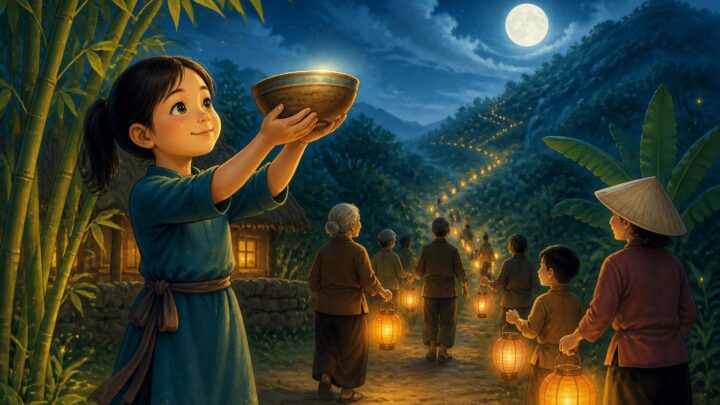
The Little Girl Who Caught Moonlight in a Clay Bowl
Once upon a time, on the edge of a green forest, there was a small village nestled beside a crystal-clear stream. The villagers made their living growing vegetables, weaving cloth, and crafting baked-clay bowls. Every morning, cooking smoke rose from the low-roofed houses, mingling with the scent of freshly cooked rice and wet grass. In
Read more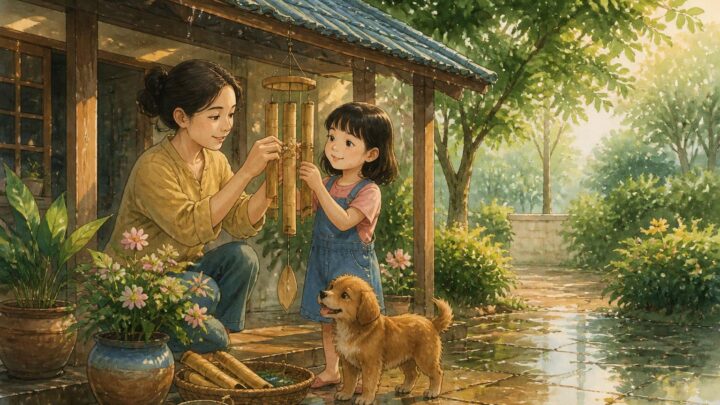
The Wind Chime and the Promise Under the Eaves
At the end of the road stood a house with a blue-tiled roof. A bamboo wind chime hung under the eaves. The chime was old; several bamboo tubes had turned honey-colored, and the string tied above them had become frayed from the sun and rain. Whenever the wind blew through, the chime rang out with
Read more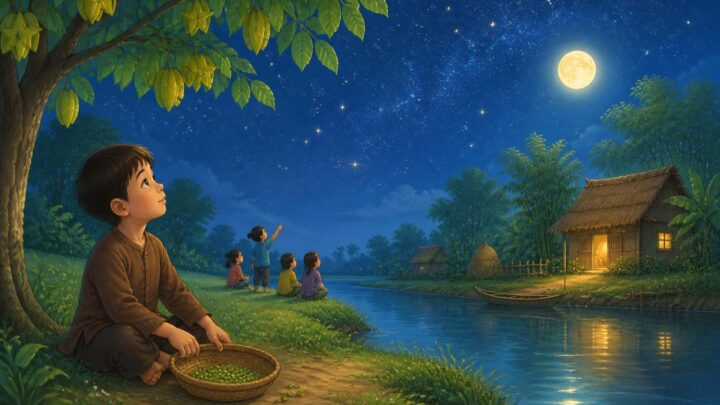
The Boy Who Counted Stars with a Bamboo Basket
Once upon a time, in a small village nestled between rice fields and a river that ran crystal-clear all year round, there lived a boy named Tí. Tí lived with his mother in a thatched-roof house. They were poor, but there was always a bed of green vegetables in front of the house, a sweet
Read more
The Little Sprout and the Garden That Knew How to Listen
At the far end of a large garden, there was a small patch of soil beside a wooden fence. Every morning, the sunlight visited it before scattering golden streaks across the path. In the afternoon, the wind from the fields carried the scent of young grass and the sound of birds calling to one another
Read more
The Bridge Made of Kind Words
At the edge of Moc Mien Village, there was a small stream that ran crystal clear all year round. Its water flowed over smooth, round stones, slipped beneath the ferns, and emptied into the wide rice fields. In summer, the children often invited one another to the streambank to float leaves like boats. In autumn,
Read more
The Little Bean Who Wanted to Hear the Rain
At the far end of a small garden, beneath the canopy of an old star-fruit tree, there was a bed of green beans that always rustled whenever the wind blew through. The bean plants grew up together, winding their soft tendrils around the bamboo fence and lifting their heads to greet the sunshine. Among them
Read more