
Story Collections · 24 November, 2026
The Empty Chair at the End of the Alley
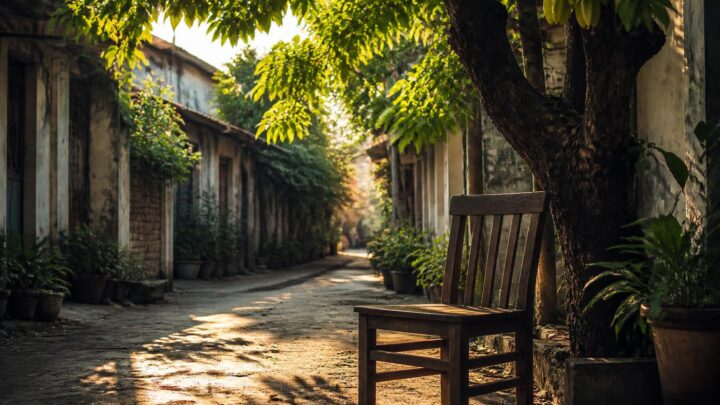
At the end of my alley stood an old wooden chair. It sat beneath a star-fruit tree, its back against a wall whose lime coating had almost entirely peeled away. In the dry season, it caught patches of dappled sunlight; in the rainy season, it was sheltered by the low eaves of the neighboring house. The chair was not beautiful. One leg had been propped up with a broken piece of brick, the wooden seat was covered in scratches, and the left armrest had been polished smooth by years of people placing their hands on it.
And yet no one ever threw it away.
The people in the alley still called it the waiting chair. The newspaper deliverer often set his bag there before finding the right house number. Elderly women returning from the market would sit for a few minutes to catch their breath. Children used it as a step to climb up and pick star fruit, though whenever they were caught, they would dust off their hands and pretend they had merely been passing by. In the afternoon, several neighbors would stand beside the chair and talk about things that would never be recorded in any notebook: rising vegetable prices, the early arrival of the rain, a grandchild who had just learned to walk, or an acquaintance who had not been seen for a long time.
I had known the chair since I was little, but I regarded it only as an ordinary object in the alley. It was not until I was twelve, when my mother sent me to stay at my grandmother’s house for several months because she was busy caring for my younger sibling, that I realized some things that seemed meaningless were what allowed a place to be called home.
The Man Who Often Sat Waiting
Back then, every day I saw an elderly man sitting on the chair. He was thin, with almost entirely gray hair, and usually wore a gray shirt with a frayed collar. He did not read the newspaper, carry a phone, or often talk with anyone. Every morning, he brought a small bottle of water, sat beneath the star-fruit tree for about an hour, and then returned to the house at the entrance of the alley.
I used to think he was waiting for someone. One day, out of curiosity, I asked:
“Are you waiting for a family member?”
He looked at me and smiled. His smile was slow and gentle, as though someone had asked him that question a very long time ago.
“Yes, I’m waiting for someone.”
“Where did that person go?”
“Away to make a living.”
“When will they come back?”
He looked toward the entrance of the alley, where the sunlight was sliding across the low rooftops.
“When they remember the way home, they’ll come back.”
I felt that answer was both true and untrue. The adults in the alley knew the story, but no one explained it clearly to me. Only the sticky-rice vendor told me that the man’s name was Uncle Tu, and that he had once been a carpenter. He had one only son, who had left his hometown for the city many years earlier and then gone abroad. Father and son had fallen out over something. The son had left without having the chance to say goodbye. From then on, Uncle Tu went to the chair every day and sat as though, if he were patient enough, a figure would eventually appear at the end of the alley.
I did not know whether the story was entirely true. Adults often keep part of the truth to themselves, perhaps because they are afraid that telling everything would make a sadness heavier.
What the Chair Had Heard
A few weeks later, I began sitting beside Uncle Tu. At first, I only wanted to hear more about his son who was far away. But Uncle Tu did not say much. He asked me about school, asked whether my mother’s back still hurt, and asked whether my little sister’s cough had gone away. I was surprised that he knew so much about the alley, even though he spent most of his time sitting quietly on the chair.
He said the chair had heard more than people imagined.
It had heard a young woman crying after receiving notice that she had failed her university entrance exams. It had heard a drunken man apologizing to his wife in the rain. It had heard two sisters fighting over the house, then, many years later, quietly leaving food outside each other’s doors. It had heard a child calling for his mother in the middle of the night with a high fever. It had even heard the sighs people tried to hide behind the words, “It’s nothing.”
“So does the chair know what people are sad about?” I asked.
“Of course. But it doesn’t ask.”
“Why doesn’t it ask?”
“Because sometimes people only need a place to sit. They don’t need advice yet.”
That sentence stayed with me longer than I expected. When I was young, I often thought helping someone meant finding a way to solve their problem. If you were sad, I would ask why. If you failed, I would search for words of encouragement. If you argued with a loved one, I would advise you to make peace. But Uncle Tu helped me understand that simply being present could sometimes be a way of helping. A chair could not mend a relationship, bring someone who had gone far away back home, or erase a loss. It could only quietly give people a place to set their bodies down when their hearts had grown too tired.
A Rainstorm and an Old Letter
At the beginning of the rainy season that year, Uncle Tu did not appear for three days. The people in the alley began asking after one another. The sticky-rice vendor brought porridge to his house. The mechanic at the entrance of the alley called his relatives. On the fourth day, Uncle Tu returned, but he walked more slowly and his face was pale.
I ran out to ask what illness he had. He waved his hand and said it was only a slight cold. Then he took a worn envelope from his shirt pocket and showed it to me. There was no stamp on the envelope, nor any address. The paper was crumpled from having been picked up and put down too many times.
“It’s a letter to my son,” he said.
“Have you received it?”
“I haven’t sent it.”
I thought I had misheard him.
Uncle Tu told me that over the years, he had written many letters to his son. Some told of the leaking roof, some told of the star-fruit tree bearing fruit, and some told of a neighbor who had just had a baby. But after writing them, he put them away. He did not know where to send them, nor whether the other person still wanted to read them.
“If you miss him, why don’t you find a way to contact him?” I asked.
He looked at the letter in his hand.
“Because missing someone and knowing how to move closer to that person are two different things.”
That afternoon, the sky opened up. Water streamed through the alley, carrying yellow star-fruit leaves and small scraps of paper along with it. Uncle Tu still sat on the chair, holding the envelope beneath his shirt to keep it dry. I sat beside him without saying anything. After a while, he asked me to read the letter for him because his eyes could no longer see clearly.
The letter contained only a few lines. Uncle Tu did not blame his son or ask why he had not come home for so long. He wrote that the chair beneath the star-fruit tree was still there, that the people in the alley still mentioned him from time to time, and that if he ever returned, he did not need to tell anyone in advance. He only needed to sit down on the chair, and Uncle Tu would know.
By the time I reached the end, the words on the paper had blurred. It might have been because rain had splashed onto them, or because my eyes were stinging.
Uncle Tu did not send the letter. He folded it, put it back in his shirt pocket, and stood up. But from that day on, he no longer sat alone. Every day, someone from the alley stopped by. One person brought a cup of tea, another brought fruit, and someone else simply sat quietly for a few minutes before going to work. The waiting chair gradually became a place where people came not to wait for a stranger, but to remind one another that no one should have to wait alone.
The Day the Chair Was Repaired
Many years passed. I left the alley to study and then work in another city. Whenever I returned home, I still stopped by the star-fruit tree. The old chair gradually sank lower, with a few more bricks wedged beneath its legs, and long cracks appearing across the wooden seat. Uncle Tu no longer sat there regularly, but the people in the alley still kept the habit of stopping by.
One Tet holiday, I returned and saw that the chair had been repaired. The seat had been sanded smooth, the new legs were sturdy, and the backrest had been replaced with another wooden slat. No one took credit for the work. The sticky-rice vendor said the mechanic had done it. The mechanic, in turn, said the children in the alley had contributed money to buy the wood. The children said the adults had taught them how to hammer in the nails.
The chair was not entirely new. Whoever repaired it had deliberately left some of the scratches on the wooden seat. Perhaps they wanted it to continue bearing the marks of the people who had once sat there.
I asked Uncle Tu about his son. He was silent for a long time, then said that his son had sent a letter. Father and son had not yet met again, but they had begun writing to each other. Uncle Tu no longer said, “I’m waiting for someone.” When anyone asked, he only smiled and said, “He’s finding his way.”
I did not know whether they would truly sit beside each other beneath the star-fruit tree someday. Some reunions do not happen as they do in stories, with loud calls and someone running through the alley in tears. Sometimes they begin with a short letter, an awkward inquiry, or the courage to reopen a door that has been closed for too long.
A Seat for Those Returning Home
Now, whenever I pass through crowded places, I often notice public benches. Some stand beneath rows of trees, some are placed outside hospitals, and some sit beside bus stops. People sit on them to wait for a bus, rest their feet, quickly eat a sandwich, or watch the stream of people passing by. I often wonder what stories each bench has heard.
People tend to remember grand things: a house, a journey, a promise, a meeting. But life is held together by things much smaller. An unlocked door. A bowl of rice set aside for someone. A phone call made for no particular reason. Someone sitting beside us without forcing us to speak. And sometimes, it is simply an old chair placed exactly where a weary person needs to find it.
The chair beneath the star-fruit tree is still at the end of the alley. Perhaps one day it will rot away and be replaced by another chair. But what has never mattered is the piece of wood or the nails. What matters is that in a world that constantly makes people hurry, that place still has an empty space reserved for anyone who needs to sit down.
Who knows? In the midst of a moment when we feel that no one is waiting for us anymore, we may pass a chair like that. And who knows? Perhaps simply having someone sit beside us in silence will give us enough calm to find our way home again.
Related articles

The Ferry Crossing Keeper and the Bell of Promises
At the end of a red dirt road, where rows of bamboo leaned down to gaze at their reflections in the broad river, there was a small ferry crossing that the local people called Cloud Ferry. The name came from summer mornings when mist covered the entire surface of the water, making the passenger ferry
Read more
The Unsent Letter from the Little Attic
The old key lay in An’s palm, cold and light, yet it made her feel as though she were holding a piece of her childhood. The wooden door of the house opened with the harsh sound of dry hinges. The smells of dust, damp wood, and old sunlight blended together, creating a familiar scent she
Read more
The Watchmaker and the Morning Without Bells
The Silent Morning At the end of the old street stood a small shop called Kim Gio. The wooden sign had faded, with only a few traces of blue paint clinging around the letters. Inside the shop, dozens of clocks hung on the walls, sat on shelves, or lay in narrow drawers. Each one had
Read more
The Raincoat Left Hanging at the Bus Stop at the End of the Street
At the end of the street stood a small bus stop with a low corrugated-metal roof and a wooden bench faded by rain and sun. The bus stop had no electronic sign, no ticket seller, and no drink stall. People only stopped there to wait for a bus, then quickly went on their way. And
Read more
The Wooden Box Beneath the Veranda Step
The day An returned, the village road had just dried after the rain. Small puddles lay still between the two rows of grass, reflecting a patch of pale gray sky. Her family’s old house was still at the end of the slope, tucked behind areca palms that had grown much taller than before. Moss covered
Read more
The Unsent Letter and the Day the Father Learned to Listen
In the bottom drawer of the wooden desk, Mr. Minh found a letter that had faded with age. It lay among a few old bills, a lighter that no longer worked, and a notebook with blank pages. There was no recipient’s address on the envelope, only one line written in blue ink: “I want to
Read more