
Story Collections · 27 November, 2026
The Clock That Wouldn’t Run and the Lesson About the Things Worth Waiting For

On a weekend afternoon, the small street behind the market still moved at an unhurried pace. The shops gradually pulled down their shutters, the sound of brooms sweeping dust blending with the motorcycles growing sparser on the road. At the end of the row of old houses, Mr. Lam’s clock-repair shop still glowed with a single yellow light. The wooden sign above had faded with age, leaving only a few visible strokes of lettering, but people in the neighborhood still knew the place by the distinctive sound of hundreds of clocks running at once.
Some ticked quickly, while others moved slowly, as if deep in thought. A pendulum clock hanging beside the door gave off a steady beat, while the wristwatches lying on the tabletop produced tiny, scattered rhythms. Mr. Lam had been doing this work for more than forty years. He did not merely repair mechanisms. He often said that he repaired the stretches of time that had been interrupted in people’s lives.
That afternoon, a young woman entered the shop. She wore a pale blue shirt and held a wooden box with worn corners. After greeting him, she placed the box on the table and said that she wanted to have an old watch repaired. Her voice was calm, but her eyes kept drifting toward the door, as though if she stayed any longer, she would have to face something she did not want to remember.
Mr. Lam opened the box. Inside was a silver-colored metal pocket watch. The glass had a long scratch, the chain had changed color, and the hands had stopped at four seventeen.
He picked it up, gently turned the winding knob, and shook his head. The watch had been still for too long. Not only were a few gears jammed, but the spring inside also showed signs of deterioration. He said he would need a few days to take it apart and inspect it, but the young woman immediately asked whether it could be repaired that very evening.
Her name was An. The watch had belonged to her father, who had died nearly a year earlier. An had found it in the drawer of his old desk when her mother decided to clean up the house. She did not know why her father had always carried the watch, and she had never asked. Now that he was gone, she realized that she had too many questions she had never had the chance to ask.
An Old Object and the Questions Left Forgotten
Mr. Lam placed the watch beneath the light. He did not ask anything more about her late father. He simply removed the back cover, held a magnifying glass before his eye, and began examining the tiny components inside. His hands were slow but steady. Each time he lifted a gear, he placed it on a soft cloth in the proper order.
An sat opposite him, silently watching his work. After a while, she said that her father had been a quiet man. He worked at a machine shop, often came home late, and left again very early in the morning. When she was young, An had thought that her father did not care about her because he rarely asked about school or her friends. The family had usually sat down to meals together, but there was not always a conversation.
When she grew older, An left her hometown for the city to study and then work. She and her father spoke even less. Whenever he called, she would often quickly say that she was busy. There were messages she read but forgot to answer. There were times when her mother said that her father wanted to hear his daughter’s voice, and An would promise to call on the weekend, only for that weekend to pass like so many others.
On the day her father was hospitalized, An was preparing for an important presentation. She thought she still had time. Her mother said that the situation was not yet too serious, and her father did not want to interfere with his daughter’s work. By the time An arrived, her father no longer had the strength to speak. The pocket watch was still in his breast pocket, stopped at four seventeen.
Mr. Lam did not look up, but the hand holding the small tweezers suddenly stopped. He asked whether four seventeen was the time her father had died. An shook her head. Her father had died close to midnight. No one knew when the watch had stopped.
Mr. Lam said that a watch could stop for many reasons. An impact, moisture, dust, or simply a component that had grown tired after years of work. The moment when a hand stopped did not always carry a hidden meaning. Sometimes, people simply wanted to find a sign to hold on to someone who had gone away.
An lowered her head. His words did not immediately make her feel lighter, but they made her stop looking at the watch as a riddle that needed to be solved. Perhaps she had been trying to find one final message from her father in it, when what she really needed to look back at was the years the two of them had lived side by side.
The Repairman Who Did Not Rush to Make Time Run Again
Mr. Lam spent nearly two hours cleaning each part. When he put the watch back together, he did not replace the old spring right away. He tried reshaping a small connector, adjusted the gears, and placed the mechanism on a wooden stand. The watch remained silent.
An asked whether it could no longer be repaired. He replied that it was too soon to say. Objects that had been neglected for a long time often needed more time before they could work again. If one forced the winding knob or replaced everything with new components, the watch might run, but it would no longer keep its original rhythm.
Those words reminded An of her brief conversations with her father. She had once wanted him to change, wanted him to be open like the fathers in movies, wanted him to express his feelings in easy-to-understand words. But she had never tried to understand the way he cared. Her father did not know how to send long messages. He would leave a raincoat on her motorbike when the weather was about to change. He repaired her bicycle whenever the chain came off. He quietly remembered the food she liked, though he never said so.
When she was young, those things had seemed too ordinary to notice. Only after no one was doing them anymore did An realize that they had filled a large part of her childhood.
While waiting for Mr. Lam to inspect the mechanism again, she asked if she could look at the other clocks in the shop. He pointed them out one by one and briefly told her about the people who had brought them in. One belonged to a woman who wanted to keep her husband’s gift. Another belonged to a boy who had asked to have it repaired so he could give it to his mother on her birthday. One had been brought in many times, not because it was particularly valuable, but because its owner could not bear to throw away an object that had stayed with him through difficult years.
Mr. Lam did not remember everyone’s names, but he remembered the story of every clock clearly. To him, objects did not become important on their own. It was the time people entrusted to them that gave them meaning.
A Return Does Not Begin with an Apology
Nearly nine o’clock that evening, the pocket watch made a very soft sound. One gear shifted, then stopped. Mr. Lam adjusted the position of the hands, added another tiny drop of oil, and tried again. This time, the ticking began. Slow and slightly uneven, but unmistakable.
An laughed, then unexpectedly began to cry. She said she had thought that when the watch started running again, she would hear something from her father. But in the end, all she heard was a very small sound inside the quiet shop.
Mr. Lam told her that sometimes an ordinary sound was enough to help someone begin again. Not begin life over, because no one could turn back time. Simply begin again in the way they looked at what had happened.
An no longer asked exactly when the watch had stopped. Nor did she try to guess why her father had always carried it. Before leaving the shop, she called her mother. The call lasted less than ten minutes, and most of the time the two of them asked each other very simple questions. Had Mother eaten yet? Was the house cold? Where had Father’s old wool scarf been put away?
But for the first time in many months, An did not look for a reason to end the call quickly. She listened as her mother told her about her father’s final morning, about how he had sat by the window for a long time and mentioned the star-fruit tree in the front yard. Those things were small and could not change anything, but they helped An realize that her father had not disappeared in a single moment. He was still present in the habits, belongings, and memories that the family had not yet found words for.
The watch was placed back in its wooden box. Mr. Lam reminded An not to leave it somewhere too damp and not to wind it too tightly. If it stopped again one day, she could bring it back, but she should not force it to run at all costs.
An thanked him and stepped out onto the street. It was already dark, and all the surrounding shops were closed. She stood outside the shop for a while, listening to the pendulum clock inside echo through the half-closed door. Each beat sounded like a reminder that time continued moving forward, whether or not people were ready.
What Is Worth Waiting For Is Not Always a Miracle
A few weeks later, An returned to her hometown for the weekend. She and her mother cleaned out her father’s room. They did not throw away any of the old belongings. They simply dusted them, rearranged them, and told each other about the things they had once missed. Her mother told her that her father had learned how to repair clocks from a craftsman in the village. An told her about her first days at work and the fear of failure she had never shared with him.
The pocket watch was placed on the bookshelf. It still ran a few minutes slow each day, and sometimes the second hand would falter briefly before continuing. But An was no longer bothered by it. She understood that some things did not need to return to a perfect state in order to become precious.
People are the same. A relationship may once have been silent, a word may have come too late, and a meeting may never happen again. Such things cannot be repaired like a gear being replaced. Nevertheless, we can still learn to look at them honestly, recognize our share of the responsibility, and cherish what can still be preserved.
Waiting is not always sitting still and hoping for a miracle. Often, waiting means patiently brushing away each layer of dust from memory, listening to what someone once tried to say in their own way, and then stepping toward a conversation that has been postponed for far too long.
Time does not return, but the way we live with what has passed can still change. And sometimes, all it takes is for an old watch to begin ticking again for someone to find the courage to open a door that has been closed inside them.
Related articles

The Stone Bench Beneath the Old Banyan Tree
Minh returned to the village one late-October afternoon, when the dirt roads had dried after several days of rain. The bus dropped him off at the head of the slope and drove away, leaving behind a thin cloud of dust suspended in the pale sunlight. He pulled his small suitcase past the areca palms at
Read more
The Lighthouse Keeper and the Map of Returns
At the far end of Vạn Chài Village stood a short lighthouse, its body painted white but streaked with salt stains. During the day, people almost forgot it existed. Only when evening fell, and the boats offshore began switching on their lights, did the lighthouse become the clearest point of brightness along the long stretch
Read more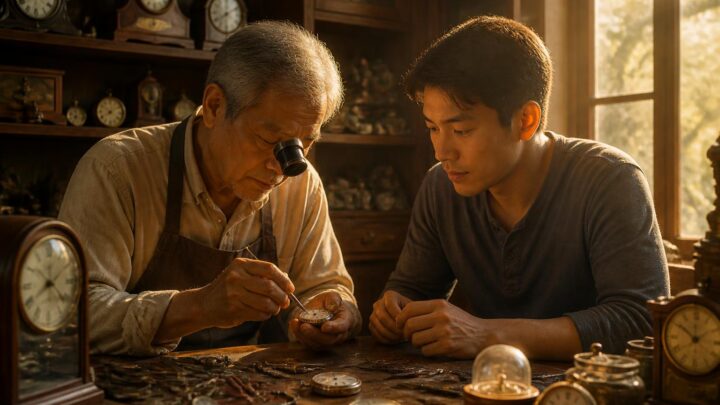
The Watchmaker and a Day Without the Hands Moving
The Watch Whose Hands Had Stopped At the end of the street stood a watch-repair shop so small that anyone walking quickly could easily pass it without noticing. The wooden sign above the entrance had faded, with only a few faint strokes of lettering remaining. Inside the shop, hundreds of watches lay still on narrow
Read more
The Scent of the Wooden Box
The wooden box lay in the bottom drawer of the low cabinet, where Grandmother often kept things that were no longer used but absolutely must not be thrown away. It was not large, just big enough to hold a spool of thread, a few buttons, and several neatly folded scraps of fabric. The surface of
Read more
The Ferry Crossing Keeper and the Bell of Promises
At the end of a red dirt road, where rows of bamboo leaned down to gaze at their reflections in the broad river, there was a small ferry crossing that the local people called Cloud Ferry. The name came from summer mornings when mist covered the entire surface of the water, making the passenger ferry
Read more
The Empty Chair at the End of the Alley
At the end of my alley stood an old wooden chair. It sat beneath a star-fruit tree, its back against a wall whose lime coating had almost entirely peeled away. In the dry season, it caught patches of dappled sunlight; in the rainy season, it was sheltered by the low eaves of the neighboring house.
Read more