
Story Collections · 26 November, 2026
The Stone Bench Beneath the Old Banyan Tree
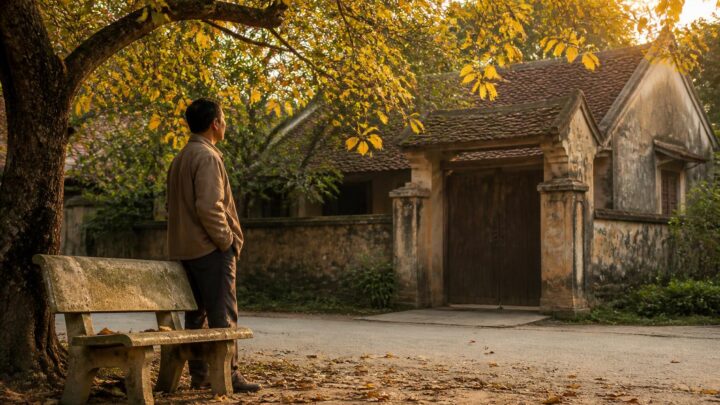
Minh returned to the village one late-October afternoon, when the dirt roads had dried after several days of rain. The bus dropped him off at the head of the slope and drove away, leaving behind a thin cloud of dust suspended in the pale sunlight. He pulled his small suitcase past the areca palms at the village gate, without the familiar flutter of excitement felt by someone returning to his hometown after a long absence. Minh only wanted to finish one task: sell his parents’ old house as quickly as possible.
The house stood at the end of a narrow alley, tucked behind a moss-covered wall. The tiled roof had darkened with age, one corner of the wooden gate had been eaten by termites, and the bougainvillea trellis in front of the yard had only a few bare branches left. Minh stood before the door for a long while before finding the key in his jacket pocket. He had not been back in nearly ten years, since the day his mother died. His father had passed away a few years earlier, after a brief illness. At the time, Minh was working in the city, busy with meetings, plans, and a schedule so packed that he always told himself he would come home the following weekend.
That following weekend never came.
A House Full of Unspoken Things
Inside, the house still smelled of old wood and sunlight trapped in faded curtains. On the low cabinet in the living room, a layer of dust blurred the family photograph. Minh ran his hand across the glass. In the picture, he was still a thin boy standing between his father and mother, holding a paper lantern. His father had placed a hand on his shoulder, while his mother smiled toward the front. Minh did not remember what year the photograph had been taken; he only remembered that his father had taken him to the communal house courtyard that day to watch the lion dance.
The real estate agent had arranged to come and view the house the next morning. Minh planned to pack a few necessary belongings, sign the papers, and return to the city. The remaining things could be dealt with by the buyer. He thought that would make it easier to let go.
In his father’s room, Minh found an old tin box beneath the bed. Inside were a few fountain pens, a yellowed notebook, and a bunch of keys whose purpose was no longer clear. The notebook was not a diary. His father had written down only trivial tasks: repairing the porch roof, buying medicine for his mother, changing the light bulb in the kitchen, sending money to Uncle Tư at the entrance to the alley. At the end of almost every page, he would add a short sentence, as if reminding himself.
“Remember to water the banyan tree when the weather is sunny.”
“The bench outside the alley is loose; repair it tomorrow.”
“Minh called, said work was busy.”
The last line made him stop for a long time. His father had not complained, nor had he written anything more. It was simply a short sentence, as calm as the others. That very calmness made Minh feel more uncomfortable than any complaint could have.
The Bench Beneath the Banyan Tree
Dusk came quickly. Not wanting to remain in the silent house, Minh went out into the alley. A few dozen steps from the gate stood an old banyan tree, its trunk so broad that two people could not encircle it with their arms. Beneath the tree was a long stone bench, its seat worn smooth and its two legs covered in green moss. Minh vaguely remembered that the bench had been placed there when he was still a child. Every noon, his father would sit on it to sharpen knives or repair an old radio. His mother would sit beside him sorting vegetables, occasionally reminding Minh not to run into the street.
Minh sat down. The chill of the stone passed through the fabric of his trousers. From this spot, he could see the gate of his house, the small canal in front, and the communal house at the end of the village. The scene had not changed much; only the people in his memories were gone.
“You’re Minh, aren’t you?”
The voice came from behind him. Minh turned and saw an old man standing by the fence, leaning on a cane. He was thin, with nearly all his hair gray, but his eyes were still bright.
“Yes, sir. Are you Mr. Bảy?”
The old man smiled and nodded. “You used to climb this banyan tree to pick its fruit. Once you fell and scraped your whole knee, and cried so hard that your mother had to run over and call your father home.”
Minh smiled too, though the memory had grown hazy. Mr. Bảy walked slowly to the bench and sat beside him. For a long while, neither of them said anything. Wind moved through the canopy, sending a few yellow leaves drifting down onto the road.
Mr. Bảy asked Minh whether he planned to stay long. Minh replied that he had only come back to sell the house.
“Selling it so quickly?”
“The house has been empty for a long time. There’s no point keeping it, sir.”
Mr. Bảy looked toward the house without objecting. He simply brushed a leaf from his knee.
“Your father once said that the house wasn’t large, but it held the footsteps of an entire lifetime. If you want to sell it, then sell it. Just before you do, take the trouble to walk through every room once.”
Minh was slightly surprised. “My father told you that?”
“Many times. He knew you didn’t like coming back to the village. He also knew you thought he didn’t understand your life in the city.” Mr. Bảy looked at Minh, speaking slowly. “In truth, old people often don’t fully understand what young people have to face. But they understand what it feels like to wait for someone to come home.”
A Journey Through Memories
That evening, Minh did not call the real estate agent to confirm the appointment. He boiled a pot of water, swept the living room, and opened each door in the house. The kitchen still held the aluminum pot his mother often used. On the wall was a black soot mark around the wood-burning stove. In a drawer, he found a stack of neatly folded handkerchiefs, a small pair of scissors, and several packets of dried seeds.
In his mother’s bedroom stood a low wooden cabinet. Minh opened the bottom drawer and found old clothes folded into separate stacks. At the bottom of the cabinet lay a brown knitted scarf. He remembered that his mother had knitted it during the winter of his first year at university. At the time, Minh had said the scarf looked old-fashioned and refused to wear it. His mother had not been angry; she had simply put it away. Years later, when he moved to the city, she still asked whether the winters were cold.
Minh sat down on the floor, the scarf resting in his hands. He realized that he had remembered those questions but had never truly answered them. His mother had not asked because she wanted to know about the weather. She wanted to know whether he was eating properly, sleeping enough, and whether there was anyone beside him when he was tired. But at the time, Minh had only given casual replies before hurriedly ending the calls.
In the living room, behind the wooden cabinet, Minh discovered a dent in the wall. He remembered that as a child he had once thrown a ball and broken the wall clock. His father had not hit him. He had simply made Minh stand beside him and help repair it. The two of them had fussed over it all afternoon, and in the end the clock still ran ten minutes slow. His father had said it was all right, as long as it could still remind everyone of the time.
Those small things returned one after another, in no particular order. A bowl of porridge when he had a fever. A new pair of sandals placed by the door at the beginning of the school year. The sound of his father coughing in the yard. The scent of his mother’s hair after she washed it with boiled leaves. A raincoat hung ready on his bicycle. None of these things had been recorded in the family genealogy, and no one would have considered them major events, but together they had shaped the form of a home.
What Someone Returning Can See
The next morning, the real estate agent arrived on time. He walked around the house, measured the rooms, and talked about the land price, the direction of the alley, and the possibility of building anew. Minh listened, but he no longer felt that the house was merely an asset to be transferred. He stepped out beneath the banyan tree, looked at the stone bench, and asked for a few more days to think.
The real estate agent looked confused. Minh did not know how to explain. He could not say that a stone bench had changed his mind. Even less could he say that he had just realized he had been too quick to sell the only place that still preserved his parents’ voices.
At noon, Minh went to Mr. Bảy’s house. The old man was repairing a birdcage on the veranda. Minh told him that he did not want to sell the house right away. Mr. Bảy did not congratulate him or offer advice. He only asked Minh what he planned to do with the house.
“I don’t know yet. Maybe I’ll repair it. If I can’t live there regularly, I’ll come back from time to time.”
“That’s good. Houses are like people. If they’re abandoned for too long, they grow cold, but as soon as someone opens the door, they remember how to welcome the sunlight.”
Minh stayed in the village for another week. He replaced the broken door, cleared the weeds around the yard, and called a repairman to fix the tiled roof. In the tin box, he found a small key that fit perfectly into the drawer of his father’s desk. Inside there was no money or important paperwork, only an old bus ticket and a piece of paper with Minh’s telephone number. The digits had faded, but they were still readable.
He took the paper and sat beneath the banyan tree. For the first time in many years, Minh called an old friend in the city and said that he might take a few more days off. He also called the real estate agent and canceled the house sale appointment. Then he called a relative with whom he had rarely been in touch lately. The conversation was awkward at first, but neither of them hurried to hang up.
Returning Does Not Mean Turning Back Time
On the afternoon before leaving the village, Minh cleaned the stone bench beneath the banyan tree. Moss had grown quite thick on its two legs, and there was a small crack in the seat. He intended to find someone to repair it, but in the end he simply used cement to patch it temporarily. The task was so simple that his father probably would have finished it in a morning.
Mr. Bảy came to see Minh off at the head of the alley. He did not ask when Minh would return. Old people understand that some promises become a burden more easily once they are spoken.
Minh looked at the house one last time. It was still old, still small, and still in need of a great deal of repair. But this time, he did not see it as a place that had been left behind. He saw it as a place waiting to have its doors opened—not to keep him trapped in the past, but to remind him where he had begun.
On the bus back to the city, Minh placed the house key in his wallet. He did not know how the future would change. Perhaps he would still have to work a great deal, and there would still be days when he could not return. Perhaps one day he would sell the house for a different reason. But he understood that he would no longer make decisions while running away from his memories.
Because sometimes, what a person needs to do is not preserve everything old exactly as it is, but remain calm enough to recognize its value before letting go. A home may deteriorate, a stone bench may crack, and a row of trees may shed all its leaves. But the years of being quietly loved often remain much longer than we imagine.
And some roads only truly lead people home after they are willing to stop beneath an old tree, sit down on a familiar bench, and listen to the things they had once been too hurried to hear.
Related articles

The Lighthouse Keeper and the Map of Returns
At the far end of Vạn Chài Village stood a short lighthouse, its body painted white but streaked with salt stains. During the day, people almost forgot it existed. Only when evening fell, and the boats offshore began switching on their lights, did the lighthouse become the clearest point of brightness along the long stretch
Read more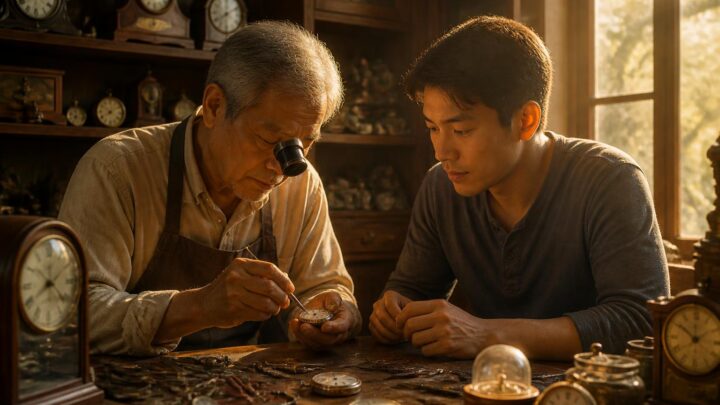
The Watchmaker and a Day Without the Hands Moving
The Watch Whose Hands Had Stopped At the end of the street stood a watch-repair shop so small that anyone walking quickly could easily pass it without noticing. The wooden sign above the entrance had faded, with only a few faint strokes of lettering remaining. Inside the shop, hundreds of watches lay still on narrow
Read more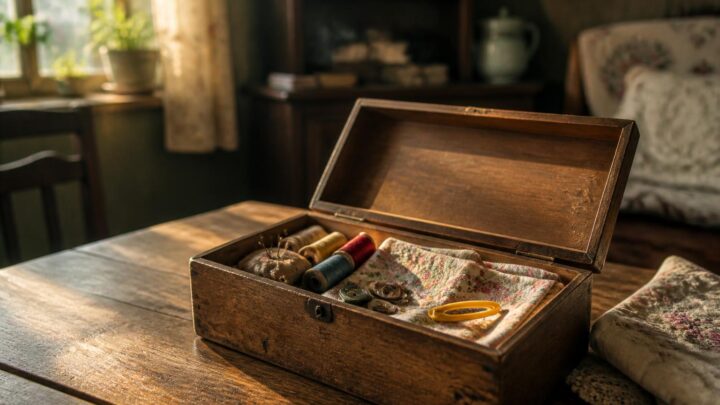
The Scent of the Wooden Box
The wooden box lay in the bottom drawer of the low cabinet, where Grandmother often kept things that were no longer used but absolutely must not be thrown away. It was not large, just big enough to hold a spool of thread, a few buttons, and several neatly folded scraps of fabric. The surface of
Read more
The Ferry Crossing Keeper and the Bell of Promises
At the end of a red dirt road, where rows of bamboo leaned down to gaze at their reflections in the broad river, there was a small ferry crossing that the local people called Cloud Ferry. The name came from summer mornings when mist covered the entire surface of the water, making the passenger ferry
Read more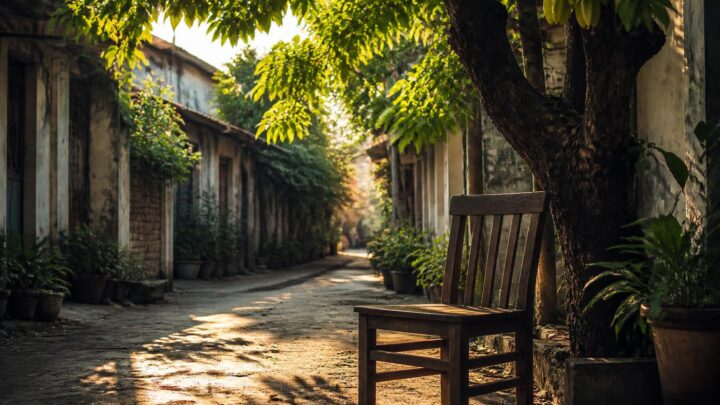
The Empty Chair at the End of the Alley
At the end of my alley stood an old wooden chair. It sat beneath a star-fruit tree, its back against a wall whose lime coating had almost entirely peeled away. In the dry season, it caught patches of dappled sunlight; in the rainy season, it was sheltered by the low eaves of the neighboring house.
Read more
The Unsent Letter from the Little Attic
The old key lay in An’s palm, cold and light, yet it made her feel as though she were holding a piece of her childhood. The wooden door of the house opened with the harsh sound of dry hinges. The smells of dust, damp wood, and old sunlight blended together, creating a familiar scent she
Read more