

 Tiếng Việt
 日本語
日本語 한국어
한국어 中文 (中国)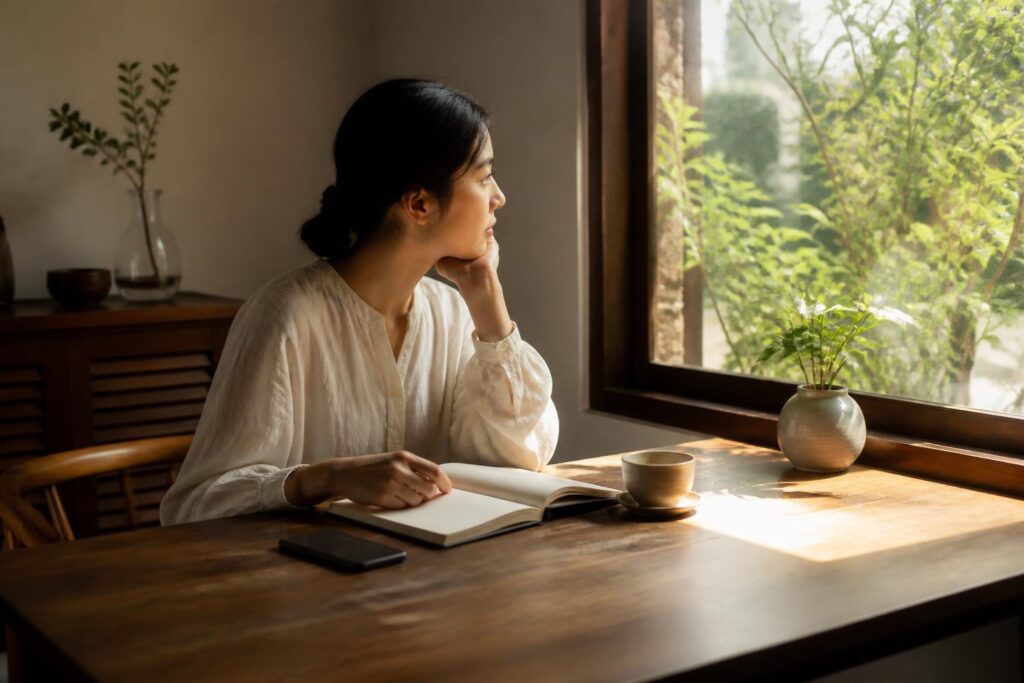
There are days that begin with the sound of an alarm and end with the feeling that we have not managed to finish anything at all. Between those two moments are countless messages that need answering, tasks that need completing, appointments that need remembering, and streams of information constantly appearing on the screen. People are busy not only because they have too much to do, but also because they always feel they must respond immediately to everything around them.
In that context, the advice to live slowly can sometimes be misunderstood as a call to abandon responsibilities, work less, or seek a life detached from reality. In fact, living slowly does not necessarily mean changing where we live, our work, or our schedule. First and foremost, it means changing the way we are present in the things we are doing. A person can still be busy without being swept away; someone else may have plenty of time while their mind remains in a constant state of haste.
Living slowly is the ability to pause just long enough to recognize where we are going, why we are going there, and what price we are paying for our current pace. When we develop this ability, we do not necessarily do less. We simply begin to act more selectively, listen more carefully, and live closer to the things we truly value.
Why Do People So Easily Become Stuck in a Hectic Pace of Life?
A fast-paced life often brings a feeling of efficiency. When we are constantly finishing one thing, answering a message, or moving on to a new task, we feel that the day is being used to its fullest. This feeling is not entirely wrong, because there are periods when people genuinely need speed, focus, and the ability to handle multiple demands at once.
The problem arises when urgency becomes a permanent state. An unanswered message makes us restless. An empty space in our schedule makes us feel that we are wasting time. An evening without a specific goal is easily filled by scrolling through endless content, even though afterward we cannot remember what we watched. At that point, busyness is no longer a tool serving life; it becomes a measure of our own worth.
Many people also confuse moving forward with never being allowed to stop. They think that if they pause for even a moment, others will overtake them, opportunities will disappear, or unfinished tasks will become more serious. The fear of being left behind leads people to accept schedules with no room for rest, reflection, or relationships that require genuine presence.
Yet the mind also needs time to organize what it has experienced. Emotions need to be recognized instead of being continually covered up by work. An important decision needs quiet space to be considered, not merely more information. Without such pauses, we may still move very quickly, but we cannot be sure that we still recognize our destination.
Living Slowly Does Not Mean Living Without Ambition
One of the greatest obstacles to practicing a slower way of life is the fear of being judged as insufficiently dynamic. In an environment that emphasizes achievement, someone who declines an appointment, turns off notifications, or spends an evening not working may feel that they are going against the current. However, ambition and haste are not the same. Ambition is the desire to grow, create value, or reach a meaningful goal. Haste is the continual reaction to every demand without taking time to ask whether those demands truly matter.
People who live slowly can still set ambitious goals. The difference lies in the fact that they do not allow their goals to turn their entire lives into a race. They understand that good work requires perseverance, a deep relationship requires time, and solid ability requires a process of practice. Not every result is created by continuously accelerating.
Living slowly also does not mean procrastinating. Procrastination is avoiding something that needs to be done even though we know it is important. Living slowly means doing what needs to be done with awareness, without forcing ourselves to handle everything at the same time. A person who lives slowly can complete work on time, but does not necessarily have to carry a panicked state of mind from beginning to end. They can distinguish what is urgent from what merely creates a sense of urgency.
Simple Expressions of a Life with Its Own Rhythm
Practicing a slower way of life often begins with very small choices. It may mean eating a meal without looking at a screen, walking part of the way without constantly checking the phone, or sitting quietly for a few minutes before starting a new task. These actions do not immediately transform our entire lives, but they help us regain the feeling that we are present in the current moment.
Another useful habit is distinguishing between response time and thinking time. Not every question requires an immediate answer. Not every invitation needs to be accepted the moment we hear it. Giving ourselves a short period to consider things helps us avoid reluctant agreements, hasty refusals, and many decisions made solely because of pressure.
At work, living slowly may mean focusing on one task for a set period instead of constantly switching between multiple tasks. When we switch too often, the mind has difficulty going deeply into any one task. We may open many windows, read a great deal of content, and reply to many people, but our attention becomes so divided that the final result lacks depth.
In the family, living slowly means listening to a loved one finish speaking without rushing to offer advice. Sometimes the other person does not need an immediate solution; they need to feel that their story has been received. Such a conversation may not produce a tangible result, but it nurtures trust, something that cannot be built through superficial check-ins.
In personal life, living slowly also means allowing ourselves periods of time without a clearly defined purpose. Not every minute needs to be turned into productivity. A morning spent looking at the trees outside the window, carefully preparing a meal, or reading a few pages in silence can all help the mind return to a state of balance. The value of these activities does not lie in how many results they produce, but in their ability to help us feel more clearly the life that is unfolding.
Learning to Choose Instead of Merely Trying to Endure
Many people turn to a slower way of life after a prolonged period of exhaustion. At such times, they often want to eliminate all responsibilities at once. But a sustainable rhythm of life is not created by escaping every demand; it is created by reconsidering what is taking up our time and energy.
We can begin with three simple questions: What truly matters? What is merely creating temporary pressure? And what could be done differently? The first question helps us reconsider our priorities. The second helps us identify unnecessary worries. The third opens up the possibility of making adjustments instead of accepting that everything must happen in only one particular way.
Not everyone can immediately reduce their working hours, change their environment, or eliminate their existing obligations. Therefore, living slowly needs to be understood realistically. It may mean rearranging the order of tasks, clearly stating our boundaries, taking a short break between two tasks, or not bringing all of today’s stress into a conversation with a loved one.
What matters is not turning living slowly into another standard by which to judge ourselves. If we cannot find inner calm today, that does not mean we have failed. If there is a period when we must work at high intensity, we do not need to feel guilty either. Balance is not a fixed state that we achieve once and then keep forever. It is a continuous process of adjustment according to our health, circumstances, and specific responsibilities.
What Can Quiet Moments Help Us Recognize?
When we are less pulled along by external signals, we have the opportunity to recognize desires that have been hidden. We may discover that we are pursuing a goal simply because we want to be recognized. We may realize that a relationship has grown distant because both people are always talking while in a hurry. We may also understand that what we need is not another new plan, but to complete an old task with calmness.
Quiet moments are not always comfortable. When we are no longer busy enough to avoid things, we may have to face sadness, confusion, or dissatisfaction with ourselves. Nevertheless, this is also an opportunity for those emotions to be called by their proper names. Something that is recognized can be cared for; something that is always pushed aside can quietly influence the way we make choices.
Living slowly, therefore, is not merely a time-management technique. It is a way of looking at life. This perspective acknowledges that human beings are not machines that must always operate at full capacity. We have abilities, but we also have limits. We have responsibilities toward our work and other people, but we also have responsibilities toward our own peace, health, and inner honesty.
Go Slowly to Go Farther with What Matters
In a world that constantly urges people to respond, choosing not to react immediately can sometimes be an intentional act. It allows us to ask questions before accepting, listen before judging, and think before deciding. These small pauses do not bring life to a standstill. On the contrary, they help make our actions less scattered and bring them closer to what we value.
Living slowly does not require a perfect life, nor does it demand that we always remain calm. It is simply a reminder that speed should not become the sole deciding factor in every choice. Some things need to be done quickly, but other things need to be done carefully. Some opportunities should be seized, but some invitations need to be considered. There are days when we must move forward, and there are days when we need to pause so that we can understand what we are carrying with us.
When we know how to create a suitable rhythm, we no longer have to choose between efficiency and peace as though they were opposites. We can still work, pursue our goals, and face life’s challenges, without trading away our entire presence for speed. Sometimes, slowing down a little is precisely the way to see the path more clearly, preserve the people beside us, and draw closer to a meaningful life.

ARTICLES IN THE SAME CATEGORY
When Attention Becomes an Asset to Be Protected
The Art of Repairing What Is Imperfect in Life
Decluttering Digital Life to Regain Focus and Peace
When a Day Ends Properly, the Heart Feels Lighter
Living Mindfully in an Age of Information Overload
Silence in Modern Life and How to Find Peace Again
ARTICLES IN THE SAME GENRE
Living Mindfully in an Age of Information Overload
From Knowing a Lot to Understanding Deeply: How to Build Systematic Thinking
Setting Boundaries in Digital Life to Regain Focus
The Art of Slowing Down in a World That Is Always Urging Us On
Listen to Understand, Not to Respond, in Difficult Conversations
Forgiveness Does Not Mean Reopening a Closed Door