

 Tiếng Việt
 日本語
 한국어
 中文 (中国)
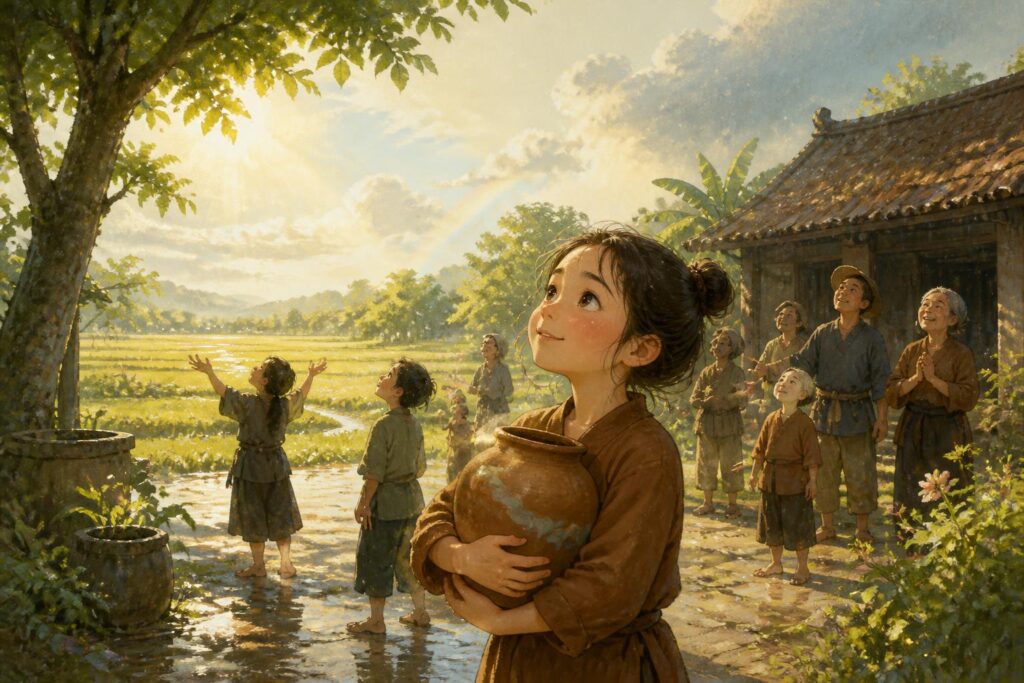
Once upon a time, at the far end of a green valley, there was a small village called Sunlit Patch. The village lay among round hills shaped like the backs of buffaloes, with a wide field in front and a forest of many ancient trees behind it. The villagers lived on rice, vegetables, and flower beds watered by a crystal-clear stream flowing down from the mountains.
Every year, when the first-season clouds arrived, everyone placed large jars outside their porches to collect rainwater. Children ran barefoot across the dirt yards, adults repaired their roofs, and sparrows chirped as they searched for shelter from the rain. To Sunlit Patch, the rainy season was like a close friend, coming and going according to a familiar pattern.
But that year, the rainy season never came.
On the first day, the villagers thought perhaps the clouds had lost their way. On the tenth day, they gazed at the clear sky and began to worry. By the following month, the ground had cracked into long lines, the leaves had curled up, and the little stream had gradually dwindled until only white pebbles remained exposed on its bed. The once-lush green fields turned a withered yellow.
In a house on the edge of the village, a little girl named May lived with her grandmother. May had no parents by her side, but her grandmother always loved her with all her tenderness. Grandmother often said that when May was born, a white cloud had flown very low over the roof. That was why she had named her granddaughter May, hoping the girl’s life would always be gentle and that she would know how to bring joy to others.
May had a special habit. Every morning, she walked around the village to see which plants were thirsty and which animals needed help, then found ways to bring them water. Sometimes she used a coconut shell to scoop water from her family’s jar and water the roots of the old banyan tree. At other times, she gave her own share of drinking water to the brown dog lying exhausted in the shade. Grandmother reminded her many times:
“You need to drink water too, May. Kindness must go hand in hand with wisdom if it is to help for a long time.”
May nodded, but whenever she saw a drooping leaf or heard an animal’s thirsty cry, she could not turn away.
The Forgotten Jar
One afternoon, while gathering firewood in the forest behind the village, May discovered a small path covered in moss. The path led to an old bamboo hut, almost completely hidden by vines. She had never seen the place before, even though she had entered the forest many times.
Inside the hut was a reddish-brown earthen jar. It was not large, only big enough for a child to embrace with both arms, but its surface bore shimmering patterns like moonlight. The jar was covered with a dry leaf, and beside it lay a piece of weathered wood. May picked up the piece of wood, but there were no words on it, only an image of a drop of water between two open hands.
Just as May reached out to touch the jar, she heard a very soft sound, like rain falling on a thatched roof.
The girl opened the jar. Inside was nothing but a single clear drop of water. The drop hovered in the middle of the jar; it did not fall to the bottom or float out. It glowed whenever May tilted the jar toward the sunlight.
May brought the jar home to ask her grandmother about it. Grandmother stared at it for a long time, then suddenly remembered a story she had heard when she was little. Long ago, there had been a stream keeper in that forest. The stream keeper did not own the water, but cared for it so that the stream would always flow to wherever it was needed. Before leaving this world, that person had placed the final raindrop in an earthen jar, in case someone truly knew how to use it for the sake of life.
“Do you think I can make the rain return?” May asked.
Grandmother did not answer right away. She placed a hand on her granddaughter’s shoulder and said:
“Some things cannot be kept by holding them tightly. If this drop is a gift, you must find out how it wants to be used.”
Three Trials
The next morning, May carried the jar into the middle of the yard. She thought that if she simply poured the drop onto the ground, a great rainstorm would appear. May tilted the jar, but the drop remained still. She tilted it farther, shook it gently, and even turned the jar upside down. The drop still did not move.
When the villagers heard about it, they came to watch. Some said the jar had to be smashed. Others said it should be taken to the mountaintop, where it would be closest to the sky. One farmer even advised May to hold it tightly, because if she was careless, the precious drop might disappear.
May listened to them all but did not know what to do. She took the jar to the dry streambed and sat quietly. After a while, she saw a small bird pecking at the layer of dry mud. The bird had searched for a long time but could not find a single drop of water.
May took a dried lotus leaf, caught a little water from her family’s jar, and placed it in front of the bird. Only a little water remained in the jar, but the girl thought she could go and ask for more. After drinking, the bird tilted its head at May and flew toward the forest.
Suddenly, the drop inside the jar began to glow. A tiny bead of water separated from it and fell onto the lotus leaf. Then the drop returned to its original state.
May understood that the jar did not respond to the desire to keep the water for oneself. It responded only to a truly helpful act.
From that day on, May began going everywhere. She did not try to create a great rainstorm. Each day, she used only a very small portion from the jar to save a seedling, wet an animal’s mouth, or help an elderly person through the hot midday. Strangely, after every act of sharing, the drop in the jar filled up again, becoming clearer and brighter.
However, not everyone believed May. A wealthy merchant named Loc heard about the jar and came to see her. He brought a chest full of fabrics and promised to exchange it for the jar, along with gold, silver, food, and a large house.
“If you give me the jar, I will build a private water tank for my household,” Mr. Loc said. “When the villagers need water, they can come and buy it.”
May asked:
“What if poor people don’t have any money?”
Mr. Loc shrugged:
“If they have no money, they must find their own way. Water is a commodity, just like everything else.”
May shook her head. She hugged the jar to her chest and felt the drop inside grow cloudy.
“I can’t give it to you. The jar doesn’t belong to anyone alone.”
Mr. Loc angrily walked away. That night, he secretly went to May’s house, intending to steal the jar. But as soon as he stepped over the fence, he heard the sound of rain falling. He looked up, yet the sky was still full of stars. The sound of rain came from inside the jar, growing clearer and clearer, as though someone were reminding him of his childhood days, when he had once drunk water from his mother’s hands.
Mr. Loc stood by the fence for a very long time. For the first time in many years, he thought about how he had kept too many things without ever truly becoming happier. The next morning, he opened his food storehouse and distributed rice to families who were going hungry. He also had his workers dig a small well at the entrance to the village and charged no one for the water.
When the first shovel struck the hard ground, the drop in the jar glowed again.
The Return of the Rain
In the days that followed, the people of Sunlit Patch changed the way they lived together. They repaired their water-collecting gutters, covered the bases of trees with straw, dug channels around the fields, and agreed not to take too much water from public sources. Children placed small bowls of water beneath trees for the birds. Adults shared seeds with families whose fields had dried out.
May still kept the jar, but she no longer considered herself the owner of the gift. Each morning, she carried the jar to the middle of the communal courtyard. Everyone discussed which place needed help the most that day. Once a decision was made, May only had to open the jar and place her hand on the warm earthen surface. A drop of water would fall, then spread into enough dewdrops to soothe a seedling or save an exhausted animal.
On the seventh day, while everyone was working together to dig channels around the fields, a cool breeze suddenly swept through the valley. The dry leaves trembled. On the mountaintop, a strip of gray cloud slowly appeared. Then another strip followed, and soon the entire sky was gradually covered with clouds.
One drop of water fell onto May’s forehead.
The second drop fell onto Grandmother’s hand.
By the third drop, the rain began to fall.
At first, the rain was only a light drizzle like silver dust. Then the raindrops grew larger, falling thickly onto the rooftops, the fields, and the cracked tree trunks. The villagers cheered, children ran into the yard, and the birds flew low through the curtain of rain. The dry stream slowly filled, carrying glittering pebbles along with it.
May looked at the earthen jar. There was no drop of water left inside. Yet a new pattern had appeared on the jar’s surface, looking like a stream flowing between two hills.
Grandmother smiled:
“The jar has finished its work.”
May asked:
“Then what should we do with it now?”
“Place it somewhere everyone can see it. So that everyone remembers that water, like kindness, becomes purer when it is given at the right time.”
A Lesson Beside the Stream
From then on, the people of Sunlit Patch placed the earthen jar in the middle of the communal courtyard. They did not turn it into a precious object to be worshiped, nor did they lock it inside a chest. Whenever someone needed help, everyone looked at the image of the drop of water between two hands on the jar and asked themselves what they could do.
Mr. Loc was still the richest man in the village, but he no longer stored food in a locked warehouse. He used part of his land to grow vegetables for everyone, and anyone in need could come and take just enough. The children who had once fought over every scoop of water now cared for the garden beside the stream together. As for May, she grew up to become the keeper of the village’s water, just like the stream keeper in the old story.
She often said to the children who came to visit the jar:
“Something good, if kept only in our own hands, can easily become small. But when we know how to share it, it can find its way farther, like a drop of water joining a stream.”
And whenever the rainy season returned, the people of Sunlit Patch were happy not only because the fields had water. They were also happy to remember that life is nurtured by many hands working together. Someone repaired a water-collecting roof, someone planted trees, someone shared seeds, and someone simply placed a bowl of water by the road for a thirsty animal.
No one knew whether the earthen jar still possessed magic. But no one cared anymore. For after learning how to give, the villagers understood that the greatest magic did not lie inside a strange object. It lay in each person’s choice when they saw a living thing in need of help.

ARTICLES IN THE SAME CATEGORY
The Boy Who Planted Light by the Stream
The Button That Knew How to Listen
The Wind Chime That Did Not Want to Ring
The Garden That Knew How to Wait for Rain
The Seed on the Tile Roof and Little May’s Garden
The Little Bell in Na’s Pocket
ARTICLES IN THE SAME GENRE
The Boy Who Planted Light by the Stream
The Wind Chime That Did Not Want to Ring
The Garden That Knew How to Wait for Rain
The Little Seed and the Garden That Knew How to Wait
Bông the Bunny and the Raindrop That Kept Its Promise
The Wind Chime and Brown Squirrel’s Promise