

 Tiếng Việt
 日本語
日本語 한국어
한국어 中文 (中国)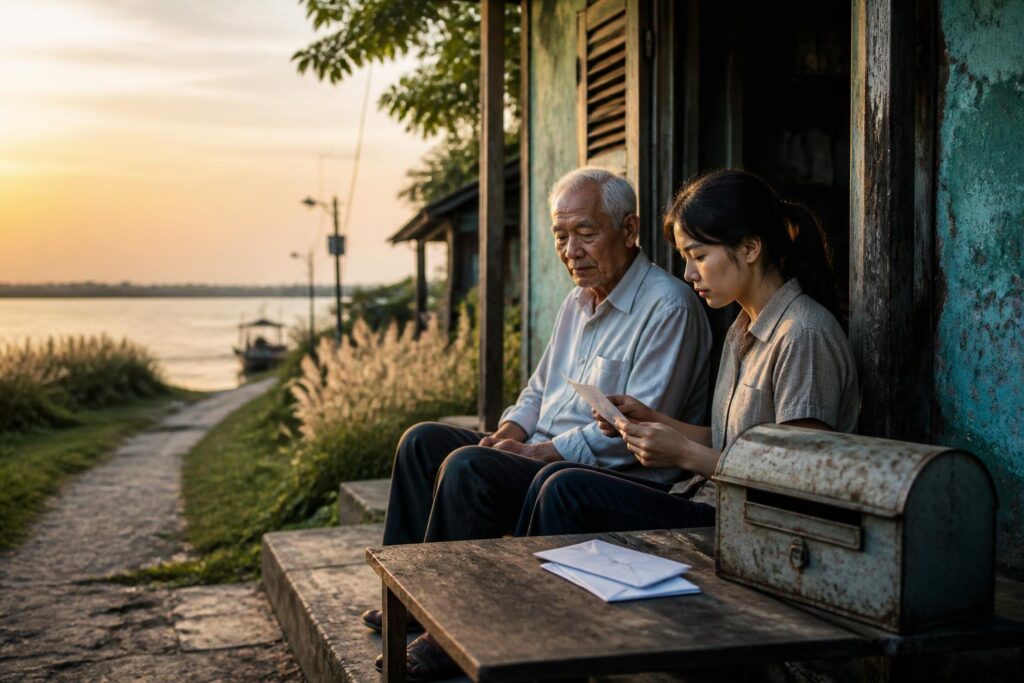
At the bottom of the slope leading down to the river landing stood a small house painted a faded blue. In front of the porch was an iron mailbox, with a few patches of white paint in the shape of flowers still clinging to its body. The locals called it Mr. Lam’s house. He was a postal worker who had retired many years earlier. Though he no longer wore his old uniform, he still kept the habit of waking very early, brewing a pot of tea, sweeping the yard, and then sitting at the wooden table to watch the road pass in front of the house.
Mr. Lam had once known every roof, every turn, and every name in town. He knew which families usually received letters at the beginning of the month, who was waiting for news from distant relatives, which house had a daughter studying in the city, and which father always pretended to be calm whenever he heard a motorbike stop outside the gate. But after thirty years in the profession, what he remembered most was not the addresses, but the letters that had never been sent.
The Drawer Without an Address
In the room at the back of the house, Mr. Lam had a low wooden cabinet with three drawers. The first held string, old stamps, and a few fountain pens. The second contained postcards that had faded with age. The last drawer was always locked. He let no one see inside, not even his granddaughter An, who often came over to help him clean every weekend.
One rainy afternoon, as the corrugated-metal roof rang with a steady patter, An happened to see a small key lying at the bottom of the tea box. She had not intended to open the drawer, but Mr. Lam had just gone around back to fetch firewood, and the cabinet stood right in front of her as though waiting for a decision.
Inside the drawer were dozens of unstamped envelopes. Some had yellowed with age; others were still new. Many of the envelopes bore only a name, with no address. On some others, the destination was written clearly, but beside it was a small note: “Not sent.”
An picked up a brown envelope. The recipient was Mrs. Hanh, the owner of the tailor shop at the head of the market. Inside was a sheet of paper containing only a few lines: “Mother, I understand now why you wouldn’t let me go far away back then. I’m sorry I was angry with you for so long.” The letter bore no sender’s name. An set it down and asked about it when Mr. Lam came back inside.
He looked at the open drawer but did not get angry. He simply pulled out a chair, added more tea, and said that those letters were not his. Other people had asked him to send them, but later changed their minds, failed to come back for them, or asked him to keep them for a while. Some were afraid of being rejected. Some thought they would speak the next day. And some had left before they had a chance to deliver their letters.
“Then why do you still keep them?” An asked.
Mr. Lam looked out at the rain. “Because sometimes, a person not being ready to speak doesn’t mean that what they want to say isn’t important.”
Stories Lying Still Inside Envelopes
The next day, An asked him to tell her about the letters. At first he was silent, but then the stories began to unfold one after another, like rooms that had not been entered for a long time.
There was a letter from a son to his father after the two had argued over selling a plot of garden land. The son thought his father was too stubborn, while the father believed his son saw only the value of the land and had forgotten the family’s memories. The letter had been written during a blackout. The next morning, the son left for the city, intending to come home that weekend and deliver it in person. But the years passed, and he called only on holidays, saying each time that he was busy.
There was a letter from a woman to an old friend. The two had once been close, but after a small misunderstanding, neither of them had been willing to explain. The woman wrote that she still remembered the afternoons when they rode their bicycles together to the riverbank, and that she still kept the hair clip her friend had given her on her birthday. She had intended to send the letter on the exact day of her friend’s daughter’s wedding, but in the end she thought the past was too distant. The envelope remained in the drawer for more than ten years.
There were also letters that no recipient needed to read anymore. An old man wrote to his deceased wife, telling her that he had learned to cook the soup she liked, though every time he seasoned it, he added too much. A young woman wrote to her brother, who never returned from a sea voyage. A child wrote to his father simply to ask why his father always came home after the child was asleep.
As An listened, the small room seemed to grow larger. She understood that unspoken words did not disappear. They merely lay still, gradually becoming a burden people carried into other conversations, into the way they looked at their loved ones, into the seemingly harmless silences of every day.
The Meeting by the River Landing
Among the envelopes, there was one letter that caught An’s attention most. The recipient was Mr. Lam. The sender’s name was Minh, someone An had never heard him mention. Inside was an apology from a boy to his older brother. He wrote that he had broken the oil lamp in the house, but because he was afraid of being scolded, he had blamed his brother. After that, the two brothers stopped speaking to each other. At the end of the letter, the sender wrote: “I know you don’t need an apology this late, but I still want you to know that I’ve remembered what happened for my entire life.”
“Who is Minh?” An asked.
It took Mr. Lam a long time to answer. Minh was his younger brother. The two of them had once lived with their mother in a house near the river landing. After the incident with the oil lamp, Minh left to seek work far away. Mr. Lam had been too proud at the time to ask his brother a single question. Many years later, Minh returned to look for him, but the old house had already changed hands. Mr. Lam had moved elsewhere for work, and someone he knew passed the letter on to him afterward.
“Why didn’t you look for him?” An asked.
“He died before the letter reached me.”
Wind from the river landing swept through the window. An did not know what to say. She looked at the grandfather who was usually so calm and suddenly felt that his shoulders were much smaller than she remembered.
That afternoon, Mr. Lam asked An to take him to the river landing. The road was not long, but he walked slowly and had to stop several times. When they arrived, he took an old envelope from his shirt pocket and placed it on the stone bench beside the reeds. He did not open the letter. He simply sat there for a long time, as though he had finally found an address for something that had been lost.
Speak While There Is Still Time
After the trip, An began noticing the hesitant pauses in her own family. Her mother often called to ask about very small things, such as what she had eaten that day or whether it was raining, but she never asked if An was sad. An, too, usually gave vague answers because she assumed her mother already understood.
That evening, An took the initiative and told her mother that she missed the meals they used to share. The statement was so simple that even An felt embarrassed. There was silence on the other end of the line for a few seconds, and then her mother asked when she would come home. The two of them did not resolve any great problem, but the conversation lasted longer than usual. Before hanging up, her mother said that she missed her too.
An realized that some words did not need to be written beautifully, nor did they need to wait for a special day. A thank-you, an apology, or a timely question could sometimes open a door that silence had closed. People often feared that their words would not be meaningful enough, or that others would not respond as they hoped. So they chose to wait. But waiting too long could turn something they wanted to say into a regret they would no longer have the chance to mend.
A few weeks later, An suggested that Mr. Lam repair the mailbox in front of the porch. She wiped away the dust, repainted the faded flowers, and placed a stack of blank paper beside it. There were also several new envelopes on the table, with no recipient’s name written on them.
“What are you going to do with them?” An asked.
“Nothing,” he replied. “They’re just there for anyone who needs them.”
From then on, people in the area began stopping by the blue house. Some came to take a sheet of paper; others simply sat and drank tea before leaving. A few letters were truly sent. A few others remained in their writers’ shirt pockets for many days, but at least they had taken shape. They were no longer vague words buried in people’s hearts.
The Address of Courage
The mailbox in front of the porch did not receive letters for the post office. Nor did anyone check it every morning. But whenever people passed by, they looked at it as they would look at a reminder: that in life, the hardest thing was sometimes not finding the right road to a distant place, but finding enough courage to walk over to the person who was very near.
Not every word spoken leads to a beautiful ending. Some apologies are not accepted, some words of love receive only silence in return, and some conversations make two people realize that they have drifted too far apart. Even so, honesty has a value of its own. It helps people stop guessing, stop constructing answers in their minds, and stop allowing the things they have not had the chance to say to control their lives.
One day at the beginning of the dry season, Mr. Lam closed the last drawer of the cabinet. He took out the old letters, returning them one by one to those who could still receive them, sending the letters with clear addresses, and placing the letters that could no longer be delivered in a small box beside the river landing. An asked why he did not continue keeping them.
He smiled. “Letters are born to be sent. If they are kept forever, they become nothing more than evidence of the things we did not dare to do.”
On the way home, An thought of the words waiting somewhere inside her. She knew she could not say everything today, but she also did not want to keep treating tomorrow as a certainty. Because sometimes, the map of things left unsaid does not lead people to a strange and distant land. It only leads them back to the people they once loved, the people who are still waiting for a sincere word by the porch.

ARTICLES IN THE SAME CATEGORY
The Empty Chair Beside the Veranda
The Lamplighter and the Road Without Darkness
A Small Promise Can Keep a Family’s Warmth Alive
When the Meal Slows Down, Family Grows Closer
The Unextinguished Lamp at the End of the Alley
The Silence Between Two Moments of Haste
ARTICLES IN THE SAME GENRE
The Seedling Who Knew How to Listen and the Forest That Awoke
Brown Squirrel’s Raincoat
The Wind Chime Finds Its Chime Again
Stepmother and Stepchild