
Zodiac Signs · 22 November, 2026
The Moon in the Birth Chart: An Emotional Landscape That Needs to Be Heard

While many people know the Sun sign as a symbol of identity and self-expression, the Moon in a birth chart points to a more private layer of experience. It speaks to the emotions that often arise before reason has a chance to speak, the need to be cared for, reactions under stress, and the feeling of what it means to have a safe place to return to. For this reason, learning about the Moon’s position is not merely a matter of reading one more element in astrology; it can also be an opportunity for each person to observe their inner life.
Astrology is symbolic and interpretive; it is not a scientific tool for reliably predicting personality or the future. A Moon placement cannot explain a whole person. Family, living environment, personal experiences, culture, and daily choices still have a major influence. The value of reading a birth chart lies in its ability to raise useful questions, thereby helping us recognize our emotions and behaviors more clearly.
What does the Moon represent?
In astrological language, the Moon is often associated with the inner world. If the Sun is linked to self-awareness and personal development, the Moon is more closely connected to emotional habits, memories, the need for protection, and natural reactions to circumstances. This is the part of a person that may not be easy to present before a crowd, yet becomes clearly visible during periods of exhaustion, privacy, or a loss of control.
The Moon is also often associated with how a person receives care and offers a sense of caring to others. Some people need direct questions and words of concern to feel connected. Others feel more at ease when their personal space is respected. Some find stability in familiar routines, while others need change and a sense of freedom. These differences should not be viewed as right or wrong. They simply show that each person has their own emotional language.
At a deeper level, the Moon can point to reactions that have become habitual. When facing pressure, a person may become silent, seek someone to confide in, try to control everything, or immediately shift into problem-solving mode. Such reactions may sometimes help them get through the situation at hand, but they can also become defense mechanisms that cause genuine emotions to be overlooked. Reading the Moon symbol should therefore go hand in hand with observing reality, rather than stopping at a personality label.
Moon signs and emotional needs
Determining the Moon sign requires a relatively accurate date, time, and place of birth, because the Moon moves much faster than many other elements in a birth chart. However, the calculated result is only a starting point for interpretation. More important is considering which descriptions genuinely reflect one’s experience, which do not fit, and why those differences exist.
The Moon in the Fire element group
People with the Moon in Fire signs are often interpreted as having emotional needs connected to initiative, enthusiasm, and the feeling of living in alignment with their inner drive. They may restore their energy through taking action, testing themselves, or pursuing something that excites them. When held back for too long, they may feel frustrated or impatient. An important lesson is distinguishing between action that comes from genuine inspiration and an impulsive reaction meant only to escape discomfort.
The Moon in the Earth element group
With the Moon in the Earth group, a sense of security is often associated with stability, practicality, and things that can be verified in everyday life. A reasonable schedule, a familiar environment, orderly work, or care expressed through concrete actions can bring reassurance. The limitation is that people in this group may sometimes endure for too long because they do not want to disrupt everything. Acknowledging emotional needs does not make them less strong; on the contrary, it is a way to maintain sustainability.
The Moon in the Air element group
The Moon in the Air group is often understood through the need to communicate, think, and understand situations clearly. A coherent conversation can help them organize their emotions more effectively. They often want to know the causes, context, and possibilities before responding. However, overanalyzing can sometimes turn emotions into a problem to be solved, when what is actually needed is simply to be heard. Learning to remain with a feeling that has no answer yet is also part of emotional growth.
The Moon in the Water element group
The Moon in the Water group is often interpreted as being sensitive to atmosphere, nuances in communication, and subtle changes in the people around them. They may remember emotionally rich experiences for a long time and need a sufficiently trustworthy space in which to open up. Empathy is a strength, but without boundaries, they can easily absorb other people’s moods as though they were their own emotions. Resting, naming their feelings, and creating healthy distance can help turn sensitivity into a source of understanding rather than a burden.
A Moon placement is not a personality sentence
A common mistake when reading a birth chart is treating a single placement as a complete explanation of a person. In reality, even two people with the same Moon sign can express themselves very differently. Someone who grew up in a family that encouraged emotional expression may use that energy openly. Someone else who experienced an unsafe environment may have developed the opposite form of defense, such as hiding their emotions or always preparing for the worst-case scenario.
Therefore, when exploring the Moon, it is worth also considering related elements in the birth chart, such as the house containing the Moon and the aspects interpreted within the astrological system being used. The house indicates the area of life where emotional needs tend to be expressed more strongly, while aspects may be used to describe ease or tension between different parts of the chart. Even so, these interpretations should still be regarded as a suggestive language, not absolute conclusions.
How to use the Moon symbol for self-observation
Instead of asking, “What exactly does my Moon say about me?” you can begin with questions closer to everyday life. When you are tired, what helps you regain a sense of safety? Do you usually seek support by voicing your needs, or do you wait for others to recognize them on their own? In important relationships, what behavior makes you feel respected? When you feel anxious, do you tend to control, withdraw, please others, or react intensely?
Writing down your answers over a period of time can provide more information than reading a short description. Record the situation, the emotions that arose, your initial reaction, and what you truly needed at that moment. For example, irritability may conceal a need for rest; silence may stem from a fear of being judged; and the desire to control every detail may sometimes come from a feeling of instability. Seeing the need behind a reaction is the first step toward choosing a different way to respond.
The Moon symbol can also be used when reflecting on relationships. Instead of assigning a fixed label to the other person, observe how the two of you differ in seeking closeness. One person may want to talk immediately after a conflict, while the other needs quiet time. One may express affection through words, while the other provides care through small acts. If both people understand this difference, they can negotiate their needs more clearly instead of assuming that the other person does not care.
Turning sensitivity into the ability to care for yourself
Understanding the Moon does not mean always indulging every immediate emotion. Emotions are signals worth listening to, but they are not always commands that must be followed. When someone realizes they are anxious, they can pause, breathe, take a walk, write down what is worrying them, or turn to a trusted person. If emotions persist, cause exhaustion, or seriously affect daily life, seeking professional support will be more practical than any astrological interpretation.
Emotional maturity does not mean eliminating familiar reactions, but having more choices before reacting. Someone who usually withdraws can learn to say that they need time while still wanting to continue the conversation. Someone who is quick to explode can recognize signs of overload and pause earlier. Someone who is always caring for others can practice clearly stating their own boundaries. Small changes like these turn self-understanding into concrete action.
Listening to the inner self with awareness
The Moon in a birth chart can be viewed as a symbolic mirror reflecting needs for safety, memories, and emotional habits. That mirror does not determine who you are, nor can it replace lived experience or psychological knowledge. It simply offers another way to ask questions, allowing you to pay closer attention to things often obscured by work, responsibilities, and the pace of life on the outside.
The greatest value of exploring the Moon sign does not lie in finding a fixed explanation, but in developing a more honest relationship with oneself. When people know what makes them anxious, what they need to recover, and how they should express their needs, they have a greater opportunity to build healthier choices. Listening to emotions does not make us weak. It is the foundation for living with awareness, establishing appropriate boundaries, and connecting with others clearly.
Related articles

The Moon in the Birth Chart and the Need for Emotional Safety
When discussing birth charts, many people usually begin with the Sun sign because it is the most familiar and accessible placement. However, if we want to understand inner life, how a person reacts to upheaval, or what makes them feel that they belong, the Moon is a noteworthy symbol. In common astrological interpretation, the Moon
Read more
The Ascendant and How Each Person Enters the World
When studying a birth chart, many people usually begin with the Sun sign because it is the most familiar placement. However, this single factor can hardly fully describe how a person appears in everyday life. Some people belong to the same zodiac sign but make entirely different impressions: one may be open and quick to
Read more
The Ascendant and How Each Person Enters the World
In a natal chart, many people first become familiar with the Sun sign because it is associated with their date of birth and is commonly used to identify their zodiac sign. However, if we want to understand more deeply how a person appears to the world, the Ascendant is also worth noting. The Ascendant, or
Read more
The Moon in the Birth Chart: A Map of Emotions and the Need to Be Understood
When exploring a birth chart, many people often begin with the Sun sign because it is the most familiar placement, associated with the date of birth and personality traits expressed outwardly. However, to understand inner life, looking only at the Sun sign is not enough. In the symbolic language of astrology, the Moon is often
Read more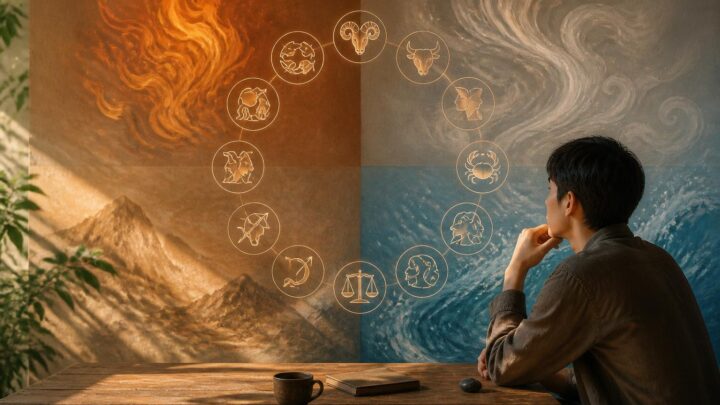
The Twelve Zodiac Signs and the Art of Reading Ourselves Through Differences
The Zodiac Should Be a Mirror, Not a Label In modern life, the zodiac often appears in many familiar situations. Someone may read a morning horoscope before starting the workday, ask a new acquaintance about their sign during a conversation, or use the characteristics of the twelve signs to explain why someone likes quiet, is
Read more
The Ascendant in the Birth Chart: First Impressions and How We Enter Life
In a personal birth chart, the Sun sign is often mentioned as a symbol of the ego and direction of development, while the Moon sign is associated with emotional life and the need for security. Alongside these two familiar placements, the Ascendant also plays a noteworthy role. It is the zodiac sign located on the
Read more