

 Tiếng Việt
 日本語
日本語 한국어
한국어 中文 (中国)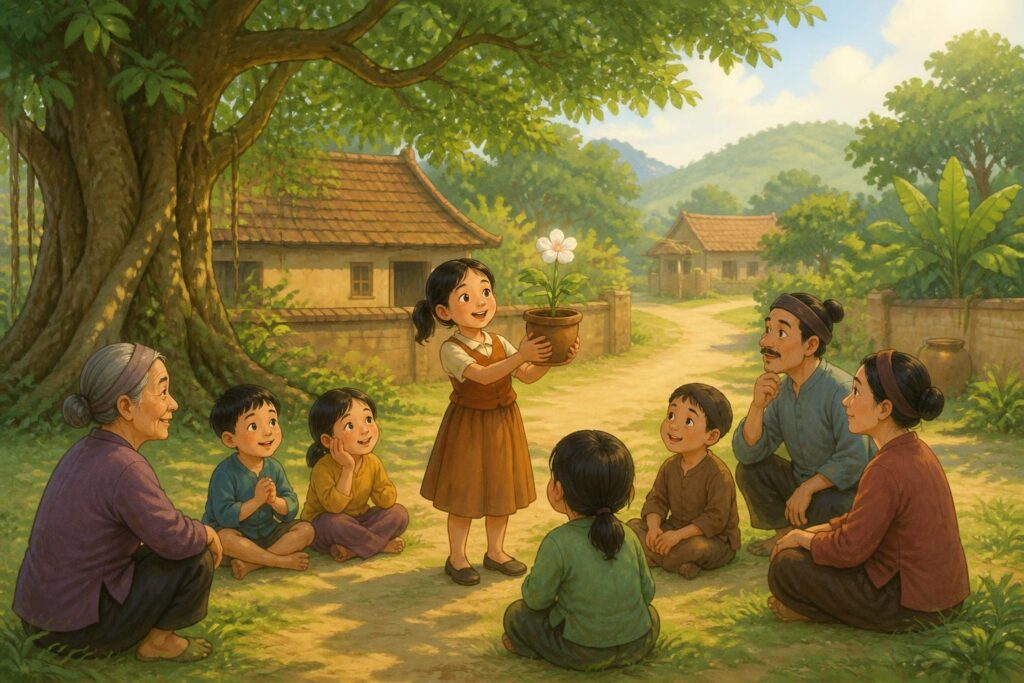
The Seed in the Wooden Box
Once upon a time, at the foot of a green hill, there was a small village called Sunny Village. The houses in the village huddled close together, and in front of every porch stood a water jar and several flower pots. The people there were hardworking and honest, but everyone was busy with their own work. The rice farmers worried about the fields, the goatherds walked along the mountainside, and the children went to school early in the morning and returned only when the sun had slanted past the bamboo grove.
In the village lived a little girl named May. May was neither the strongest nor the quickest child, but she had a special ability: she knew how to listen. When a frightened baby bird chirped beside the kitchen roof, May sat still until it calmed down. When the old woman next door was sad because the wind had carried away her scarf, May did not hurry to say that it was only a small matter. She sat beside the old woman, listened to her tell how the scarf had been with her for so many years, and then went searching for it with her.
One afternoon at the end of the rainy season, May helped her grandmother clean the old attic. In a dusty wooden chest, the girl found a small bamboo box. The box had no lock. Inside was only a round, light-brown seed and a piece of paper that had yellowed with age. Written on the paper were the words: “This seed will sprout when it hears something that people often forget to say.”
May read the sentence over and over. She brought the box down to the kitchen and asked her grandmother:
“Grandmother, what is it that people often forget to say?”
Her grandmother smiled, her eyes reflecting thoughtfulness.
“It could be thank you. It could be I’m sorry. Or it could be something even simpler, such as telling someone that you are sad.”
May did not fully understand, but she still asked her grandmother for a small clay pot. She placed the seed in the middle of the soft soil, watered it a little, and set the pot by the window. The next day, May eagerly ran to look. The seed was still lying motionless. The following day was the same. By the seventh day, the soil in the pot was still as flat and quiet as if no seed had ever been planted.
The Forgotten Words
May did not lose heart. Every morning, the girl sat beside the pot of soil and told the seed about the events of the day. She told it about the calico cat that often slept on the haystack, the difficult math problem in class, and the cloud shaped like a fish. Yet the seed did not move at all.
One day, on her way home from school, May saw two brothers, Tung and Ti, standing beside a fence. Tung was holding a torn kite, while Ti stood with his arms crossed, looking in the other direction.
“You tore my kite and refuse to admit it,” Tung said angrily.
“I only touched it a little. You scolded me before asking anything,” Ti replied, his eyes red with tears.
May walked closer. She did not immediately say who was right or wrong. She looked at the kite, then at the two brothers. Tung was still gripping the string tightly, while Ti kept using the tip of his toe to draw little lines in the dirt.
“Would you two like to tell me what happened?” May asked.
Tung explained that he had just finished making the kite after many afternoons of work. When he went to get some bamboo, Ti had taken the kite and run out into the yard. A strong gust of wind blew the kite into a tree branch and tore off one corner. Ti said that he had only wanted to see how the kite would fly, but because he was afraid of being scolded, he had kept silent. When Tung saw it, he became angry right away.
May quietly picked up the kite. She realized that the tear was not very large, but the anger between the two brothers was growing larger and larger.
“Tung,” May said, “perhaps what you want to hear is not just an explanation. You want Ti to say that he knows how much effort you put into it.”
Tung lowered his head.
“And Ti,” May continued, “perhaps you want your brother to hear that you did not mean to ruin the kite. But you also need to tell the truth that you took his things without asking.”
Ti bit his lip and then said softly:
“I’m sorry, brother. I know you spent a long time making the kite. I was afraid, so I didn’t dare tell you right away.”
Tung was silent for a while. At last, he reached out and rubbed his brother’s head:
“I’m sorry too for scolding you before listening to what you had to say. Next time you want to play with it, ask me first, all right?”
The two brothers carried the kite home together to repair it. May walked beside them, feeling relieved. That evening, when the girl told the story to the seed, a very soft sound came from the pot. The soil rose, and a tiny green sprout appeared.
The Young Plant Grows Only When Someone Is Honest
May happily called her grandmother. Her grandmother bent down to look at the sprout and said:
“It has heard something that was forgotten.”
“Was it an apology?” May asked.
“Perhaps. But it was not only an apology. What mattered was that the two brothers honestly expressed what they felt and were willing to listen to each other.”
From that day on, May took even better care of the young plant. She did not water it too much or tug at its leaves to see how quickly it was growing. Each day, she simply placed the pot where there was gentle sunlight, lightly loosened the soil, and told it sincere stories from the village.
Before long, the young plant grew two more round leaves. But then, for an entire week, it did not grow any further. Worried, May asked her grandmother whether she had been caring for the plant incorrectly.
Her grandmother replied:
“This plant needs more than soil and water. Perhaps there is something in the village today that has not been said.”
May walked around the village to find out. She saw the carpenter sitting in front of his house, looking at a chair that was still unfinished. He had promised to make a chair for Lan’s family, but several rainy days had caused the wood to become damp, slowing the work more than expected. Lan walked by, looking displeased.
“You’re taking too long,” she said. “If I had known it would be like this, I would have asked someone else.”
The carpenter did not answer. He only lowered his head toward the chair, although his hands were already aching from exhaustion.
May stood there for a while, then asked:
“Is there something you would like to say to Lan?”
The carpenter sighed. He explained that he had tried to make the chair especially sturdy because he knew Lan wanted to use it for her elderly mother. He did not want to use the rain as an excuse, but he was also hurt that Lan thought he was lazy.
May turned to Lan. Lan silently looked at the chair. After a moment, she touched the wooden surface, which still smelled fresh.
“I’m sorry,” she said. “I was worried about my mother, so I became impatient, but I didn’t ask you why the work was delayed.”
The carpenter smiled:
“I’m sorry too for not telling you sooner that the wood had become damp. If I had explained, perhaps you would not have had to wait anxiously.”
The two of them discussed a new date for receiving the chair. Neither of them lost anything because of those apologies. On the contrary, they understood each other better. That evening, when May returned home, the young plant had grown another new leaf.
A Garden of Honest Things
News of the strange young plant spread throughout Sunny Village. Children came to May’s house, and adults also found excuses to pass by the window and look at the growing tree. Everyone wanted to know what kind of flowers it would bloom and what kind of fruit it would bear. Some said it was a tree that produced gold, while others guessed that it would grow fragrant pastries.
But May realized that the tree grew only after someone spoke sincerely and was willing to listen to another person. So the girl did not let anyone pick its leaves or touch its trunk. She told everyone to care for it with patience.
One morning, the village chief came to see May. He said that the villagers were arguing about the road leading up the hill. The vegetable farmers wanted to widen the road so they could transport their produce, while the families living nearby were afraid that vehicles would damage the fields and endanger young children. Everyone spoke louder than everyone else, but no one was truly listening.
May suggested that everyone sit in a circle beneath the banyan tree. She placed a clay bowl in the middle of the circle and said:
“Whoever holds this bowl may speak. Everyone else will listen without interrupting. When that person has finished speaking, they will put the bowl down to give someone else a turn.”
At first, many people were unaccustomed to this and kept looking at one another impatiently. But gradually, each person began to tell what they were worried about. The vegetable farmers spoke about the mornings when they had to carry their produce a long distance. A mother with a young child said that the slippery road always made her afraid her child would fall. An old man remembered the bushes that had once provided shade for people walking along the road. After listening to all the stories, they realized that everyone was trying to protect something important.
In the end, the villagers agreed to widen only part of the road where the land was empty, preserve the large trees, and build a separate narrow path for children. The work would take more time, but the people were no longer as angry as before. They worked together, with some contributing bamboo, some stones, and some their labor.
That night, the young plant in the pot suddenly stretched higher than the window frame. The next morning, a white flower bud appeared at its tip. The bud opened little by little. Inside there was no gold, silver, or sweet pastry. It was a flower as clear as a dewdrop, giving off a cool, gentle fragrance.
A Gift for the Whole Village
Grandmother told May to bring the tree to the middle of the village yard. When everyone had gathered, the flower trembled in the wind and then split into many tiny seeds. The seeds flew away, falling into garden beds, along roadsides, and beneath the porches.
The villagers asked May in amazement what was happening. May remembered the piece of paper in the bamboo box and told them the whole story. After listening, Grandmother said:
“Perhaps this seed never belonged to just one person. It was born to remind everyone that speaking sincerely does not make us smaller. Knowing how to apologize is not weakness. Knowing how to say thank you is not mere politeness. And knowing how to listen is a way for us to see other people’s hearts.”
From those tiny seeds, many young trees grew throughout the village. There was one beside the water well, one next to the classroom, and one in front of the carpenter’s house. They did not bloom every day, but whenever someone in the village was willing to speak truthfully, admit a mistake, or sit quietly and listen to someone who was sad, a white flower bud appeared on the branches.
May grew up and became the caretaker of the village’s shared garden. She still kept the old bamboo box, but there were no more seeds inside. Instead, it held a new piece of paper written by May herself: “A kind word needs a pair of ears that knows how to listen. A listening heart will find a way to bring people closer together.”
Later, whenever disagreements arose, the people of Sunny Village no longer hurried to scold one another or turn away and leave. They would often sit together beside the clear flowers, pass the clay bowl from hand to hand, and take turns telling one another what they thought. Some conversations lasted a very long time, but afterward everyone felt lighter at heart.
And the girl May understood that the greatest miracle did not lie in the seed or the flower. The true miracle lay in the moment when one person was willing to stop and listen, and another person was brave enough to say what they had hidden in their heart.
Lesson: When we know how to listen with patience and express our feelings sincerely, we can resolve many misunderstandings. A timely apology, a heartfelt thank-you, or a gentle question can sometimes be the very seed that helps love grow.

ARTICLES IN THE SAME CATEGORY
The Bridge of Kind Words
The Wind Chime That Awakened the Garden
The Seed Asleep Beneath the Fig Tree
Brown Squirrel’s Leaf Bridge
The Little Bell and Little Hedgehog’s Promise
The Seedling That Knew How to Listen
ARTICLES IN THE SAME GENRE
The Wind Chime That Awakened the Garden
The Button That Went Looking for Someone Who Keeps Their Word
Tam Cam Part 2: The Vengeful Spirits of the Palace
Tam and Cam: The Palace Intrigue and the Original Ending – Part 1
Tam Cam
Coconut Skull