

 Tiếng Việt
 日本語
日本語 한국어
한국어 中文 (中国)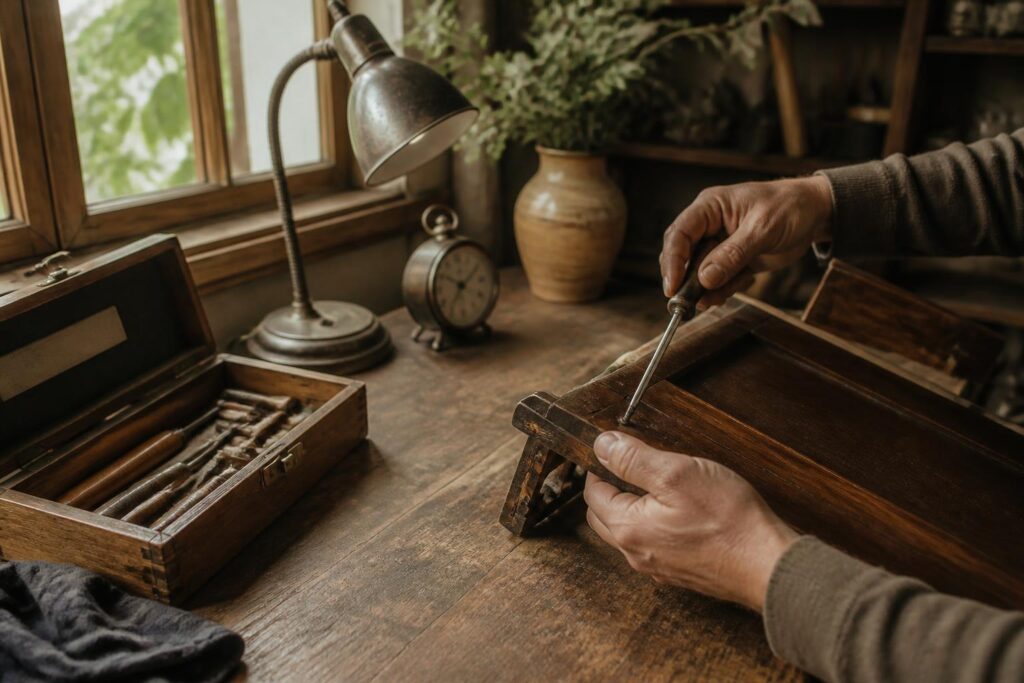
In a modern home, objects often pass through our lives at astonishing speed. A phone is replaced when its battery starts to weaken, a shirt is abandoned simply because a thread has come loose, and a wobbly chair is sometimes sent straight outside before anyone has had time to consider whether it could be repaired. Buying something new is often much easier than finding a way to keep an old item useful.
Yet amid a pace of life that constantly urges people to be faster, newer, and more convenient, objects that have been used for many years quietly offer a different lesson. They remind us that not everything old has lost its value, just as not every malfunction is a sign that we need to start over from the beginning. Sometimes, all that is needed is to pause, observe more carefully, and give things a chance to be cared for.
Old Objects Are More Than Material Possessions
A wooden table marked with scratches, a pot that has darkened at the bottom, or a fan that makes a faint noise may no longer be perfect. But that imperfection often contains history. The scratches on a tabletop may have appeared during children’s homework sessions, family gatherings around a meal, or a hurried house move. Faded paint on a door may bear the marks of sunlight, rain, and many years of opening to welcome loved ones home.
People often associate memories with places, sounds, and scents, but objects also preserve memories in their own way. An old towel may make us think of our mother’s hands. A chipped ceramic cup may bring back memories of the kitchen in a house that was sold long ago. A radio that can no longer tune in to many stations may still make someone who once listened to the news with their grandparents feel a sense of closeness. The value of such objects does not lie in their market price, but in the connections they create between the present and what has passed.
This does not mean that every old object must be kept. An item that is completely broken, no longer safe, or taking up space without providing any benefit can be replaced. Living slowly does not mean turning a home into a storage room for memories. The point is that before throwing something away, we should ask ourselves: has this object truly reached the end of its ability to serve, or does it simply need one repair and a little patience?
Repair Is a Form of Care
In many families, repairing things was once an ordinary skill. Adults knew how to replace a lock, mend a seam, tighten a loose screw, or make use of an old material to create a new function. These tasks may not offer a glamorous feeling, but they teach people to observe causes rather than merely react to results.
When a chair wobbles, we have to find out whether a leg is misaligned, a joint is loose, or the floor is uneven. When a faucet leaks, we need to determine whether the water is escaping from a connector, a valve, or a pipe. The repair process forces us to slow down and look at the situation more specifically. Instead of concluding, “This is broken,” we learn to ask, “Where is it broken, and what can be done?” This way of asking questions is useful not only with objects; it can also change how we face many problems in life.
A tense conversation is not necessarily a sign that a relationship has ended. An unproductive workday does not mean that a person has lost their ability. A period of exhaustion does not mean that one’s entire life has gone in the wrong direction. When we know how to distinguish between one part malfunctioning and the whole losing its value, we become less likely to rush into irreversible decisions.
Repair is also a form of care. A craftsperson spends time on an old watch because they understand that its owner does not merely need to know the time but also wants to preserve a piece of memory. A father who patiently fixes a drawer for his child is not merely doing a household chore; he is also conveying the message that things of meaning deserve to be cared for. Small actions like these create a sense of attachment that buying something new cannot always provide.
The Value of Using Things Long Enough
The habit of constantly replacing things is often driven by advertising, trends, and the feeling that we will be happier when we own the latest version. A new item can indeed offer convenience, but that satisfaction is sometimes shorter-lived than we imagine. After a while, the feeling of novelty fades, while the urge to buy more continues to arise. Without awareness, people can easily fall into a cycle of buying, using, getting bored, and discarding.
Using an item for long enough helps us see more clearly the difference between a need and a passing desire. A shirt that is still comfortable to wear does not become useless simply because there is a different style this season. A phone that still meets our communication and work needs does not necessarily have to be replaced just because the market has a new model. Considering when to buy, whether something can be repaired, and how long it can be used makes consumption decisions more deliberate.
This is also a way to reduce household waste, even if each person starts with only very small choices. Reusing a box, repairing a bag, taking good care of a pair of shoes, or giving a still-useful item to someone else are all concrete actions. They do not solve every problem in society, but they help people realize that each daily choice has an impact beyond the walls of their own room.
Decluttering Does Not Mean Erasing the Past
Some people keep too many objects because they are afraid of losing their memories. Conversely, others clear everything out in one go because they want to begin a new life. Both extremes can leave us exhausted. A healthy space does not need to contain every memory, but it also does not have to be so sterile that no trace of human life remains.
When reorganizing the home, we can divide objects into a few simple groups: things used regularly, things that can be repaired, things that should be given away, and things that have completely lost their practical value. For items with a special emotional attachment, it may be enough to keep a few representative pieces instead of storing everything. A photograph of ourselves with an old lamp may sometimes be enough to preserve the story; it is not necessary to keep the lamp in a corner of a cupboard for many years.
The important thing is that decluttering should make us feel lighter, not guilty. A gift that is no longer suitable does not mean that the giver’s affection has disappeared. Giving a keepsake to someone else to use does not mean that the past has been denied. Memories reside in people before they reside in objects. When we understand this, we can let go more peacefully.
Learning to Slow Down Through Small Things
There is no need to turn repair into a grand philosophy. We can begin by sewing a button back on, cleaning a fan, sharpening a kitchen knife, or organizing a drawer instead of buying more storage boxes. As we work, we can pay attention to how we feel. At first, the task may seem time-consuming, but afterward we may realize that keeping our hands busy helps our minds become less scattered. Time spent away from a screen can also bring the quiet we often seek in faraway places.
We can also practice postponing a nonessential purchasing decision. Simply wait a little longer, write down why we want to buy the item, and consider whether it truly addresses a specific need. If the answer remains clear, the purchase will be more intentional. If the desire fades, we will have both saved money and avoided bringing another unnecessary object into our lives.
These small actions do not make life slow or lacking in convenience. On the contrary, they help us use convenience consciously. Technology can still support people, and new things can still be purchased when necessary, but the final decision is no longer guided entirely by haste.
A Different View of Resilience
Old objects teach us that resilience does not mean holding on to everything at any cost. Resilience means knowing what is still worth caring for, what needs to change, and what should be let go. A table that has been polished can continue serving for many years, but a frayed electrical cord needs to be replaced immediately to ensure safety. Clear-mindedness must always accompany affection.
The same is true in human life. We can be patient with a relationship that is facing difficulties, but we should not use the word “effort” to justify prolonged hurt. We can give ourselves more time after a failure, but we also need to recognize when a path is no longer suitable. The lesson from repair is not to keep everything, but to look carefully before deciding.
In a world accustomed to replacing things quickly, the ability to care for and restore them becomes a valuable quality. It makes people appreciate the effort that has been invested, understand the limits of material things more deeply, and take greater responsibility for what they own. More importantly, it creates a pace of life in which every choice has time to be considered.
One day, the cup we are using may break, the shirt may become worn, and the table may no longer be as sturdy as before. Not everything lasts forever. But during the time they accompany us, these things deserve to be used respectfully and cared for properly. When we learn to repair an object instead of immediately throwing it away, we are also learning to look at people, relationships, and ourselves with greater patience. That may be the deepest value that old objects can give back to modern life.

ARTICLES IN THE SAME CATEGORY
A Meal with Someone Waiting: The Art of Keeping a Home Close
The Keeper of the Bus Tickets
The Room with a Window Overlooking the Backyard
The Clock Repairer and the Forgotten Hours and Minutes
The Scent of Rain on the Old Tile Roof
The Water Carrier Across Windy Hill
ARTICLES IN THE SAME GENRE
The 12 Zodiac Signs and How Each One Establishes Healthy Boundaries
Learn to Repair Before Replacing: A Slower Way of Living in an Age of Fast Consumption
Living Mindfully in an Age of Information Overload
From Knowing a Lot to Understanding Deeply: How to Build Systematic Thinking
Setting Boundaries in Digital Life to Regain Focus
The Art of Slowing Down in a World That Is Always Urging Us On