

 Tiếng Việt
 日本語
日本語 한국어
한국어 中文 (中国)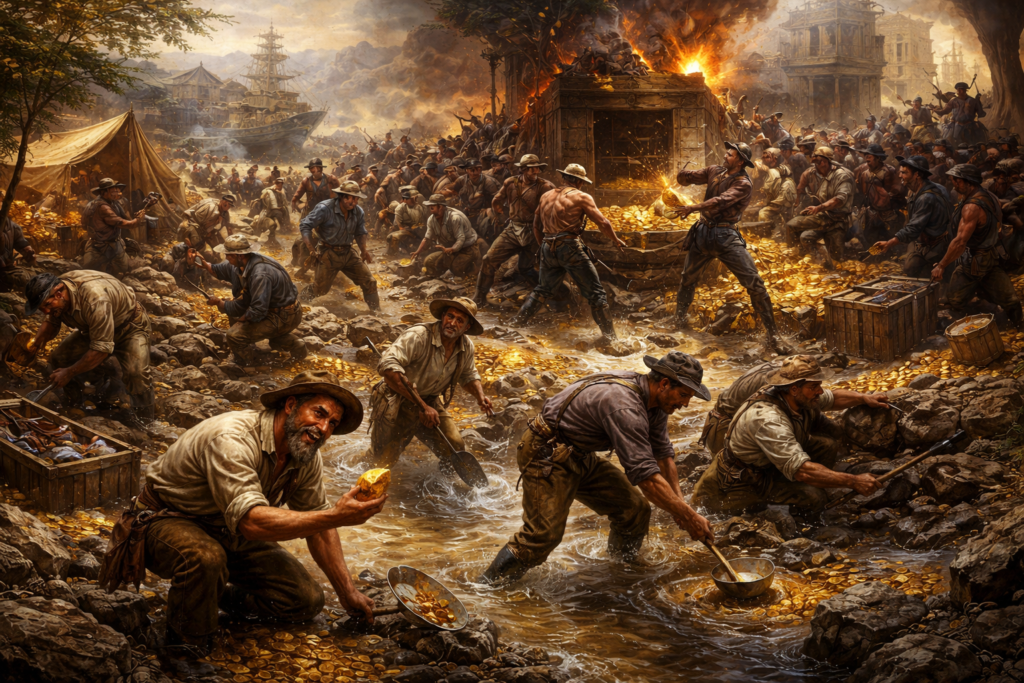
Throughout history, gold has always been seen as a symbol of power, wealth, and financial security. In times of stability, gold is jewelry and stored wealth. In times of uncertainty, gold becomes the final refuge of trust. Yet it is precisely in these moments that human greed rises most strongly, creating waves of speculation, hoarding, and competition that drive gold prices upward while simultaneously fueling deeper economic, political, and social instability.
Vietnamese ancestors once warned that greed leads to ruin. The Buddha also taught that greed is one of the three roots of suffering. When these teachings are applied to historical upheavals involving gold, a recurring pattern emerges: wherever gold becomes the object of collective greed, disorder soon follows.
When Gold from the New World Shook Europe
In the sixteenth century, following conquests in the Americas, the Spanish Empire brought vast quantities of gold and silver back to Europe. At first, this wealth was seen as a blessing. Overflowing treasuries allowed the monarchy to wage wars, build palaces, and fund expeditions.
However, the massive inflow of precious metals into the economy caused widespread price increases. This period became known as the Price Revolution. Currency lost value, living costs rose rapidly, and workers and peasants fell into hardship. The enrichment of the monarchy and nobility went hand in hand with the impoverishment of the masses.
Here, greed was not merely personal but imperial. The desire to extract wealth from colonies created a prolonged monetary shock. A Vietnamese proverb says, “Grasping a bowl and losing the whole tray.” Spain held gold in its hands but gradually lost its long term economic foundation and declined on the global stage.
The Buddha taught that actions driven by greed create suffering. In this case, the consequences appeared not in mystical form but through inflation, poverty, and social unrest.
Gold Rushes and the Dark Side of the Dream of Fortune
The nineteenth century witnessed major gold rushes in California, Australia, and the Klondike. News of new gold discoveries spread like wildfire. Hundreds of thousands abandoned farms and families, crossing mountains and rivers with dreams of becoming rich overnight.
Boomtowns sprang up rapidly around goldfields. Saloons, gambling halls, and brothels developed faster than schools or hospitals. Law enforcement was weak, and violence and robbery were common. Indigenous populations were displaced from their lands, and many traditional communities were destroyed.
Gold brought wealth to a few, but it also brought crime, disease, and the collapse of local social structures. When the gold ran out, many towns became ghost towns, leaving behind broken lives and unfinished stories.
An old saying goes, “What is taken from the earth must be repaid to the earth.” Gold rushes clearly illustrate this. When people exploit resources purely for short term greed, long term social and environmental damage often follows. The Buddha reminded that desire is never satisfied; the more one chases it, the more exhausted one becomes. The image of gold seekers returning home empty handed vividly reflects this teaching.
Gold and the Global Monetary Shock of the Twentieth Century
In the twentieth century, gold became not only a precious metal but also a pillar of the international monetary system. Many currencies were tied to gold, creating a sense of stability and discipline. However, as wars and public spending grew, governments began to see gold as a constraint.
In 1971, the United States ended the convertibility of the dollar into gold. This decision ushered in the era of fully fiat money. While it initially gave governments more flexibility, it also opened the door to high inflation in the following decade.
As prices rose and trust in paper money weakened, investors and ordinary people rushed to buy gold. Gold prices surged, reflecting fear and uncertainty about the monetary system. Gold became a barometer of instability.
Vietnamese wisdom says, “Money entering the house is like wind entering an empty home.” When paper money rapidly loses value, savings evaporate and people feel powerless. The desire to preserve wealth pushes them toward gold, yet this very movement can make financial markets more volatile.
The Buddha taught that all things are impermanent. Trust in a seemingly solid monetary system can change with a single political decision. Clinging absolutely to any form of wealth carries the risk of suffering.
Gold in Modern Crises
During the global financial crisis of 2008 and the later pandemic period, gold once again proved its role as a safe haven. When banks collapsed, stock markets plunged, and economies stalled, capital flowed heavily into precious metals.
This phenomenon has two sides. On one hand, it reflects a legitimate defensive instinct. On the other, it fuels herd behavior and speculation. Many buy gold not for long term protection but for short term profit. As prices rise, greed rises with them, creating a self reinforcing cycle.
Capital flowing into gold means capital leaving productive sectors. Businesses face tighter financing, investment slows, and economic recovery weakens. In this way, individual efforts to seek safety can unintentionally weaken the broader economy.
An old saying teaches that one tree does not make a hill, but many trees together do. When everyone focuses only on personal protection, society struggles to generate the collective strength needed to overcome crises. Individual greed, even when rational on its own, can become a systemic burden.
When Central Banks Also Turn to Gold
In recent years, many central banks have increased their gold reserves. This often reflects a desire to reduce reliance on a single reserve currency and to hedge geopolitical risks.
To some extent, this is a rational strategic move. However, when many countries simultaneously buy gold, prices are pushed even higher. Markets interpret this as a signal of growing global anxiety, further amplifying defensive sentiment.
A feedback loop forms. Instability drives gold purchases. Large scale gold buying signals instability, making financial markets more sensitive. Gold not only reflects fear but can also amplify it.
Ancient wisdom says that people’s hearts are like water; they can carry a boat or overturn it. Trust in the financial system works the same way. When trust is strong, money flows smoothly. When trust falters, gold rises and waves of instability follow.
Rising Gold Prices and Social Consequences
Sharp increases in gold prices often bring effects beyond financial markets. In many countries, people rush to buy gold and withdraw money from banks, increasing pressure on the financial system. Wealth gaps can widen as those who already own gold benefit, while others suffer from inflation.
In regions with informal gold mining, high prices encourage uncontrolled digging, leading to pollution, landslides, and conflicts over land and resources. Gold, once a store of value, becomes a source of destruction and dispute.
The Buddha taught that craving leads to attachment, and attachment leads to suffering. When society overvalues gold as the ultimate security, people may live in constant anxiety, always fearing loss. Inner peace is traded for material reassurance, yet that reassurance remains fragile.
Lessons from History and a Reminder for the Present
Looking back at periods of soaring gold prices, one common thread appears. Gold shines brightest during the darkest moments of trust. Greed, whether in the form of profit seeking or asset protection, can intensify instability if not guided by balance and wisdom.
Vietnamese tradition advises knowing what is enough. The Buddha emphasized the Middle Way, avoiding extremes of indulgence or deprivation. Applied to gold, this suggests that balance is the true foundation of stability. Gold can play a role in finance and personal assets, but when it becomes a collective obsession, society risks falling into a spiral of anxiety.
History does not condemn gold, nor does it glorify it absolutely. What has been warned against across generations is uncontrolled greed. When greed leads, gold can shift from a symbol of security to a catalyst of division and unrest.
In a world of continuing uncertainty, this lesson remains deeply relevant. Maintaining clarity in the face of feverish rushes, nurturing trust in long term values, and supporting sustainable development may be the best ways to avoid repeating the spirals history has already shown us.

ARTICLES IN THE SAME CATEGORY
Read less, understand deeply: 4 filtering layers to keep you clear-headed amid a sea of information
The art of saying “no” without offending: 7 boundary techniques for modern Vietnamese
Maintaining a slow pace of life in the era of short attention: small strategies for long-term calm
Reducing Digital Noise: 9 habits to streamline information for a lighter mind every day
Heavenly Officials in Vietnamese Folk Belief: Bestowers of Blessings from the Celestial Realm
The Judge Figures in Vietnamese Folk Belief: Guardians of Justice in the Afterlife
ARTICLES IN THE SAME GENRE