

 Tiếng Việt
 日本語
日本語 한국어
한국어 中文 (中国)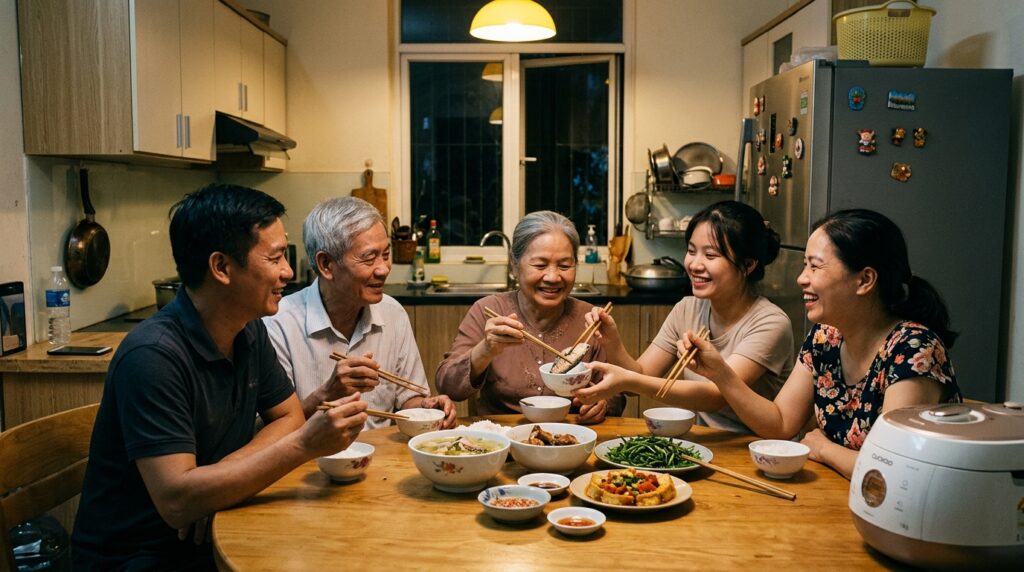
There are families who still live together under one roof but are increasingly unlikely to truly see one another. In the morning, those going to work rush out, while the children head to school amid a constant stream of reminders. In the evening, whoever comes home first eats first, and whoever comes later reheats the food, while conversations are often fragmented by phones, work, and personal concerns. The kitchen is still lit, and the table still has a full spread of dishes, but the feeling of gathering together gradually becomes thinner.
In modern life, family meals are no longer as easy to maintain as they once were. Conflicting work schedules, long commutes, packed school schedules, and one appointment after another often lead people to think that simply loving one another is enough. In reality, if love is not expressed through time, attention, and repeated actions, it can easily be obscured by the hurried pace of life. A warm family is not formed through a few large celebrations, but through many ordinary moments deliberately preserved.
What Matters in a Family Meal Is Presence, Not an Elaborate Spread
Many people hesitate to organize family meals because they think they must cook many dishes, clean everything thoroughly, or wait until the weekend before everyone can sit down together. This way of thinking unintentionally turns gathering together into a burdensome task. Meanwhile, a simple meal of soup, vegetables, and a familiar savory dish can still become a time of connection if everyone is truly present with one another.
Presence does not simply mean sitting at the same table. It means that each person temporarily sets work aside, does not answer messages while eating, does not let a screen take up all their attention, and does not treat a few minutes of conversation as a task to finish as quickly as possible. Loved ones usually do not demand overly grand words. They need to feel that their stories are being heard, their faces are being seen, and their presence matters.
Therefore, a family does not necessarily need to establish a rigid schedule. It can begin with two or three meals a week, on relatively convenient days. If everyone cannot eat at the same time, they can still set aside a short period to sit beside one another, drink tea, eat fruit, or recount something memorable from the day. What matters is creating a rhythm that repeats regularly enough so that closeness does not depend entirely on luck.
Do Not Turn the Dining Table Into a Place of Interrogation and Criticism
One reason family members may be reluctant to sit together is that the dining table sometimes becomes a place of reprimand. As soon as a child sits down, they are asked about their grades; older people are reminded about their health; working adults are questioned about their income or personal decisions. When every meal is associated with the feeling that they are about to be judged, people will find ways to eat as quickly as possible and leave.
Families need to have serious conversations, but not every issue should be brought up while everyone is eating. Advice that is appropriate in content but wrong in timing can still cause hurt. The dining table should first and foremost be a place that creates a sense of safety, where each person can tell a small story without immediately being compared, corrected, or blamed.
This does not mean adults must remain silent about every inappropriate behavior by their children, or that family members must avoid every disagreement. A better approach is to distinguish between listening and judging. When a child talks about a difficult day, parents can ask, “What upset you the most?” instead of quickly saying that the child overreacted. When a spouse shares their stress, the other person can ask whether they want to be listened to or want to look for a solution together. A well-timed question often opens up more connection than a long lecture.
Small Stories Help Loved Ones Understand One Another’s Lives
In a family, not everyone has a habit of telling stories. Some people grew up in environments where expressing emotions was considered a weakness; others are used to enduring things alone because they think their loved ones are already too busy. Therefore, do not wait for a family member to naturally become open. Sharing often needs to be encouraged through gentle and specific questions.
Instead of asking the general question, “How was your day?”, you might ask, “Did anything make you laugh today?”, “What made you the most tired today?”, or “Was there anything today that made you feel proud of yourself?” Questions like these do not force the other person to tell a major story. They simply open a small door for each person to enter the lives of the others.
Adults should also share about themselves, to an appropriate extent. A child will find it difficult to learn how to talk about emotions if they are always required to answer while their parents never say that they have felt worried, disappointed, or in need of rest. When parents say that they did not handle something well today and are looking for a way to fix it, their children will understand that no one in the family has to play the role of a perfect person. A sufficient degree of sincerity helps make the distance between generations less rigid.
However, sharing does not mean unloading every burden onto loved ones. Overly complicated issues require choosing an appropriate way and time to discuss them. The goal of a family conversation is not to make everyone know absolutely everything, but to ensure that no one feels completely left outside.
Sharing Household Chores Is Also a Way to Nurture Connection
Many families talk about love but allow one person to quietly bear most of the work of preparing meals, cleaning, and caring for the other members. In that case, the meal may still take place, but behind it lie exhaustion and the feeling of being unrecognized. To preserve a warm atmosphere, the family needs to view housework as a shared responsibility rather than one person’s assumed sacrifice.
Not everyone cooks well, cleans quickly, or has the same standards of tidiness. Therefore, the division of labor should be based on ability, time, and initiative, not only on roles within the family. One person can buy the ingredients, another can cook a simple dish, and young children can set out the bowls and chopsticks or wipe the table within their abilities. These tasks not only reduce one person’s burden but also help each member understand that a shared meal is the result of everyone’s contribution.
What should be avoided is assigning tasks together with complaints or reminders of what one has done. If someone has completed their share of the work, they should not have to continually prove how hard they have worked. At the same time, those receiving care should know how to express thanks and proactively reciprocate. A specific thank-you, such as acknowledging the meal that was prepared or the effort put into cleaning, can make everyday work feel less invisible.
When Family Members Have Different Schedules
Not every family has the conditions to maintain meals at the same time. A person working the night shift, someone traveling for work, a student living far away, or a member with an unusual class schedule can all make gathering together difficult. In such circumstances, do not turn one single format into the standard for love. The family can find more flexible ways to stay connected.
A short breakfast before everyone leaves home, a call while preparing dinner, or a fixed day each week to cook a familiar dish together can all have value. If someone is absent, those at home can save a portion of the meal for them, tell them about the day’s stories, or arrange another time to talk. What matters is not that everyone is always present during the same time slot, but that no one is treated as an outsider.
The family also needs to accept that there will be periods when connection is interrupted. As children grow up, parents change jobs, or a family member moves elsewhere, the old routine cannot remain unchanged. Instead of dwelling on regret for too long, everyone can create a new ritual together. A weekend call, a monthly meal, or a planned visit can still become an emotional anchor if carried out with genuine care.
Protecting Family Meals From the Control of Devices
Phones are not the enemy of the family. They help people communicate, handle work, and maintain connections with those who are far away. The problem only arises when devices constantly intrude on periods that should be devoted to the person sitting in front of us. One brief notification may not matter, but repeated distractions will prevent the conversation from ever going anywhere.
The family can agree on a simple rule, such as keeping phones in a separate place during meals, except when an urgent matter needs to be handled. This rule should apply to both adults and children, because children will find it difficult to accept a rule that the person who established it does not follow. Putting phones away should not become a power struggle. Explain that this is a way for everyone to give one another a period of undivided time, not a form of control.
If a family member is not used to it, the change can begin with short meals. When everyone realizes that the table is quieter, conversations flow more smoothly, and their mood after the meal is more pleasant, the new habit will gradually become natural. A family does not need to create a perfect space. It only needs to reduce the things that constantly pull everyone’s attention away from one another.
What Creates Memories Is Not Perfection
There may be meals where the food gets burnt, someone arrives late, a child does not want to tell a story, or the adults argue right before setting the table. These things do not mean the family has failed. A real home always contains fatigue, differences, and days of impatience. What matters is whether, after clashes, everyone knows how to return, apologize, adjust, and continue caring for one another.
Do not wait until the children are grown, the parents are frail, or someone has moved far away before realizing how precious ordinary meals once were. Connection is built while people can still sit beside one another, ask how they are, and share things that seem insignificant. A familiar dish, the sound of bowls and chopsticks, a story about work, or a reminder of what needs to be bought tomorrow can become a more lasting memory than elaborately prepared occasions.
Maintaining family meals does not mean forcing everyone to sit beside one another at all costs. It means creating a place where each member feels welcomed, heard, and responsible for making the home a more livable place. When being present becomes a valued choice, the dining table will be more than a place to eat. It will become a place to return to, where busy people can temporarily set down a long day and remember that they do not have to go through life alone.

ARTICLES IN THE SAME CATEGORY
When Plans Fall Apart: How to Calmly Start Over with What Remains
The art of saying “no” without offending: 7 boundary techniques for modern Vietnamese
Maintaining a slow pace of life in the era of short attention: small strategies for long-term calm
Reducing Digital Noise: 9 habits to streamline information for a lighter mind every day
The Judge Figures in Vietnamese Folk Belief: Guardians of Justice in the Afterlife
The world is never short of those who judge others by their material possessions; however, the most concerning poverty of all is the lack of wisdom and self-cultivation.
ARTICLES IN THE SAME GENRE
Stepmother and Stepchild