

 Tiếng Việt
 日本語
 한국어
 中文 (中国)
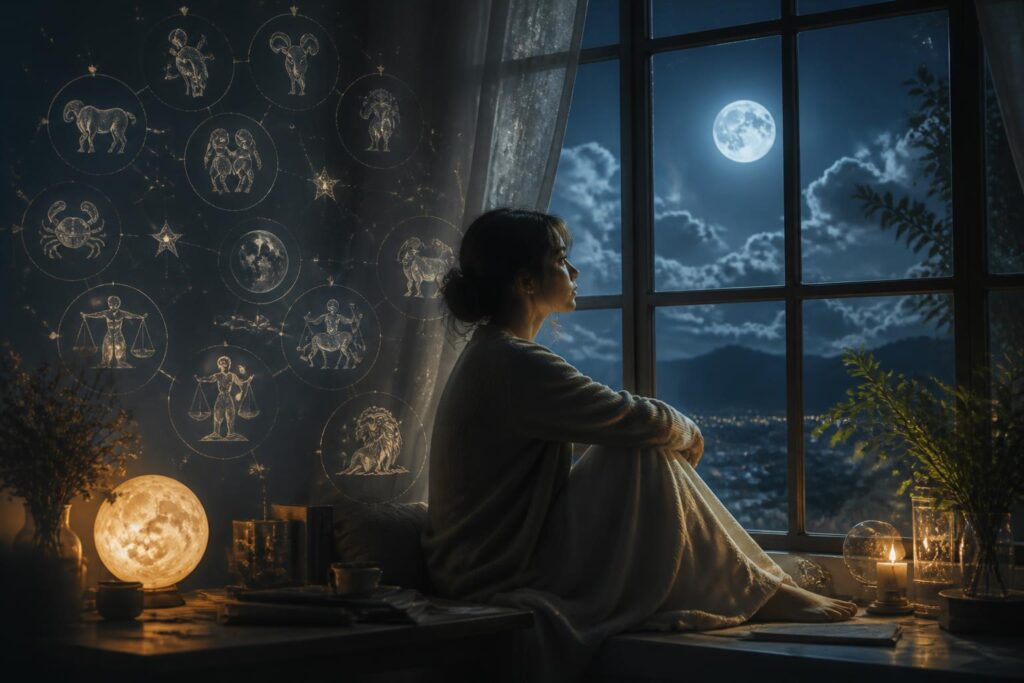
When learning about birth charts, many people often begin with the Sun sign because it is the most familiar placement. However, if you want to observe a person’s inner life, need to feel loved, and reactions when feeling unsafe, the Moon is also a particularly noteworthy factor. In popular astrological interpretation, the Moon is associated with emotions, memories, unconscious habits, and the sense of familiarity that each person seeks in life.
Unlike the personality image we consciously project outwardly, the Moon’s placement is often associated with the more private part of who we are. It may reflect how you calm yourself after a stressful day, the kind of care you show your loved ones, or the first reaction that appears before reason has time to intervene. This is not a scientific conclusion about personality or destiny, but rather a symbolic language that can help each person reflect on their emotions in a systematic way.
Why Is the Moon Often Associated with Emotions?
In observing daily life, emotions do not always operate according to what we have thought through and chosen. Sometimes a small remark can bring back an old memory. At other times, we may need to be alone, reach for a familiar food, or call a loved one even when nothing special has happened. Such reactions often occur quickly, are instinctive in nature, and are connected to the need for inner stability.
Astrology uses the image of the Moon to describe this layer of experience. The Moon’s position in the zodiac is determined based on the time and place of birth because the Moon moves through the signs relatively quickly. Therefore, birth time can be important when creating a birth chart. Without accurate data, determining this placement may be subject to error, especially for people born around the time the Moon moves from one sign to another.
It is important to note that a person is not described solely by their Moon sign. The Sun sign, Ascendant, other planets, and the relationships among them create a more complex picture. Therefore, the descriptions below should be read as suggestions for self-observation rather than as templates for judging yourself or others.
The Emotional Meaning of the Moon Through the 12 Signs
Moon in Aries
People with the Moon in Aries often need to feel proactive and able to start something on their own. Emotions may arise quickly, clearly, and directly. When unhappy, they tend to want to take action immediately rather than sit and analyze for too long. This directness helps them release emotions quickly, but it can sometimes cause them to speak before their feelings have settled. An environment that allows them to move, make decisions, and renew their energy often has a more calming effect than overly strict control.
Moon in Taurus
The Moon in Taurus is often associated with a need for stability, regularity, and a sense of security that can be experienced through concrete things. A familiar rhythm of life, a comfortable home, a satisfying meal, or the reliable presence of loved ones can help them regain balance. They generally dislike being pressured to change their emotions too quickly. When unsettled, returning to habits that care for the body and to enduring values can be a helpful way to regain calm.
Moon in Gemini
With the Moon in Gemini, the need to talk, ask questions, and name emotions is often quite prominent. They may feel relieved when they can share with someone who knows how to listen or when they find a clear way to express what is happening inside. Prolonged monotony can make their spirits feel heavy, while a new conversation or intellectual activity can generate positive energy. However, constantly changing subjects can sometimes prevent emotions from being fully felt and understood.
Moon in Cancer
The Moon in Cancer often emphasizes the need for attachment, care, and belonging to a familiar place. Family memories, old objects, or private spaces can carry deep meaning. People with this placement are often sensitive to the surrounding atmosphere and quick to notice changes in other people’s attitudes. The positive side is an ability to care with subtlety, while the challenge is a tendency to hold on to emotions for too long or withdraw into themselves when hurt. Healthy boundaries help ensure that caring does not become a burden.
Moon in Leo
The Moon in Leo often needs to be sincerely recognized. Feeling valuable, appreciated, and able to express creativity helps them maintain inner warmth. They can be very generous toward the people they love, but may also feel sad if their efforts are continually taken for granted. Learning to acknowledge themselves, rather than relying entirely on external praise, is an important direction for growth with this placement.
Moon in Virgo
People with the Moon in Virgo often find reassurance when life is orderly and problems are handled step by step. They may express affection by helping, organizing, reminding, or taking care of details that others overlook. The limitation is a tendency to turn self-observation into self-criticism, especially when things do not happen perfectly. Resting without needing a reason, accepting emotions that cannot be resolved immediately, and reducing excessively high expectations can help them be gentler with themselves.
Moon in Libra
The Moon in Libra often places great value on harmony in relationships. They may feel uncomfortable with prolonged conflict and want to find a balanced way of speaking so that everyone can be heard. Beautiful surroundings, music, art, or pleasant social gatherings can also support their emotional well-being. However, the desire to keep the peace can sometimes lead them to delay expressing their true needs. Lasting harmony comes not only from avoiding arguments but also from the ability to engage in honest dialogue.
Moon in Scorpio
The Moon in Scorpio is often associated with a deep, private emotional life and a strong need for trust. They do not easily share everything with just anyone, but once they open up, they often seek sincerity and meaningful connection. Emotions hidden for too long can become burdensome, so journaling, safe conversations, or finding a suitable method of self-awareness can be helpful. Privacy is necessary, but it should not become a reason to isolate oneself.
Moon in Sagittarius
People with the Moon in Sagittarius often need a sense of openness, hope, and the freedom to explore the world in their own way. When their spirits are low, they may turn to learning something new, going somewhere, reading, or talking about subjects larger than the problems immediately before them. Optimism helps them overcome difficulties, but it can sometimes cause them to rush past sadness that has not been resolved. Emotional freedom does not mean having to be cheerful all the time; being honest about slower days is also essential.
Moon in Capricorn
The Moon in Capricorn often seeks a sense of solidity through responsibility, competence, and measurable goals. They may be accustomed to carrying burdens on their own, remaining calm in the face of difficulties, and revealing emotions only when they feel sufficiently safe. This creates resilience, but it can also make them forget that they have the right to rest and ask for support. Acknowledging emotional needs does not make them weak. On the contrary, it is a way to build stability from within rather than relying solely on endurance.
Moon in Aquarius
The Moon in Aquarius often needs personal space to think and a connection based on mutual respect. They may care about the community, new ideas, or issues that extend beyond the personal sphere. When emotions become overwhelming, they often want to step back and observe them rationally. The ability to view matters from a different perspective is a strength, but if they distance themselves from their emotions too much, they may find it difficult to recognize what they truly need. Honest conversations without possessiveness often help them feel safer.
Moon in Pisces
The Moon in Pisces is often associated with sensitivity, imagination, and the ability to sense the surrounding atmosphere. Music, art, nature, or periods of quiet can help them restore their energy. They easily empathize with others, but for that very reason, they also need to pay attention to distinguishing their own emotions from those they absorb from their environment. A routine with clear boundaries, regular rest, and the habit of recording personal feelings can help transform sensitivity into a source of creativity rather than a cause of overwhelm.
Reading the Moon’s Placement in a More Practical Way
The greatest value of learning about the Moon does not lie in labeling someone as hot-tempered, sensitive, or rational. More importantly, it can prompt specific questions: When I am stressed, what do I do first? What makes me feel respected? Do I tend to express my needs or wait for others to recognize them on their own? What kind of care truly helps me recover, and what kind of care only makes me more tired?
These questions bring astrology closer to the practice of self-reflection. For example, one person may realize that they are always seeking certainty before making a decision. Someone else may find that they usually use conversation to process emotions, while a loved one needs some quiet instead. Such differences are not necessarily a sign of an unsuitable relationship. They simply show that each person has their own way of regulating emotions and needs to learn how to express it more clearly.
The Moon’s placement should also not be used to justify hurtful behavior. Emotions may explain why a reaction arises, but they do not automatically make every way of acting right. Personal responsibility, the ability to apologize, listen, and change remain more important than any astrological symbol.
Conclusion
The Moon in a birth chart is often viewed as a lens through which to observe emotional needs, inner habits, and the ways each person seeks a sense of security. Each sign brings a different way of responding, from the need for action, stability, and conversation to the need for privacy, creativity, or deep connection. However, no placement is absolutely better than another. What matters is understanding one’s strengths, recognizing one’s limitations, and finding suitable ways to care for oneself.
When approached thoughtfully, astrology can become a tool that opens the door to deeper conversations with oneself. You are not fixed by your Moon placement. You still have the ability to learn how to name your emotions, adjust your reactions, and build relationships that respect everyone’s needs.

ARTICLES IN THE SAME CATEGORY
The Moon in the Birth Chart: The Key to Understanding the Emotional World of Each Sign
What Is the Ascendant, and Why Does It Affect How You Appear to the World?
The Ascendant in the Birth Chart: How You Appear and Begin Every Journey
The Moon in the Birth Chart: The Key to Understanding the Emotional World of the 12 Zodiac Signs
The Four Elements and Three Modalities in the 12 Zodiac Signs: Reading the Map of Personality in Depth
The Moon in the Birth Chart: A Key to Exploring the Emotional World
ARTICLES IN THE SAME GENRE
The 12 Zodiac Signs and the Art of Saying ‘No’: Setting Healthy Boundaries at Work and in Relationships
Career strategies for the 12 zodiac signs in the digital era: practicalities and application suggestions
About Zodiac