

 Tiếng Việt
 日本語
 한국어
 中文 (中国)
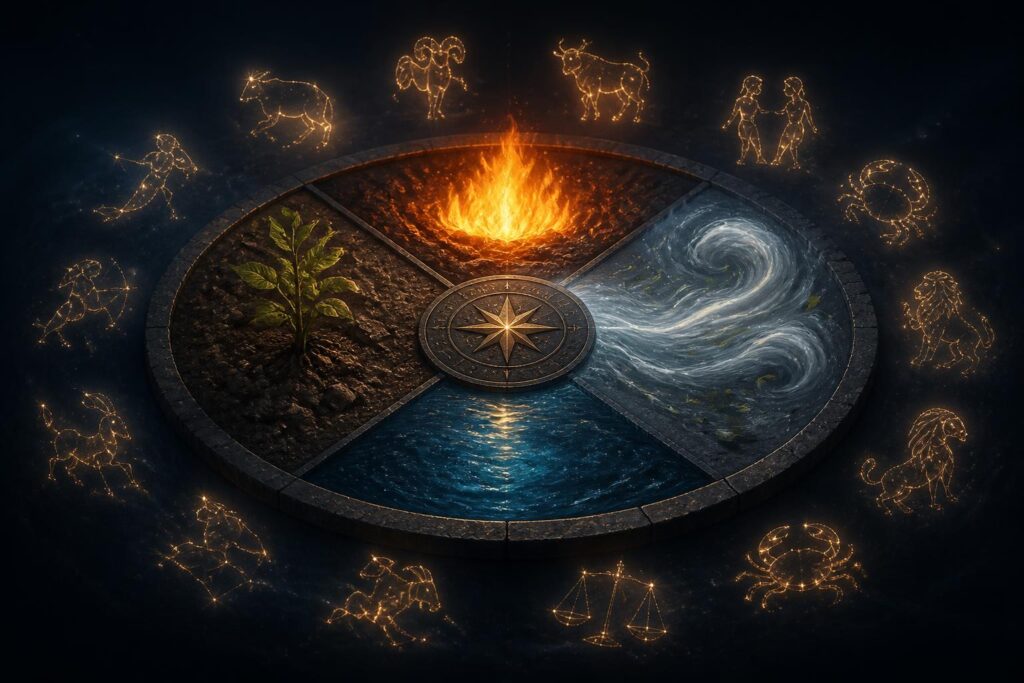
When exploring the 12 zodiac signs, many people often begin by asking which signs are compatible with them, which signs have strong personalities, or which signs are likely to have good luck in love. However, if we read only brief descriptions based on birth dates, we can easily view a person through a few stereotypical traits. Even among people born under the same sign, each individual can still think, react, and make choices very differently.
A more in-depth approach is to observe two systems commonly used to group the signs: the four elements and the three modalities. The four elements—Fire, Earth, Air, and Water—offer insight into the dominant energy in the way a person experiences the world. The three modalities—Cardinal, Fixed, and Mutable—describe how that energy is put into action. When these two layers are combined, reading the zodiac becomes more balanced and also helps readers avoid making absolute judgments based on a single personality label.
What do the four elements say about how people connect with life?
In Western astrology, each zodiac sign is assigned to one of four elemental groups. These are not four completely separate types of people, but rather four symbolic tendencies. A person may express several different elements in their birth chart, while the Sun sign is only one part of the whole. Therefore, the descriptions below should be viewed as reference tools for self-observation, not as fixed conclusions about personality.
The Fire group: motivation, initiative, and confidence
Aries, Leo, and Sagittarius belong to the Fire group. The image of fire is often associated with enthusiasm, the ability to initiate, and the desire to bring ideas into reality. People with a prominent Fire quality may enjoy challenges, be quickly drawn to something new, or feel more energized when they are free to take action.
The strength of this group is its forward-moving spirit. They often inspire others through confidence, enthusiasm, and the ability to see opportunities in unclear circumstances. However, Fire energy also has aspects that need adjustment. Impatience may cause someone to start many things while lacking patience with the completion stage. Strong confidence can sometimes turn into overconfidence if it is not balanced by listening and checking against reality.
The Earth group: practicality, stability, and lasting values
Taurus, Virgo, and Capricorn belong to the Earth group. This group is often associated with the ability to observe concrete realities, build foundations, and pursue verifiable results. People with strong Earth qualities often care about quality, safety, schedules, and feasible steps.
They may be reliable at work because they do not easily overlook details and often understand that lasting achievements take time. In relationships, the Earth group tends to show care through practical actions rather than flowery words. On the other hand, their need for stability may make it difficult for them to adapt to sudden changes. When they focus too heavily on efficiency, they risk putting undue pressure on themselves or evaluating emotions according to rational standards.
The Air group: thought, communication, and the ability to connect ideas
Gemini, Libra, and Aquarius belong to the Air group. This group is often associated with language, information, abstract thought, and exchange between people. People with a pronounced Air quality are often curious, enjoy asking questions, and feel stimulated when exposed to many different viewpoints.
The strength of the Air group is the ability to see an issue from multiple perspectives. They can quickly connect data, express ideas, or create an open atmosphere for dialogue. However, living so much in the world of thought can sometimes make it difficult for them to stay focused on a single choice. An Air person may also be misunderstood as distant if they tend to analyze emotions instead of expressing them directly.
The Water group: feeling, intuition, and emotional depth
Cancer, Scorpio, and Pisces belong to the Water group. Water often evokes inner life, empathy, and sensitivity to the surrounding atmosphere. People with strong Water qualities may easily notice subtle changes in other people’s attitudes, tones of voice, or emotions.
This group has the ability to nurture connection. They often value memories, trust, and the feeling of being understood. When living in a safe environment, their perceptiveness can become a significant source of creativity and compassion. But without personal boundaries, the Water group can easily absorb other people’s moods or hold on to unresolved feelings. An important lesson for them is distinguishing between empathy and carrying everyone else’s emotions for them.
The three modalities show how energy is put into operation
If the elements answer the question of which areas a person tends to care about, the three modalities suggest how that person begins, maintains, or adjusts their actions. Each element contains one Cardinal sign, one Fixed sign, and one Mutable sign.
The Cardinal modality: beginnings and creating momentum
Aries, Cancer, Libra, and Capricorn belong to the Cardinal group. These signs are often associated with the ability to open a new cycle, make decisions, or create initial momentum. The Cardinal quality is not expressed only through boldness. It can also appear in the way a person proactively cares for their family, establishes order, or seeks balance in relationships.
The challenge for the Cardinal group is maintaining momentum after the initial excitement has passed. They may be good at breaking new ground but need to develop patience, the ability to coordinate, and consistency so that their ideas do not stop at the starting point.
The Fixed modality: maintaining, deepening, and protecting what matters
Taurus, Leo, Scorpio, and Aquarius belong to the Fixed group. They often possess endurance, the ability to pursue long-term goals, and a serious attitude toward what they have chosen. When they believe in a value, this group does not easily change simply because of temporary pressure.
This quality creates loyalty and reliability, but it can also lead to stubbornness. A viewpoint that was suitable in the past is not necessarily still appropriate to present circumstances. Therefore, people with a strong Fixed quality need to learn to distinguish between holding firm to their principles and refusing every adjustment.
The Mutable modality: adapting, connecting, and completing a cycle
Gemini, Virgo, Sagittarius, and Pisces belong to the Mutable group. This is the energy of flexibility, learning, and transition. People in this group are often able to adjust their approach when circumstances change, while also seeing many different possibilities within the same issue.
Flexibility helps them adapt easily, but without an anchor, they may become hesitant or scattered. Adding another option does not always make a decision better. Setting deadlines, identifying priorities, and completing each step will help the Mutable group make good use of its expansive abilities.
Combining elements and modalities to avoid one-dimensional readings
The value of these two systems lies in combining them. Aries is a Fire and Cardinal sign, so its prominent energy is often associated with initiating, competing, and taking direct action. Leo is also a Fire sign but has a Fixed modality, so its expression may lean toward maintaining identity, shining consistently, and protecting what it takes pride in. Sagittarius is Mutable Fire, often evoking the expansion of experience, learning, and changing one’s perspective.
Likewise, the Earth group does not have only one form of practicality. Taurus is Fixed Earth, Virgo is Mutable Earth, and Capricorn is Cardinal Earth. One person may seek security by maintaining what has already been built, another may create security by continually improving their skills, while yet another may pursue it by planning and taking responsibility for long-term goals.
This combination helps us ask more specific questions. What is this person seeking? How do they begin and maintain something? When faced with change, do they resist, lead, or adapt? Questions like these are more useful than simply labeling a sign as good or bad, compatible or incompatible.
Applications in self-awareness and relationships
Grouping zodiac signs can be used as a suggestive language for reflecting on oneself. For example, a person with a strong Fire emphasis might ask whether they have spent enough time listening. Someone with a strong Earth emphasis might consider whether their need for control is causing them to miss opportunities for experience. Someone with a strong Air emphasis might practice staying with their emotions instead of merely analyzing them, while someone with a strong Water emphasis might strengthen their boundaries so that empathy does not turn into exhaustion.
In relationships, differences between the elements and modalities are not necessarily signs of conflict. A Cardinal person may create momentum for a Fixed person, the Fixed person may help keep a plan from being abandoned, and the Mutable person may bring the ability to adjust when circumstances change. What matters is not using astrology to justify disrespectful behavior or to make decisions in place of real communication.
Astrology cannot replace observation, dialogue, and personal responsibility. A birth date does not explain a person’s entire life circumstances, family history, education, or the choices they have made. A useful reading should open up more questions rather than confine a person within an unchanging conclusion.
The four elements and three modalities are therefore best viewed as a reference map. They help readers recognize tendencies that may be influencing how they act, while also pointing to qualities that need to be developed to create balance. Understanding a zodiac sign is not about finding an exact label for oneself, but about beginning a more clear-eyed conversation with oneself and with the people around us.

ARTICLES IN THE SAME CATEGORY
The Moon in the Birth Chart: The Key to Understanding the Emotional World of the 12 Zodiac Signs
The Moon in the Birth Chart: A Key to Exploring the Emotional World
What Is the Ascendant, and Why Does It Affect How You Appear to the World?
Venus in the Birth Chart: How You Love, Choose, and Enjoy Life
The Moon in the Birth Chart: The Mirror of Emotions and the Need for Security
What Is the Ascendant, and Why Does It Affect How You Appear to the World?
ARTICLES IN THE SAME GENRE
The 12 Zodiac Signs and the Art of Saying ‘No’: Setting Healthy Boundaries at Work and in Relationships
Career strategies for the 12 zodiac signs in the digital era: practicalities and application suggestions
About Zodiac