

 Tiếng Việt
 日本語
 한국어
 中文 (中国)
Once upon a time, at the edge of a small village nestled among green hills, there lived a boy named An. An was quick, kind, and very fond of helping people. However, he had one habit that often made his grandmother smile as she reminded him: An always did everything in a great hurry. He would answer before someone had finished speaking, dig up seeds to check on them before they had even sprouted, and run off to search for a bird’s nest after hearing its song for only a short while. An thought that if he simply did things quickly, everything would soon turn out well.
Behind An’s kitchen was a small garden. In it stood a gourd trellis that his grandmother had planted many years before, an old guava tree that bore sweet fruit, a few beds of herbs, and a shallow pond full of duckweed. His grandmother often said that the garden was like an old friend. It did not speak with words, but if one paid attention, one would notice that the garden was always sending its own special signs.
“When the leaves droop, the garden is thirsty,” she said. “When the soil cracks, the garden needs to be cared for. And when the flowers bloom, that is when the garden is happy.”
An listened, but he did not truly understand. He thought, How could plants know happiness or sadness? To An, plants only needed to be given plenty of water, plenty of fertilizer, and have their pests dealt with quickly in order to grow strong and healthy.
The Seeds That Did Not Want to Be Rushed
One spring morning, his grandmother gave An a small wooden box. Inside were three round brown seeds, so tiny that An had to place them in the palm of his hand to see them clearly.
“These are the seeds of the early bellflower,” she said. “Plant them in the corner of the garden near the fence. But remember, don’t dig them up to check on them every day.”
An nodded vigorously. He dug three small holes, placed the seeds inside, and covered them with soil. Then he watered them very generously. The next day, An ran out to the garden. The ground was still as flat as before. He added more water. On the third day, when he still saw no sprouts, An used a stick to gently poke at the layer of soil above them. One seed was exposed, soaked through and soft.
His grandmother saw him and gently asked:
“What are you doing?”
“I’m checking whether the seed has sprouted. Maybe it’s too lazy.”
His grandmother did not scold An. She simply picked up the seed, placed it in his palm, and said:
“Every seed has its own timing. If you keep pulling a sprout out of the soil, it won’t have the chance to grow on its own.”
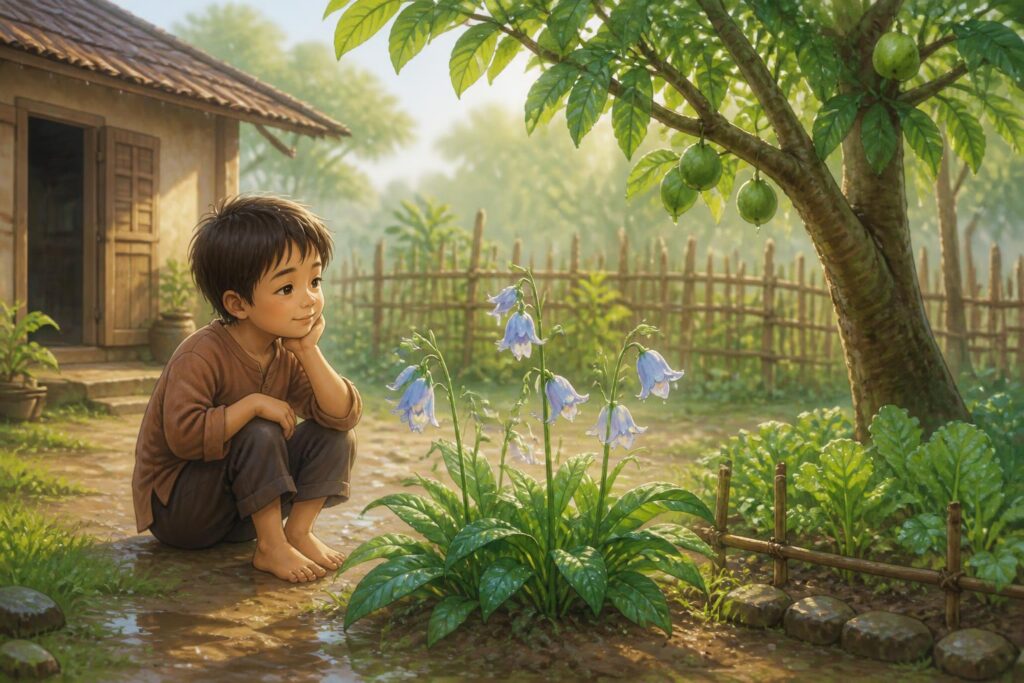
An felt a little sad, but he still did not fully understand. He replanted the seed and, this time, used less water. However, just one day later, he ran out to look again. The soil remained silent. An squatted beside the bed and rested his chin in his hands as he waited.
Just then, a gust of wind blew past. The blades of grass rustled, the guava tree swayed, and the gourd trellis gently tapped against the kitchen roof. Suddenly, An heard a very faint sound, like someone whispering beneath the ground.
“Don’t hurry…”
An looked up. There was no one in the garden. He leaned his ear close to the ground, but all he could hear was the loud beating of his own heart. He ran inside to ask his grandmother. She was sorting vegetables by the veranda, and after hearing him, she only smiled.
“Perhaps the garden has told you something you have been unwilling to listen to all this time.”
The Sounds Around the Garden
From that day on, An began sitting in the garden for longer periods. He did not simply water the plants and leave; he observed every bed of soil and every leaf. In the morning, he noticed that the basil plants leaned toward the water jar because the soil there was drier. At noon, he saw ants moving in a line past the base of the guava tree, carrying small pieces of leaves. In the late afternoon, a sparrow often perched on the fence and called repeatedly toward the bamboo thicket.
An thought the sparrow was calling to a friend, so he did not chase it away as he had before. He sat still and watched. After a while, the faint chirping of a baby bird came from beneath the grass. The mother sparrow flew down, carrying a small caterpillar in her beak, and fed it to her chick. An understood that sometimes a call was not meant to make noise, but was the cry of someone who needed to be found.
Day by day, An learned to care for the garden more slowly. He watered just enough and pulled weeds out by hand instead of yanking them forcefully and uprooting the vegetables. When he saw a withered leaf, he did not immediately conclude that the plant was diseased; he checked whether the surrounding soil was too wet. He also placed a small bowl beneath the guava tree to collect rainwater for the birds and squirrels to drink.
The three early bellflower seeds still had not sprouted. This time, An did not dig them up. Every morning, he simply placed his hand on the soil and said:
“You can grow in your own way. I will wait.”
A week later, tiny green shoots poked up. An was so happy that he almost ran off to call the whole village, but then he remembered his grandmother’s words and simply sat down beside the bed. He watched the three young sprouts sway in the wind and felt a very gentle joy in his heart.
The Heavy Rain and An’s Choice
At the end of spring, dark clouds rolled in and covered the sky. The wind blew so strongly that the kitchen door kept banging noisily against the wall. His grandmother told An to put away the baskets outside, while she went to inspect the roof. As An gathered the things, he heard water rushing loudly from the direction of the garden.
He ran outside and saw that the ditch carrying water down to the pond was completely blocked by dry leaves. Rainwater flowing down from the hillside was pouring into the garden. If the ditch was not cleared, the water might wash away the vegetable beds and the three early bellflowers.
In the past, An might have run around in a panic, starting a little of one task and then abandoning it. But this time, he stood still and listened. Where was the water flowing most strongly? Where was the soil beginning to erode? Which plants could hold the bank in place?
An realized that the water ditch was blocked near the base of the guava tree. He used a small shovel to push the dry leaves aside, then arranged branches in a row across the low section of ground to block the flow. The water began running along the ditch and no longer spilled into the vegetable beds. The wind still whistled through the roof, and the rain still fell heavily, but the garden was less chaotic.
Suddenly, An heard his grandmother calling from the storage shed. A roof plank had been blown loose, and she was trying to hold the door shut so that water would not blow inside. An ran to help her, but before pulling the door closed, he turned back to look at the garden. The three early bellflowers were still standing because of the row of branches blocking the wind. He understood that they had not made it through the rain all by themselves. The garden had held back the water for them, and An had only needed to listen carefully to know what to do.
The Gift That Bloomed in Silence
The next morning, the sky had cleared and turned blue again. The leaves gleamed in the sunlight, and the garden soil smelled of fresh rain. An went to inspect every corner of the garden. A few vegetable stems had been battered, and part of the fence had tilted downward, but most of the plants were still healthy. The three early bellflowers had grown many more leaves. In the middle of the tallest plant, a pale green flower bud was beginning to open.
An sat beside the flower bed all morning. He did not pick the flower or call anyone over to see it right away. He simply waited quietly. Near noon, the bud opened into a small bell. When the wind passed through it, the flower trembled and gave off a clear, very soft sound, like glass touching glass.
His grandmother came outside and sat down beside An.
“Do you hear anything?” she asked.
“I hear the garden thanking us,” An replied.
His grandmother smiled. “Perhaps so. But I think the garden is also thanking you for learning how to listen.”
An looked at the flower, then at his dirt-stained hands. He understood that listening was not only about hearing with one’s ears. Listening also meant observing carefully, waiting patiently, and trying to understand what others could not yet put into words. A sad friend might not explain the reason right away. A tree with dry leaves might not need more water, but might need to be moved out of a place with too much sun. A bird that kept calling might be calling for a lost chick.
From then on, the garden behind the kitchen became the place An often went whenever something left him confused. He was still quick and still liked helping people, but before acting, he usually paused for a moment to observe. When his grandmother told stories, An did not interrupt. When a friend needed to confide in someone, he did not rush to offer advice. He sat beside them and listened until they had finished.
The three early bellflowers produced more and more blossoms. Whenever the wind passed through, the garden rang with clear, crystalline sounds. No one in the village knew why that garden had such special music. Only An and his grandmother understood that the most wondrous gift did not lie in the flowers, but in the patience that had helped a boy notice the things that had always been present around him.
An’s story reminds us that listening is a way of showing love. When we take the time to slow down, we may notice a request for help in the eyes of a loved one, weariness in a friend’s voice, and nature’s need for care. Not everything important is spoken loudly. Often, the things that need our attention most speak only in a very soft sound.

ARTICLES IN THE SAME CATEGORY
The Sprout in the Pocket
The Wind Chime That Kept Promises
Little Hedgehog and the Moonlight Garden
The Tiny Boy’s Pencil
Bông the Bunny and the Raindrop That Kept Its Promise
The Little Firefly and the Guiding Light
ARTICLES IN THE SAME GENRE
Bông the Bunny and the Raindrop That Kept Its Promise
The Wind Chime and Brown Squirrel’s Promise
The Boy Who Gathered Laughter for a Wind Chime
The Wind Chime That Awakened the Garden
The Button That Went Looking for Someone Who Keeps Their Word
Tam Cam Part 2: The Vengeful Spirits of the Palace