

 Tiếng Việt
 日本語
日本語 한국어
한국어 中文 (中国)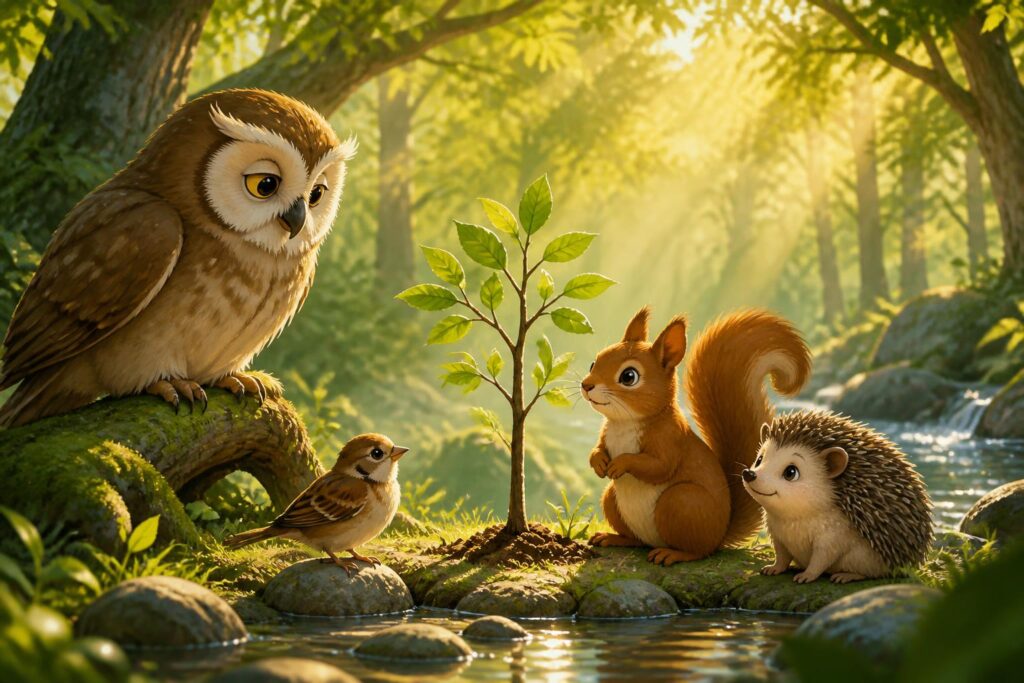
At the edge of a green forest, a tiny seedling had just sprouted after the rain. The seedling had two tiny young leaves, a soft stem, and a very lovely name: Mầm. No one had given Mầm its name. When Old Owl first saw it, he said, “A little seedling this small surely needs a very short name so everyone can call it easily.” And so, from then on, all the animals called it Mầm.
Mầm grew up in a forest that was always filled with sounds. Sparrow chirped on the branches, Brown Squirrel swung from one tree to another, and the baby rabbits ran through the dry leaves, making cheerful rustling sounds. A little farther away, the crystal-clear stream babbled constantly, while the reeds along its banks rustled whenever the wind blew through them.
But that forest also had a rather unpleasant habit. Everyone liked to talk, but hardly anyone was willing to listen. Sparrow often sang loudly to drown out the sound of the stream. Brown Squirrel was always telling stories before anyone else had a chance to speak. The Frogs croaked all together, even when they sometimes had nothing special to say. Even Old Owl, who was considered the wisest animal in the forest, often hurried to give advice before hearing the whole story.
The Forgotten Sounds
Mầm could not run and jump like the rabbits, could not fly like the birds, and was not yet tall enough to see everything in the forest. So it had plenty of time to listen. Mầm could hear water slipping between the pebbles beneath the stream. Mầm could hear a dry leaf falling to the ground even when the wind was strong that day. Mầm could also hear the roots of old trees shifting in the earth on nights when the weather turned cold.
Those sounds were not loud, but each one told a story.
One morning, just as the sunlight began to shine through the canopy, Mầm heard a very faint “tap, tap” from the edge of the forest. The sound repeated many times, stopping and starting as though someone were trying to knock on a door. Mầm tilted its leaves toward the source of the noise, but before it could hear clearly, Sparrow flew over.
“Mầm, today I’m going to tell you about the cloud I saw that looked exactly like an elephant!” Sparrow chirped.
“Wait, I think I just heard…”
“It’s such a funny story—you have to hear it right away!” Sparrow said, then began telling it in an increasingly loud voice.
The “tap, tap” disappeared beneath the sharp, cheerful song. Mầm could not hear it anymore.
At noon, Brown Squirrel came running over, holding a large acorn. It called out as it ran:
“Mầm, have you seen where my little nest is? I hid an acorn in it, but when I came back, I couldn’t find it anywhere.”
Mầm was about to tell Brown Squirrel about the strange sound that morning, but Squirrel spoke so quickly that it did not give Mầm a chance. Squirrel said it had searched beneath the tree, behind a rock, and beside the ferns. It even asked Mầm whether the North Wind had blown the nest away.
“I don’t know,” Mầm answered honestly. “But this morning I heard a sound near the edge of the forest.”
“Maybe it was the sound of my stomach,” Brown Squirrel laughed loudly. “I’m so hungry that everything sounds strange to me.”
Then Brown Squirrel ran off, leaving Mầm with something it had not managed to finish saying.
A Very Small Cry for Help
That afternoon, the wind suddenly rose. Gray clouds gathered and covered the sun. The wind swept through the forest, making the branches tremble and sending dry leaves flying in every direction. The animals hurried to find shelter. Sparrow crawled into a hollow tree, Brown Squirrel clung tightly to a large tree trunk, and the Frogs jumped into a deep puddle.
While everyone was rushing about, Mầm heard the familiar “tap, tap” again. This time, the sound was clearer. It came from the edge of the forest, just beneath a low bush. Along with the knocking was a weak sound, almost like a sigh.
“Is anyone there?” Mầm called out.
There was no answer. Only a soft “tap” sounded.
Mầm could not go there by itself. It could only lean its stem toward the wind and call as loudly as it could:
“Old Owl! I hear a strange sound at the edge of the forest. Someone may need help!”
Old Owl was preparing to fly into a hollow tree to shelter from the rain. When he heard Mầm call, he turned around.
“Are you sure? The wind is blowing very hard. Perhaps you only heard branches hitting each other.”
“I’m not sure what is happening,” Mầm said, “but I have heard the sound many times. It is small, intermittent, and does not sound like branches.”
Old Owl looked at Mầm for a moment. Perhaps because it was the first time Mầm had spoken in such a serious voice, he did not hurry to give advice. He spread his wings and flew toward the edge of the forest. Sparrow, Brown Squirrel, and several other animals followed curiously.
Beneath the low bush, they saw a baby hedgehog trapped inside an old bamboo basket. The basket had probably been left there long ago, and one end had been pinned down by a branch. Whenever the baby hedgehog tried to move, one bamboo strip struck another, creating the “tap, tap” sound.
“How long have you been here?” Sparrow asked.
“Since this morning,” the baby hedgehog replied tiredly. “I called out, but everyone who passed by couldn’t hear me. I thought I would have to stay here forever.”
Brown Squirrel quickly called the others over to help. Old Owl used his beak to push the branch aside. The baby rabbit dug away the soil around the basket. Sparrow flew up to find a sturdy vine. After working together for a while, they lifted the basket out and brought the baby hedgehog back into the forest.
When the Whole Forest Learned to Listen
The baby hedgehog thanked everyone and then bowed its head to Mầm.
“If you hadn’t heard me, no one would have known I was trapped there,” the hedgehog said.
Mầm felt a little embarrassed. It had never imagined that its habit of staying quiet could help someone.
“I just happened to hear you,” Mầm replied.
“It wasn’t just a coincidence,” Old Owl said. “In this forest, many sounds are overlooked because they are so quiet. To hear them, there needs to be a moment of silence.”
The animals looked at one another. Sparrow remembered how loudly it had spoken that morning. Brown Squirrel thought of all the times it had been so busy telling stories that it forgot to listen to its friends. The Frogs also realized that sometimes they croaked loudly simply because they were afraid of silence.
The next day, Old Owl invited all the animals to a clearing beside the stream. He did not give a long lecture. He only suggested that everyone sit quietly for a few minutes—no singing, no running, and no calling to one another.
At first, everyone felt uncomfortable. Sparrow kept fidgeting its wings. Brown Squirrel looked around because it was not used to sitting still. One little frog was about to croak, but its mother gently touched it on the shoulder.
Then the forest gradually grew quiet.
They heard water flowing beneath the moss. They heard a butterfly’s wings brush against a flower. They heard Brown Squirrel’s stomach rumble because it had not eaten breakfast. They even heard the drops of water still clinging to the leaves fall onto the ground.
“So the forest has been talking all along,” Sparrow whispered.
“It’s just that we used to talk too much,” Brown Squirrel replied.
From that day on, the animals established a small rule. When one friend was telling a story, the others would try to listen until the end before responding. If someone spoke too softly, everyone would move closer instead of telling that friend to speak louder. Every afternoon, the forest would set aside a quiet period to listen to the things that were usually overlooked.
Mầm also changed. It no longer thought that, because it was small, it could only stand still in one place. Whenever it heard something unusual, Mầm would call its friends. Whenever an unhappy animal came to see it, Mầm would not rush to comfort or advise. It would simply listen until its friend had finished speaking.
The baby hedgehog later became Mầm’s closest friend. The hedgehog often stopped by to tell Mầm about new paths in the forest. Some days, the hedgehog talked for a long time; other days, it simply sat quietly beside the tree. Mầm never asked why the hedgehog was not talking. It understood that sometimes sitting beside a friend in silence was also a way of showing care.
What Mầm Wanted to Tell the Children
One day, when Mầm had grown into a young tree with many leaves, a little bird asked:
“Why do you always listen to everyone?”
Mầm swayed its leafy branches in the wind and answered:
“Because everyone has something they want to say. Some things are very big, so they are easy to hear. But some things are small and require a truly patient listener to notice them.”
The little bird thought for a moment, then flew away very slowly. From that day on, it no longer hurried to interrupt others. It knew that when it was willing to listen, it could understand more about its friends, notice who needed help, and see the beauty that had always been all around it.
The forest still had noisy days. Sparrow still loved to sing, Brown Squirrel still often told stories, and the Frogs still created cheerful harmonies together. But amid all those sounds, there was always a space of silence wide enough for everyone to hear one another.
As for Mầm, the young tree that had once stood quietly at the edge of the forest grew taller and taller. Whenever the wind passed through its canopy, the whole forest heard a gentle rustling. It was like a reminder that not everything valuable needs to be loud. Some things appear only when we know how to stop, open our hearts, and listen.
A lesson for children: Listening is a way of showing love. When we patiently listen to others, we can understand our friends’ feelings, recognize difficulties that are being hidden, and find ways to help one another. Even a quiet voice deserves attention, because sometimes it carries a very important cry for help.

ARTICLES IN THE SAME CATEGORY
The Little Bean and the Garden That Knows How to Wait
A Little Raindrop Finds Its Way Back to the Cloud
The Wind Chime and the House of Sounds
The Promise of the Flying Leaf
The Raindrop Keeps Its Promise to the Little Bean Plant
The Little Bell Beneath the Banyan Tree
ARTICLES IN THE SAME GENRE
Brown Squirrel’s Raincoat
The Wind Chime Finds Its Chime Again
Stepmother and Stepchild