

 Tiếng Việt
 日本語
日本語 한국어
한국어 中文 (中国)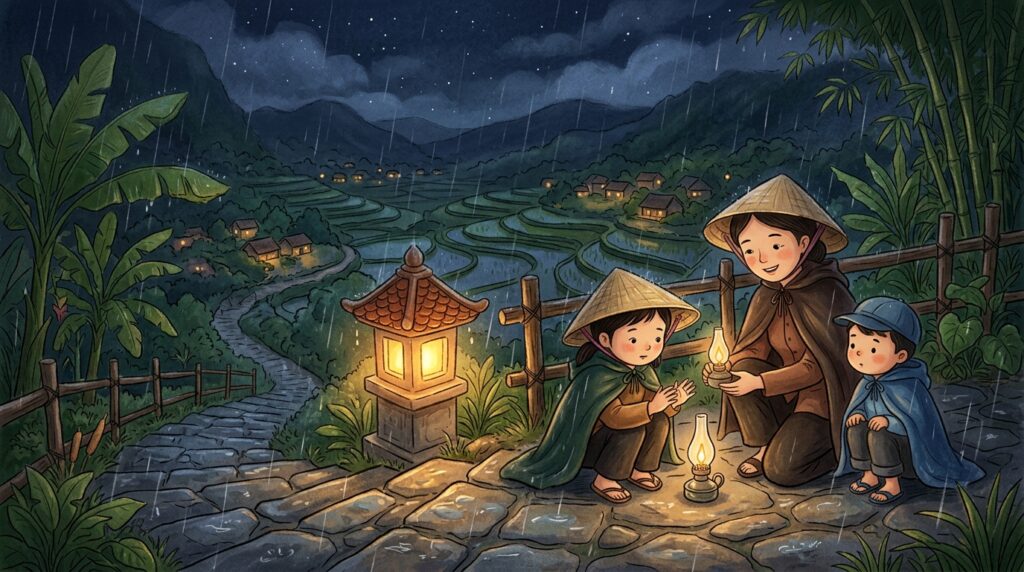
The Lamp Beside the Slope
Once upon a time, in a village nestled among green valleys, there was a long slope leading from the village gate down to the streambank. The slope was not very high, but it was winding and covered with many jagged rocks. During the day, children often ran and played on it, adults led their buffalo and cattle along it, and vegetable carts rolled slowly down the road each early morning.
But when darkness fell, the slope became frightening. On both sides of the road were dense bushes, their branches and leaves intertwined like enormous hands. Whenever the wind blew, the shadows of the trees swayed across the ground, making travelers feel as though someone were silently walking behind them.
At the bottom of the slope stood an old stone lamp. It was placed on a raised platform, with a tiled roof and a small brass door. The villagers passed down that the lamp had been there for a very long time, so long that no one remembered who had first lit its flame. Every evening, someone from the village would bring oil to light it. The warm yellow glow from the lamp helped travelers see the stone steps clearly and find their way home.
An was a nine-year-old girl who lived in a wooden house near the top of the slope with her mother and grandmother. She had bright eyes, and her black hair was usually tied with a blue strip of cloth. An loved listening to her grandmother tell stories, especially stories about kind people, animals that helped one another, and lamps that never went out.
Every afternoon, An would carry a small jar to the well to fetch water. On the way, she always looked down toward the bottom of the slope to see whether the lamp had been lit. What she liked most was the moment when the flame sprang up behind the brass door. At first, the light was only as small as a pea, but before long it spread out, casting a gentle golden circle over the road.
The Rainy Night When No One Lit the Lamp
One late-afternoon at the end of the season, dark clouds gathered very quickly. Wind roared through the rooftops, sending dry leaves swirling all across the yard. An’s mother looked up at the sky and told her to close the windows early because a heavy rainstorm was coming.
That day it was Uncle Lam’s turn to bring oil and light the lamp. He was the carpenter who lived at the far end of the village. However, since morning, Uncle Lam had had to go to the neighboring village to care for his sick younger brother. No one knew when he would return. The other villagers were also busy gathering the rice from their yards and bringing the livestock into their stalls.
As soon as darkness fell, the rain began. Raindrops struck the tiled roof with a pattering sound. The wind swept the water into sheets of white. Through the crack in the door, An looked down at the slope. The stone lamp was still shrouded in darkness.
“Mother, is no one going to light the lamp tonight?” An asked.
Her mother was tying up a bundle of firewood and softly sighed. “Perhaps everyone forgot. With rain like this, no one wants to go outside.”
An was silent for a moment. She thought of the people who might be on their way home. It could be a farmer carrying vegetables, a mother holding a small child, or an elderly person whose eyesight had grown weak. If the slope were pitch-black, how would they make their way?
“I want to take a lamp down there,” An said.
Her mother looked at the small oil lamp on the table, then at the curtain of rain outside the door. “The path is very slippery. You are still little; you cannot go alone.”
An knew her mother was right. But when her grandmother heard about it, she took an old raincoat and a small oil flask from the cupboard.
“Long ago, I also used to go and light that lamp,” she said. “Not because I was unafraid of the darkness, but because I knew someone would be more afraid if there were no light.”
An’s mother was still worried, but in the end she agreed to go with her daughter. She carried the oil lamp, while An hugged the oil flask to her chest. Mother and daughter put on their raincoats and stepped out of the house.
Light in the Wind
The path down the slope was more slippery than An had imagined. Rainwater streamed between the stones. Each time the wind blew, An had to bend down to keep the flask from being knocked away. Her mother held her hand tightly, and they walked very slowly, one step at a time.
When they reached the stone lamp, the brass door was cold as ice. There was not a spark of fire inside. An’s mother dried the stone platform, poured oil into the small reservoir, and lit the wick. But as soon as it caught fire, a strong gust blew through the crack in the door and snuffed out the flame.
An used her body to shield the doorway. Her mother tried to light it again. The flame trembled, brightening and dimming before going out once more.
“The wind is too strong,” her mother said. “Perhaps we have to wait until the rain eases.”
An looked up at the slope, black with darkness. Suddenly, she heard a very faint sound, like someone calling. Mother and daughter listened carefully. Through the sound of the rain, they heard a weak cry coming from the bushes beside the road.
An’s mother took the lamp and moved closer. Beneath a tree, a boy of about six was sitting huddled up. He wore a soaking-wet brown shirt, and beside him lay an overturned bamboo basket.
“Who are you? Why are you sitting here?” An’s mother asked.
The boy sniffled and said his name was Tí. He had gone into the forest with his father to gather bamboo shoots. On the way back, Tí had become distracted chasing a firefly and gotten lost. His father had gone to search near the stream, but Tí had heard the water roaring so loudly that he did not dare go on.
An took off the blue scarf around her neck and wrapped it around Tí’s shoulders. She took a small roasted sweet potato from her pocket and gave it to him.
“Don’t cry anymore. We will take you home,” An said.
An’s mother looked at the lamp, then at the two children. “To find Tí’s father, we need light. But the lamp still won’t stay lit.”
An suddenly remembered the small wooden box her grandmother used to keep glowing embers in. Her grandmother often said that embers protected from the wind would hold their warmth for a very long time. An took a piece of dry cloth from the oil flask, rolled it into a new wick, and then used both hands to shield the flame. An’s mother stood in front to block the wind. Tí also used both hands to shield the other side.
This time, the flame did not go out. It was small, but persistent. Through the brass door, a ray of golden light fell across the wet stones. The rain continued to fall, and the wind continued to blow, but the lamp had begun to do its work.
Those Who Found Their Way Home
The light from the lamp did not reach very far, but it was enough to illuminate the nearby stone steps. An’s mother led Tí one step at a time. An walked ahead, carrying the small oil lamp. All three called out Tí’s father’s name as they went.
Before long, a reply came from the streambank. Tí’s father was holding a wet torch and anxiously running up the slope. When he saw the light at the end of the road, he knew his son was nearby.
He hugged Tí tightly and thanked An and her mother again and again. Tí clung to his father, but still turned back to look at the stone lamp.
“If the lamp hadn’t been lit, I would probably still be sitting under that tree,” he said.
An smiled. “It wasn’t just the lamp. Mother and I found you too.”
On the way back, they heard the clopping of horse hooves again. A woman was trying to pull a vegetable cart up the slope. The wheel was stuck between two rocks, and the horse was slipping in the mud. Thanks to the light from the lamp, everyone could see one another. Tí’s father set his son down and helped An’s mother pull the cart. An and Tí gathered dry branches to place beneath the wheels.
When the cart got past the slippery spot, the woman thanked everyone and continued on her way. The lamp was still burning at the bottom of the slope, casting golden light over the falling drops of water.
That night, when An reached home, she saw her grandmother waiting beside the fire. The old woman dried her hair and then asked:
“Now do you know why the lamp must be lit every evening?”
An nodded. “Because someone may need the light, even if we don’t know who they are.”
Her grandmother smiled. “That’s right. Some good deeds do not bring an immediate reward. But they make someone else’s path less dark.”
The Flame Passed On
The next morning, the story of the rainy night spread throughout the village. Everyone knew that Uncle Lam could not return in time, but they also knew that An and her mother had taken his place in keeping the lamp lit. Everyone felt guilty for having thought that lighting the lamp could be put off until another day.
That afternoon, the villagers gathered beside the banyan tree. The village chief proposed making a new schedule. Each evening, two people would light the lamp together, so that if one person was busy, the other could still take over. The older children were taught how to clean the glass, while the village elders would check the oil and wick.
Tí from the neighboring village also often came to visit. He brought An a new bamboo basket to replace the one that had been ruined by the rain. An gave Tí another blue scarf in return, because the old scarf had been used to dry him off during the rainy night.
From then on, the stone lamp at the end of the slope was always lit on time. On clear nights, its light illuminated only the empty road. On some nights, no one passed by at all, yet the flame still burned quietly beneath the old tiled roof. But the villagers did not think those nights were useless. They understood that light was not meant only for moments when someone could see it. It was also a reminder that this place always had a road leading home.
Many years later, An had grown up and left the village to study in a distant place. Every time she returned, the first thing she did was go to the end of the slope to visit the lamp. The old lamp had been repaired, the stone platform was covered with green moss, and the brass door shone more brightly than before. But the flame inside was still as warm as it had been on that rainy night.
The villagers said that An became the first person to teach young children how to care for the lamp. She always told them that a small flame might not be able to drive away the entire night sky, but it was enough to help someone see their next step.
And indeed, many good things began with the lamp at the end of the slope. Someone who saw the way would stop to help someone else. A child learned how to shield a flame from the wind. A family remembered that shared responsibilities belonged to no one person alone. In this way, the light passed from one person to another, like a kind word that never disappears when it is given away.
Night after night, anyone passing along the slope would see the stone lamp casting a gentle golden glow in the valley. And if they listened very carefully, they might hear the wind whispering through the treetops:
“Keep a flame burning for the person searching for the way.”

ARTICLES IN THE SAME CATEGORY
The Button That Went Looking for Someone Who Keeps Their Word
The Boy Who Heard Rain in a Bean
The Seedling Beneath the Veranda and the Little Watering Can
THE STORY OF SOWING SEEDS
The Power of Silence
Coconut Skull
ARTICLES IN THE SAME GENRE
Stepmother and Stepchild