

 Tiếng Việt
 日本語
 한국어
 中文 (中国)
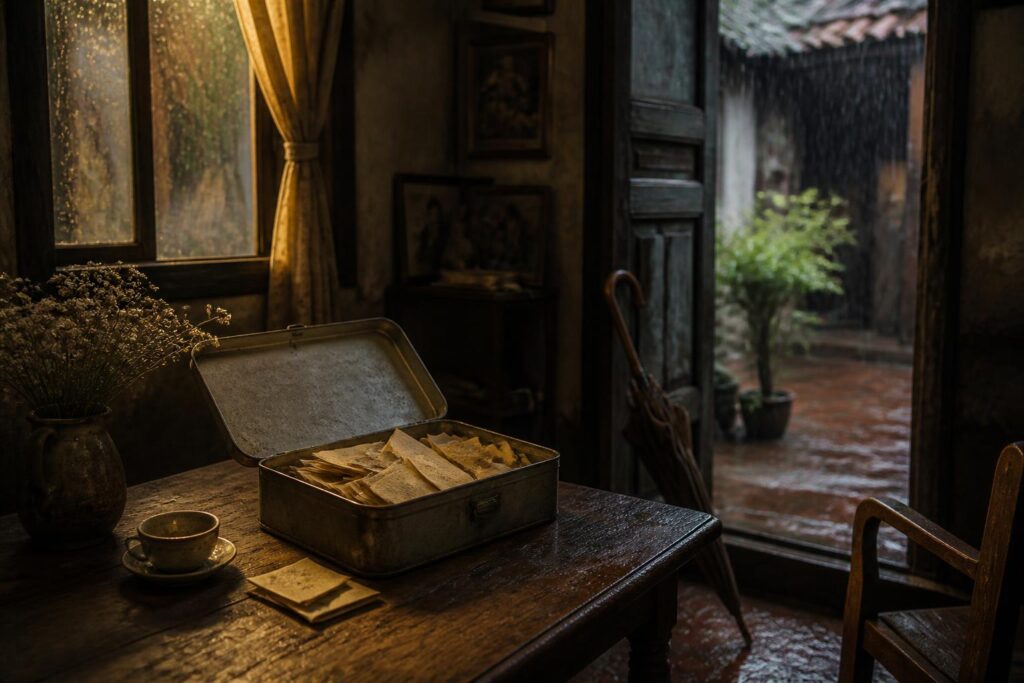
On the day she cleared out her father’s old house, An found a tin box at the bottom of a wooden cabinet, just behind a stack of handkerchiefs gone yellow with age. The box had once held biscuits, and its exterior was printed with blue flowers whose paint had almost entirely peeled away. It was not locked, nor did it appear to be anything special. An only meant to open it to see whether there were any papers inside that needed keeping, but the moment she lifted the lid, she smelled the musty scent of old paper, the smell of wood, and a fleeting fragrance of rain, as though it were still caught somewhere inside.
Inside were small pieces of paper folded into quarters. There were no bank accounts, contracts, or certificates. Each piece of paper contained only a name, a date, and a few brief lines. One read: “Return the umbrella to Ms. Hanh at the entrance to the alley.” Another said: “Fix the leg of the chair for Mrs. Mui’s family.” One piece, its ink blurred, read: “Leave the cold medicine outside Room 304. Don’t say it was me.”
An sat down on the floor, her back against the cabinet, and read through, one by one, all the things her father had once done. What surprised her was not the number of tasks, but the fact that she had never heard him mention any of them. When he was alive, An’s father had been a quiet man. He repaired bicycles on the corner, opening early in the morning and closing late in the afternoon. When people asked him questions, he usually only smiled or nodded. An had once thought that silence was a distance between father and daughter. Only that day did she realize that perhaps her father had used most of his words to do other things.
The Things That Were Never Told
The box took An back to many afternoons in her memories. She remembered that the house often heard knocking at the door when the sky was about to rain. At those times, her father would get up very quickly, take a raincoat or a hand pump from the storeroom, and leave. If An asked where he was going, he would simply reply, “Someone needs help.” That answer used to irritate her. She believed her father was always willing to help outsiders but rarely made time for his own family.
On one piece of paper, An recognized her own name. It had been written twelve years earlier, on the day she was preparing for the university entrance exam. The message was very short: “Ask Teacher Lan to save An a place in the tutoring class. The girl is too shy to ask. Don’t let her know.” An remembered that the family had been struggling financially that year. She had once thought that her teacher let her attend out of sympathy for her circumstances, but she had never known that her father had gone to the teacher’s house beforehand.
Another piece bore her mother’s name. “Replace the hallway lightbulb. She is afraid of the dark but doesn’t want to bother anyone.” An’s mother had died many years earlier. She often suffered from joint pain and had difficulty walking, but she rarely complained. An remembered that the hallway had been brighter than usual on certain nights and that her father had quietly checked every lightbulb. It turned out he had not simply replaced the bulbs. He had noticed the very small fear his wife carried, a fear that even she had never put into words.
The farther An read, the larger the house seemed to become. Familiar objects suddenly carried another layer of memory. The low chair beside the door had once been repaired by her father for a boy who sold lottery tickets. The iron coat hook was probably something he had made for the owner of the grocery shop when her hand was hurting. Even the potted plant on the veranda might have been part of a story An had never known.
A Meeting on a Rainy Day
That afternoon, heavy rain began to fall. An was planning to take the box back to the city when a middle-aged woman stopped by. She wore a brown raincoat and carried a cloth bag in her hand. When she saw An, she asked whether An was the daughter of Mr. Tu, the bicycle repairman.
An nodded. The woman introduced herself as Hanh, saying that she lived in the house at the entrance to the alley. She had heard that he had died, she said, but had been busy caring for her grandchild and had not yet been able to come pay her respects. After a few words of condolence, she took an old umbrella from the cloth bag. Its wooden handle had been polished smooth from years of use.
“I have to return this to you,” she said.
An recognized the umbrella from an old photograph of her father. She asked why it had been at the woman’s house. Hanh told her that many years earlier, she had been stranded at the market during a heavy downpour. Her husband had recently died, her children were working far away, and there was also a child at home with a high fever. An’s father had given her the umbrella and then walked home through the rain. She had tried to return it many times, but he always told her to keep it and lend it to someone else whenever they needed it.
“I used it to help many people cross the flooded stretch of road,” Hanh said. “Whenever someone asked whose it was, I told them it belonged to someone who didn’t like being thanked.”
An looked at the umbrella. Its fabric had faded, and one of its ribs was slightly bent, but it could still keep off the rain. She suddenly understood why her father had written down those small deeds on scraps of paper. Perhaps he was afraid that he would forget, not that other people would forget. Those notes were like a way of reminding himself that a kind deed was only truly complete when it continued to pass through other people’s lives.
A Legacy That Does Not Take the Shape of Property
After that day, An did not take the box away immediately. She called each person whose name could still be read on the scraps of paper. Some remembered her father very clearly; others took a long time before recognizing the story. A few said that those were small things, not worth mentioning. An old carpenter said that her father had once paid the labor costs for a poor customer, but had not wanted anyone to know. A young woman who had once lived in Room 304 said that, that night, she had thought the cold medicine was a gift accidentally sent by a relative.
The more An listened, the more she saw that her father’s deeds did not resemble a list of achievements at all. They had not been done to create a good image, nor to force the recipients to feel indebted. Her father had simply seen a difficulty in front of him and found a way to make it a little lighter. When someone needed an umbrella, he gave them an umbrella. When a chair broke, he repaired the chair. When someone was afraid of the dark, he replaced the lightbulb. He could not resolve every hardship in life, but he did not ignore the share of hardship within his reach.
That made An think about how people often judge a life. We tend to count what can be seen: how large a house is, how much money is in an account, what title stands before a person’s name. But some people leave behind a kind of wealth that is harder to measure. It is the evenings when someone feels less cold, the journeys someone does not have to make alone, the moments when a desperate person realizes that there is still someone willing to help without demanding an explanation.
Giving in silence is not always easy. People who do good sometimes need recognition, need to be thanked, and need to know that what they have done matters. Yet An’s father’s story suggests another way of looking at kindness: not as a performance, but as a quiet habit. It begins with paying attention to the person beside you, recognizing what they lack, and acting before embarrassment causes them to give up asking for help.
The Box Is Opened Once More
Before returning to the city, An placed the tin box on the table and wrote another note. She wrote about the woman who had brought back the umbrella, about the stories her father had never told, and about how she felt when she realized she had misunderstood his silence.
An did not write to turn her father into a perfect man. He had been short-tempered, had forgotten his daughter’s birthday, and had sometimes made her mother sad because he did not know how to say gentle things. Every life contains interwoven patches of light and darkness. Kind deeds do not erase flaws, nor do they turn a person into a flawless figure. But they show that people are capable of choosing what is good even when they themselves still have many shortcomings.
She closed the lid of the box, then opened it again. In the end, An decided to leave it in the old house. She placed the umbrella beside the door, straightened the potted plant outside, and taped a small note to the inside of the cabinet door: “If you need it, take it. When you no longer need it, pass it on to someone else.”
The next morning, before leaving, An saw a neighbor’s little boy standing and looking at the umbrella. It had not begun to rain, but clouds covered the entire alley. The boy asked whether the umbrella had belonged to Mr. Tu. An said yes, then told him to take it if it rained on his way home. The boy took it, ran a few steps, then turned back to ask when he should return it.
An looked toward the tin box on the table and smiled. She said, “When someone else needs it more.”
That afternoon, the city welcomed a long rain. In the old house, the tin box still lay quietly at the bottom of the cabinet, holding scraps of paper that no one needed to read in order to know how good the person who wrote them had been. But outside in the alley, an umbrella was being passed from one person’s hands to another’s. Perhaps that is how a kind deed endures the longest: not by remaining still in memory, but by continuing through the rainy days of people’s lives.

ARTICLES IN THE SAME CATEGORY
When Someone in the Family Falls Silent: How to Listen to What Has Been Left Unsaid
The Watch Repair Shop That Does Not Accept Money on Saturday Afternoons
The Ferryman and the Seed That Never Bloomed
The Keeper of the Bell at the Old Ferry Landing
The Tea House That Opens After the City Falls Asleep
The Mailman at the End of the Hill and the Letters Without Addresses
ARTICLES IN THE SAME GENRE
Stepmother and Stepchild