

 Tiếng Việt
 日本語
 한국어
 中文 (中国)
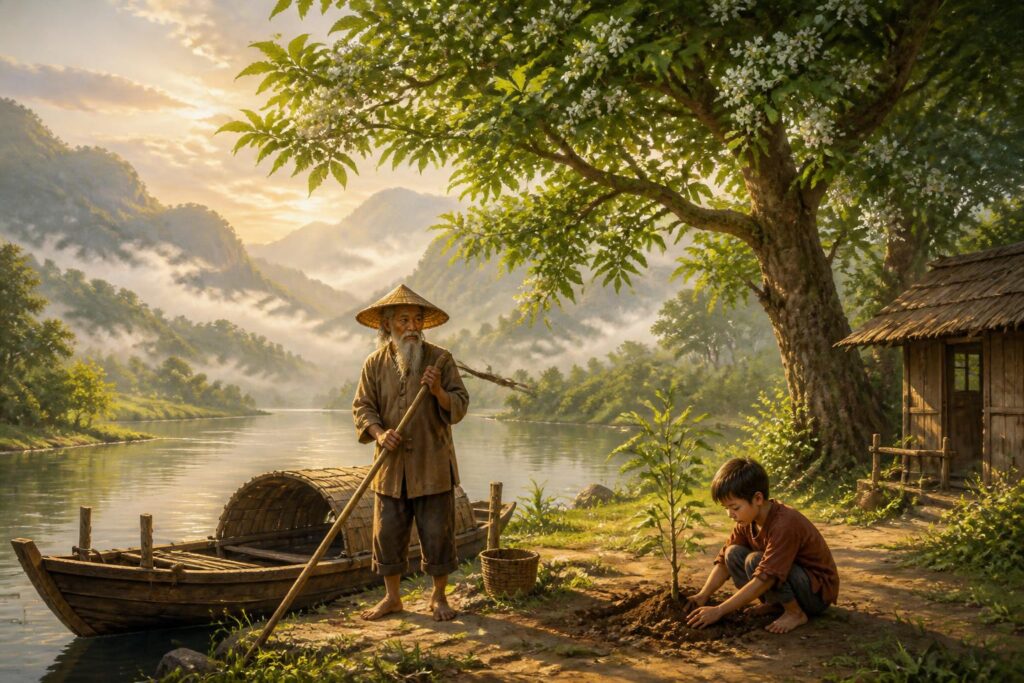
Once upon a time, at the end of a valley shrouded in mist all year round, there was a river so wide that people standing on one bank could not clearly see the rooftops on the other. The river was gentle during the dry season but became fierce whenever the rains came. Thus, the villagers could cross only by means of a wooden ferry operated by an old man named Lam.
Mr. Lam had tended the ferry crossing for nearly forty years. No one in the area remembered exactly when he had begun the work; they only knew that every morning, while the mist still clung to the reeds, he was already there beside his oar. He took people to the market, carried children to school, and helped farmers transport their rice to the opposite bank. Those who had money paid him; those who did not, he simply smiled and said they could repay him when it was convenient.
His ferry was not large, with just enough room inside for a few people and a small amount of cargo. But the villagers believed it was a lucky boat. Through all those years, no one had ever been left in midstream after stepping aboard. If the wind rose, Mr. Lam waited until the water grew calm. If someone was frightened, he rowed more slowly and told a story to make that person stop looking at the water.
The Seed in the Wooden Box
One late afternoon at the end of the rainy season, just as Mr. Lam had pulled the ferry into the landing, he saw a strange woman standing beneath a banyan tree. She wore a brown garment darkened by the rain and held a small wooden box in her hands. She asked him for directions to the village on the other side of the river. Mr. Lam invited her aboard without asking anything more.
During the crossing, the woman looked several times at the box resting in her lap. When they reached the middle of the river, she said softly that it contained a special seed. She had traveled through many lands looking for a suitable place to plant it, but nowhere had made her feel at ease. Mr. Lam asked what kind of tree the seed would grow into. The woman replied that she did not know either. It might be a tree that provided shade, a flowering tree, or a species of tree that had never before appeared in the world.
When the ferry reached the bank, the woman did not step ashore at once. She looked at Mr. Lam and handed him the box, saying, “Please keep this seed for me. Do not plant it out of curiosity. Plant it only when you find a place where people know how to care for something small even though they cannot yet see its benefit.”
Mr. Lam accepted the box and asked when she would return. The woman only smiled. “When the seed no longer belongs to just one person.” Having said this, she disappeared down the riverside path. From that day on, no one in the village ever saw her again.
Those Who Wanted to See Results
Mr. Lam took the box back to the little hut beside the ferry landing. He placed it on a wooden shelf beside a water jar and an oil lamp. Every morning, he opened the lid, looked inside once, and closed it again. The seed was tiny and dark brown, no different in appearance from an ordinary dried seed.
Word of the seed quickly spread throughout the village. Children came in groups to see it. Adults also found excuses to take the ferry so they could ask about it. Some said it should be planted on the high hill, where there was plenty of sunshine. Others thought it had to be planted beside the river so the tree could absorb enough water. A wealthy merchant even offered to buy the seed for a very high price, thinking that if a strange tree grew from it, he could charge people to come and see it.
Mr. Lam refused them all. He said he did not yet know which place was suitable, much less what the seed needed in order to grow. The impatient people began to mock him. They said, what could an old ferryman possibly know about trees? They said keeping a seed in a box forever was simply a way of preventing it from living.
Once, a boy named Tin, the son of a vegetable seller, asked him, “If you don’t plant it, how will you know whether it can grow?”
Mr. Lam looked at the river flowing slowly beneath the afternoon sun and replied, “Some things cannot be learned by rushing. If we plant it in the wrong place, we may destroy its only chance.”
Tin did not fully understand, but from that day on, he often sat beside the ferry hut. He helped Mr. Lam sweep away leaves, remove weeds caught along the side of the boat, and listen to his stories about the people who crossed the river.
A Flood Season and a Difficult Decision
That year, the rains came early and lasted a long time. Water pouring down from upstream caused the river to rise higher than ever before. The ferry landing was flooded, and many houses near the bank had to move their belongings upstairs. Mr. Lam tied the ferry to a large tree, then joined the villagers in helping one another take the elderly and young children to higher ground.
While everyone was clearing things away, a powerful gust of wind knocked the wooden box off the shelf. It fell onto the wet ground and sprang open. The seed rolled out and became lodged in a crack in the wood.
Tin saw it first. He picked up the seed, his hands trembling. Outside, the water was rising by the hour. If they kept the seed in the box, it might grow moldy. But if they planted it in the ground at that moment, the floodwaters might carry it away.
Mr. Lam held the seed and walked around the landing. The highest patch of ground lay right beside the ferry hut, where nothing had grown for years except weeds. The soil there was mixed with gravel, dried out by the river wind, and constantly trampled by passersby. No one would have thought it a good place to plant a precious seed.
Yet Mr. Lam suddenly remembered the woman’s words: plant it only when you find a place where people know how to care for something small even though they cannot yet see its benefit. He looked at the villagers, who were sharing every sack of rice, every plank, and every dry shirt among themselves. Those who had more helped those who had less. The strong supported the weak. No one asked what immediate benefit their efforts would bring.
Mr. Lam dug a small hole beside the ferry hut. Tin shielded it from the wind with his hands, while the others brought good soil from their gardens to heap around it. They placed the seed in the ground and then set up a row of bamboo stakes so the water would not wash it away. No one knew whether it would survive, but everyone agreed to care for it.
The Sapling Beside the River
After the flood season, the seed remained silent. Day after day, the ground did not change. Those who had once been curious stopped coming to ask about it. The wealthy merchant completely forgot about buying the seed. Only Tin and Mr. Lam continued taking turns watering it, pulling weeds, and mounding the soil back up after every rainstorm.
Many months later, on a lightly sunny morning, Tin discovered a small green shoot poking out of the ground. He ran down to the landing to call Mr. Lam. The two of them stood beside the sapling for a long time, afraid to touch it. The news spread, but this time the villagers did not crowd around to see it. Instead, they quietly brought what was needed: a low fence to protect the tree, several containers of compost, and a piece of cloth to shade it from the sun.
The sapling grew very slowly. Throughout its first year, it rose only a little above knee height. In the second year, its trunk grew sturdier, but it still had no flowers or fruit. Some people began to lose hope. They thought that if this were a special kind of tree, it should have grown faster.
Mr. Lam did not blame them. He continued to care for the tree as he would care for a passenger easily lost in midstream. Whenever someone asked when the tree would become useful, he replied that first it needed time to take root. A tree could not reach upward if its foundation below was not yet strong enough.
By the fifth year, the tree began to cast shade. People waiting for the ferry often sat beneath its canopy during hot afternoons. Children played around its trunk. The elderly placed bamboo chairs beneath its low branches to chat. The tree’s roots held firmly to the bank, keeping the soil from sliding into the river as it had before.
In the seventh year, the tree produced clusters of tiny white flowers. The flowers were not brilliant, but their fragrance drifted gently on the wind. By autumn, round yellow fruits appeared on the branches. The fruit had a mild sweetness, enough for travelers to eat a little while waiting for the ferry.
Something That Belonged to Everyone
Only when the tree had matured did the villagers understand why the woman had once said that the seed would no longer belong to just one person. The tree provided more than shade or sweet fruit. It became a place where people met, where conversations began, and where disagreements were resolved calmly. On days when the water was high, the tree’s roots held the riverbank in place and helped keep the ferry hut standing.
Mr. Lam grew increasingly frail. On days when he did not have the strength to row across the swift current, Tin, now grown, took hold of the oar in his place. He still remembered the early days of sitting beside the wooden box, when he had not understood why a seed needed to be treated with such care.
One morning, Mr. Lam handed Tin the key to the ferry hut and said, “This landing needs more than someone who knows how to row a boat. It needs someone who knows how to wait, how to see, and how to preserve things that have not yet had the chance to become useful.”
Tin asked whether he thought the woman would return. Mr. Lam looked at the tree canopy trembling in the wind and smiled. “Perhaps she has already returned many times. Some people do not need to appear in order to know how well what they gave away has been cared for.”
From then on, Tin became the new ferryman. Whenever someone found an unusual seed, an injured animal, or a still-clumsy idea, the villagers would usually bring it to him and ask what they should do. Tin never answered at once. He would study the small gift for a long time, then ask everyone whether they were willing to care for it before knowing what it might bring.
The river continued to flow through the valley, sometimes gently and sometimes fiercely. The ferry continued to carry people back and forth each day. And beside the landing, the tree that had grown from that long-ago seed continued to grow quietly, reminding everyone that the most precious things often begin very small. They need a place to take root, a patient hand, and a community willing to give care without demanding an immediate reward.
From then on, whenever someone impatiently asked what benefit a good deed would bring, the villagers would simply point toward the tree canopy beside the ferry landing. For they had come to understand that not every seed blooms today, but that does not mean it does not contain an entire green season within it.

ARTICLES IN THE SAME CATEGORY
The Keeper of the Bell at the Old Ferry Landing
The Tea House That Opens After the City Falls Asleep
The Mailman at the End of the Hill and the Letters Without Addresses
The Watchmaker and the Room That Kept the Rainy Season
The Bridge Watchman Who Never Crossed the River
The Lamp Beneath the Station Eaves
ARTICLES IN THE SAME GENRE
Stepmother and Stepchild