

 Tiếng Việt
 日本語
 한국어
 中文 (中国)
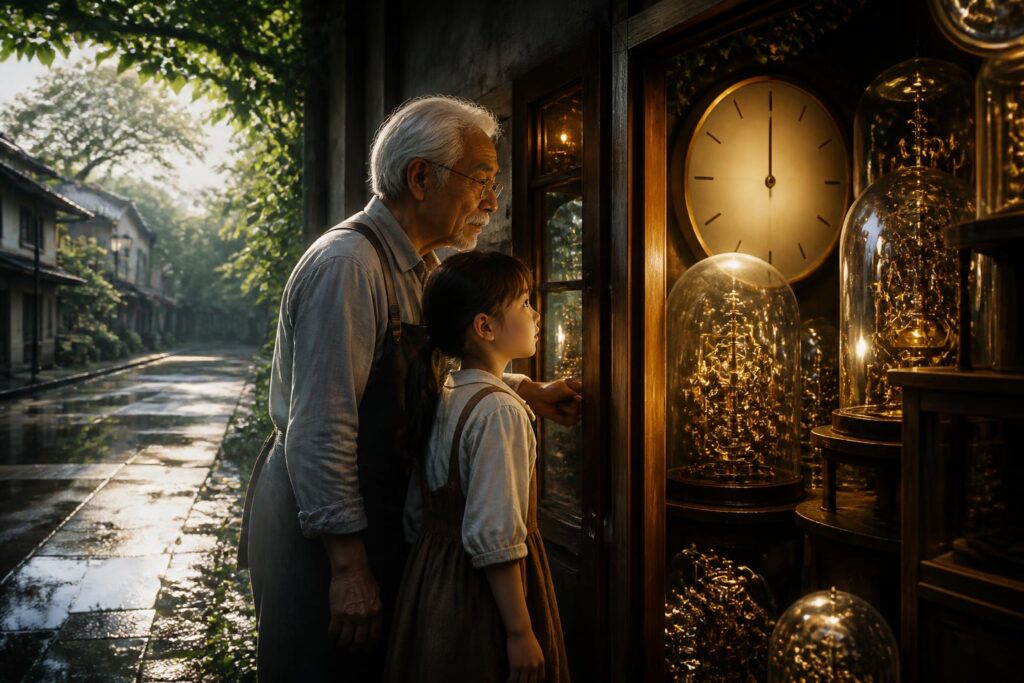
At the end of a small street stood a shop that never put up a sign. People in the neighborhood simply called it Mr. Lam’s watch shop. The shop was narrow, with a low tiled roof, and a wooden bench sat outside, polished smooth by the many years people had spent waiting there. Inside, hundreds of clocks and watches of every shape quietly ticked on the walls, in glass cabinets, and on cramped shelves. Some ticked steadily, some ran a beat fast, and some had been silent for a very long time, but Mr. Lam still kept them.
Mr. Lam had been repairing clocks and watches since he was a boy. His father had once told him that a broken timepiece did not merely lose its ability to tell the time. Sometimes, it also held on to a story that its owner was not yet ready to bring to a close. That was why he never hurried to discard an old watch. He cleaned each gear, replaced the mainspring, straightened bent hands, and patiently listened to the faintest sound coming from the mechanism.
Among the things few people knew about him was a room behind the shop. The room’s door was always locked, yet the lock showed no trace of rust even though no one had touched it for years. People rumored that it contained a collection of valuable watches. A few children even insisted that Mr. Lam kept a watch in there that could turn time backward. But no one had ever seen the room, except for his granddaughter, An, who often came to help him tidy the shop every weekend.
An did not believe the rumors. She only knew that whenever the room was mentioned, Mr. Lam would remain silent for a very long time. One day, he set down his screwdriver, looked toward the door, and said, “There are things that, if opened too soon, leave people not knowing how to close them again.”
The Rain That Would Not Pass
That year, the town went through a prolonged dry season. The stream behind the market became so shallow that white stones showed through its bed. The trees were coated with a thin layer of dust, rooftops grew scorching at noon, and the street vendors frequently had to wipe their faces with wet towels. Everyone waited for rain, but every day the sky remained coldly blue.
Then one afternoon, clouds suddenly gathered. Rain poured down violently, slanting in the wind and drumming incessantly on the tiled roofs. The townspeople rushed onto their porches; some held out their hands to catch the water, while others laughed with relief. The rain continued throughout the night, and then through the following day. By the third day, the streets had become streams of muddy water. By the seventh day, the water had risen above the thresholds of many low-lying houses.
Mr. Lam still opened the shop, even though no one brought in a watch for repair. He sat beside the wooden table, listening to the rain and watching the hands move. An came to visit him one morning beneath a sky thick with gray clouds. She found him wiping dust from a pendulum clock.
“Are you going to repair this one?” An asked.
“No,” he replied. “I only want to hear whether it still remembers how to run.”
That afternoon, water flooded into the shop. An and Mr. Lam raised the boxes onto higher shelves, but the rain still did not stop. When a clap of thunder made the glass door tremble, Mr. Lam suddenly stood up and took a silver key from a drawer.
“The time has come,” he said.
He opened the room behind the shop. An followed him inside and immediately felt that the air there was completely different from the air outside. The room had no windows, yet faint streaks of light, like sunlight after rain, appeared across the ceiling. Along all four walls stood large glass jars, each containing a thin vapor of its own color. One glowed with the gold of early morning, another was pale blue like a late-autumn afternoon, and another was reddish brown, like the color of bare earth after the first rain of the season.
In the very center of the room stood a clock taller than a grown person. Its face had no numbers, only an empty circle and a single hand that stood perfectly still.
“What is this, Grandfather?” An whispered.
“The town’s rainy days,” Mr. Lam replied. “Long ago, people brought here the things they were afraid they would forget. An afternoon when a loved one returned. A night spent beside the hearth. A rain that soothed the heart after many months of heat. I kept them here this way.”
An gazed at the jars, astonished and confused. “Then is the rain outside connected to this room?”
Mr. Lam nodded. “Perhaps I have kept too much. When someone tries to hold on to every beautiful thing, those things have nowhere to flow away. Rain is the same.”
The Still Hand
Mr. Lam told her that many years earlier, the town had once experienced a very short rainy season. The rain stopped almost as soon as it arrived, leaving the fields cracked and the wells gradually dry. At the time, he had been just over thirty and had recently lost his younger brother to an illness. His brother had loved the rain. He would often sit on the porch listening to the water fall and say that every raindrop carried good news from somewhere far away.
After the funeral, Mr. Lam could not bear the sunny days. He found a way to preserve the sound, the smell of earth, and the color of the sky from the last rainstorm the brothers had sat through together. From being a watchmaker, he became a keeper of memories. Whenever someone wanted to preserve a special day, he helped them place that day inside a jar. Gradually, the room filled up.
At first, keeping them made everyone happy. They could return to a memory whenever they wished. But then some people began living more in the jars than in the present. A mother listened endlessly to the sound of her child’s laughter from an old afternoon and forgot to ask how the child who was growing up was doing. A man remembered only the year of a plentiful rice harvest and refused to sow seeds for the new season. A young woman preserved the day she had been loved, then rejected every new encounter because she feared the present would never be as beautiful as the past.
Mr. Lam realized what was happening but did not have the courage to open the room. He was afraid that if he let the rainy days pass, he would also lose the image of his younger brother. So he locked the room, continued repairing clocks, and pretended that time could stand still if the gears were carefully maintained.
An walked closer to the large clock. She saw a fine crack in the glass, running from the center to the outer edge. The hand remained motionless.
“What would happen if we opened the jars?” she asked.
“Every memory would return to where it belongs,” Mr. Lam said. “But I don’t know whether I can bear it.”
“Perhaps you don’t have to bear it alone.”
Those words made Mr. Lam look at An for a long time. Outside, the water had risen to the final step of the doorway. The watch shop trembled gently beneath the sound of rain. Every hand on the walls continued moving, as though none of them cared about the fear of an old man.
Returning the Rainy Days
The grandfather and granddaughter began with the smallest jar. Mr. Lam removed its glass stopper, while An placed the jar beside the room’s doorway. A transparent vapor drifted out, carrying the scent of wet leaves and the sound of children laughing. At once, the voices of neighbors calling to one another rang through the streets. An old woman sitting inside her house suddenly remembered that she still had an old friend at the far end of town. A father looked at his child standing by the window and, for the first time after so many days of rain, asked, “Are you cold?”
They opened the second jar, and then the third. Each time a memory was returned, the water in the streets receded a little. Some rainy days had been joyful, while others had carried sorrow. Someone burst into tears upon hearing again the footsteps of a person who had died. Someone sat for a long time on a porch, realizing that they had forgotten an apology. But after each sadness, the town seemed to breathe a little more easily.
When they reached the final jar, Mr. Lam could not open it himself. Inside was a silver vapor, quietly swirling like kitchen smoke. He knew it was the last afternoon he had spent with his younger brother. The two of them had sat beneath the porch roof, sharing a hot sweet potato and listening to the first rain of the season. His brother had said that the following year, they would repair the roof together so they would no longer have to dodge leaks.
“You can keep it,” An said.
Mr. Lam shook his head. “No. If I keep it, I won’t be able to hear what is happening today.”
He opened the jar’s stopper. The silver vapor floated out, swept through the room, and dissolved into the air. The large clock made a soft, dry sound. The hand that had stood still began to move, inch by inch. Outside, the rain slowed, changing from a furious downpour into sparse drops falling on the tiled roof.
When the rain stopped, the town emerged beneath a clear blue light. The stream behind the market was full of water, the trees had shed their dust, and the road reflected the faint light of the afternoon. The room behind the shop no longer held jars filled with cloudy vapor. They were now simply empty glass vessels, clean and transparent.
What Time Truly Needs
From that day on, Mr. Lam no longer preserved rainy days for anyone. If someone brought him a watch that had stopped at an important moment, he still repaired it, but he always returned it with the same reminder: a watch can only help us know that time is passing; it cannot live that stretch of time for us.
The secret room was opened to everyone. Mr. Lam turned it into a small reading room. People in the town could come to recount a memory, write a word of thanks, or simply sit quietly and listen to the clocks running. No one was allowed to imprison memories in jars anymore. They could only share the story of a memory with one another, so that it could become part of the present.
An continued helping him repair clocks. She learned to recognize a stuck mainspring, a misaligned gear, and a hand that was running too fast. But the most important lesson she received was not found among the tools on the table. It was understanding that people often want to hold on to beautiful days because they fear tomorrow cannot be as good. Yet if they keep returning to what has already passed, they will miss the chance to create another beautiful day.
Mr. Lam lived for many more years. Whenever rain seemed near, he would pull the wooden bench out in front of the shop, pour two cups of tea, and sit with An. They did not try to guess how long the rain would last. Nor did they try to hold every sound inside a jar. They simply listened, talked, and let the rainwater flow wherever it needed to go.
Because time is not a road along which people can go back to pick up every moment that has fallen. Time is a quiet current carrying what has passed into the distance, while opening before us a new expanse of space. That space may frighten us, but it is also precisely where the days that have never yet existed are waiting to be created.

ARTICLES IN THE SAME CATEGORY
The Bridge Watchman Who Never Crossed the River
The Lamp Beneath the Station Eaves
The Sweet Soup Stall Under the Tropical Almond Tree and the Debt of Kindness
A Kind Person Is Not Someone Who Is Always There, but Someone Who Knows When to Stay
An Ordinary Family Meal and the Things That Keep a Family Together
A Proper Apology Can Reopen a Closed Door
ARTICLES IN THE SAME GENRE
Tam Cam Part 2: The Vengeful Spirits of the Palace
Tam and Cam: The Palace Intrigue and the Original Ending – Part 1
The world is never short of those who judge others by their material possessions; however, the most concerning poverty of all is the lack of wisdom and self-cultivation.
Stay Away from Foolishness: Seven Forms of Self-Deception and the Path to Awakening
Letting Go of Attachment to Overcome Anxiety: When What Exhausts Us Is Not Life Itself, but the Way We Hold On to It
Drinking Tea or Living Life: When People Get Lost in Material Glamour and Forget Themselves