

 Tiếng Việt
 日本語
 한국어
 中文 (中国)
What Is Precious Often Begins with an Ordinary Meal
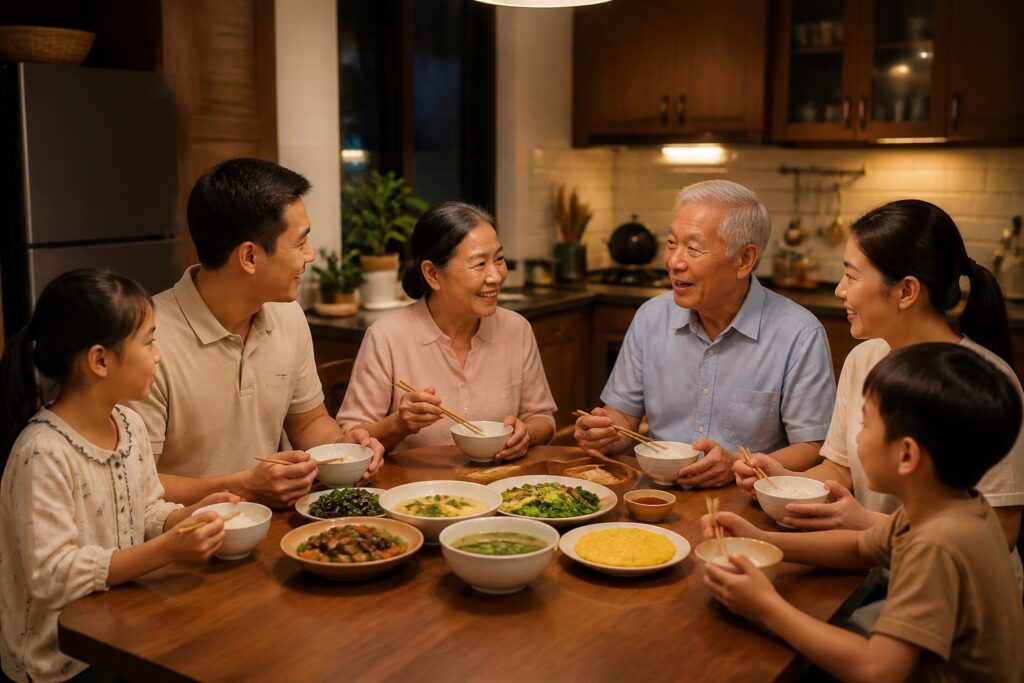
In many people’s memories, family meals did not always include special dishes. Sometimes there was only a pot of vegetable soup, a plate of fried eggs, a bowl of fish sauce placed in the middle of the table, and a few dishes prepared in haste after a busy day. Yet it is often these simple meals that remain longest in the mind. People remember the sound of bowls and chopsticks touching, the familiar questions asked by their parents, the sight of someone quietly serving food to everyone, or the feeling of being able to sit down beside people who, even at times, still did not know how to fully express what was in their hearts.
Modern families are often not lacking in affection, but in the time needed for that affection to be recognized. Each person has a separate schedule, separate work and separate concerns. Adults go to work, children go to school, older people stay at home, and the amount of time when the whole family is together continues to shrink. Therefore, a shared meal should not be viewed as a compulsory ritual or a standard by which to judge a family. Its value lies more in creating a pause, a place where people have the opportunity to see one another after spending hours living in different worlds.
Being Present Matters More Than an Elaborate Meal
Many people think that to organize a proper family meal, there must be delicious food, a beautiful dining table, or plenty of unhurried time. This way of thinking unintentionally turns getting together into a difficult task. A meal may last only twenty minutes, the food may be simple, and the table and chairs may not be perfect. What matters more is that during that time, everyone is truly present with one another instead of merely sitting beside one another.
Being present does not simply mean appearing in the same room. Someone who sits down to eat but keeps looking at their phone is not truly taking part in the conversation. Someone who listens to their child while replying to work emails will also find it difficult to fully take in what is being shared. No one can maintain absolute focus during every meal, but a family can agree on one small rule: once everyone sits at the table, give one another a few minutes free from interruptions by outside notifications.
That rule does not need to be stated in a commanding tone. Adults can set an example by putting their phones aside, taking the initiative to ask questions, and listening without rushing to judge. When children tell a story about school, what they need is sometimes not immediate advice but the feeling that their story is worth hearing. When parents talk about a tiring day, they may simply want to share what they are going through rather than turn the meal into a family meeting.
Small Conversations Can Prevent Great Distances
Families do not usually grow distant only because of a major event. Distance sometimes takes shape through very small things repeated over a long period: no one asks how the other person is doing today, a story is ignored because everyone is too busy, a complaint is always answered with “everyone is tired,” or a disagreement is never explained but merely set aside. Conversations during meals do not automatically solve every problem, but they help people recognize problems before they become too difficult to talk about.
The topics of conversation do not need to be profound. They can begin with today’s food, something interesting seen on the way home, something that made someone laugh, or simple plans for the weekend. When lighthearted stories appear regularly, family members become accustomed to sharing. From that foundation, more difficult matters also have a chance to be brought up more naturally.
What matters is how people listen. In a family, each person has a different age, personality, and set of experiences. Adults may think a child’s sadness is trivial, while the child feels it is the most serious thing that happened all day. A wife may simply want her husband to acknowledge how hard she has been working, while the husband may think that quietly handling other tasks is enough to show his sense of responsibility. If people listen only to argue or compare, a conversation can easily turn into a debate. If they listen in order to understand the circumstances behind the words, the meal can become a place where closeness is restored.
Do Not Turn the Dining Table into a Place of Judgment
One reason family members are reluctant to share is that they are afraid of being judged. Some families still sit down to eat together, but their meals are always filled with criticism about grades, money, work, or ways of living. In such cases, the dining table is no longer a place to rest but a place where everyone goes on the defensive. Younger people stay silent to avoid being questioned, adults hide their exhaustion so as not to cause trouble, and quiet resentment accumulates behind an outward appearance of peace.
This does not mean that families cannot offer feedback or discuss serious issues. However, giving feedback is different from humiliating someone, reminding them is different from berating them, and discipline is different from using a meal to apply pressure. Matters that require deeper discussion can be addressed at a more suitable time, when everyone is calm enough and there is private space. A meal should be a place where concern begins, not a place where someone has to prove that they deserve to be loved.
In particular, adults should avoid turning one family member’s mistake into a topic for the whole family to criticize. A child who has not done well on an assignment, a working person who has experienced failure, or an older person who has forgotten something should not be associated with harsh conclusions about their character. When people feel safe, they are more willing to take responsibility. When they are constantly made to feel ashamed, they usually learn only how to hide things.
Not Every Family Can Eat at the Same Time
Real life does not allow every family to maintain the same eating schedule. Some people work evening shifts, some frequently travel for work, some children attend extra classes until late, and some families live far apart. Therefore, we should not use the image of a full family gathered around the table every day to create an additional sense of inadequacy for families doing their best under their own circumstances.
Connection can be created in many other ways. A family that cannot have dinner together can choose a weekend breakfast, a time to prepare a dish together, or a short period to call and check in with one another. Those who live far from home can send one another photos of their meals, talk about what they have just cooked, or arrange a regular time to talk. What matters is not one particular form, but the consistency and sincerity of remembering one another.
Even when only one person in the household prepares the meal, the other members can still contribute. One person washes the vegetables, another sets the table, another washes the dishes, and someone asks whether today’s food tastes right. These small tasks change the feeling of a meal: it is no longer the responsibility of one person alone but a shared activity. When care is shared, the person who cooks also feels acknowledged rather than treated as an invisible part of family life.
Nurturing Memories Through Simple Habits
Children often do not remember exactly every dish that has appeared on the table, but they remember the atmosphere of the meals. They remember whether they were allowed to tell stories, whether the adults listened, whether someone in the household often became angry, and whether, on difficult days, there was still a moment of peace. Family memories are formed from details that are repeated, not only from trips or major holidays.
A small habit can create a sense of belonging. The whole family can share one memorable thing from the day, take turns choosing the weekend meal, preserve a traditional dish, or clear the table together after eating. These activities do not cost much money or require any special skills. They only need the patience to be maintained long enough to become a natural part of daily life.
Throughout this process, families should also accept that not every meal will be cheerful. Some days someone is tired, some days an argument occurs, and some days everyone simply eats in silence. Connection does not require a family to be perfect all the time. It is built through the ability to return to one another after periods of disharmony, to know how to apologize, to know how to ask after one another, and to know how to begin again with an ordinary conversation.
What Remains After a Long Day
People often devote most of their energy to work, study, and responsibilities outside the home. By the time they return, everyone may be so tired that they only want to remain silent. But precisely on days like these, a simple meal or a brief question about how someone is doing becomes even more meaningful. It reminds each person that they are not only an employee, a student, a manager, or someone who has to deal with countless tasks. They are also a family member who is awaited, cared for, and has a place to return to.
Not every family expresses love in the same way. Some people speak gently, some quietly serve food, and some repair the fan, set aside a portion of food, or remember to buy exactly what a loved one likes. These actions may be so small that they are easily overlooked, but they are often the enduring language of care. Recognizing them is also a way of making family affection more visible.
An ordinary meal cannot erase every difference between generations, nor can it immediately solve difficulties involving finances, health, or work. However, it creates a foundation that keeps family members from becoming strangers living under the same roof. Through a question, a glance, or a period without screens, people can rediscover the rhythm of connection that busy life has interrupted.
Therefore, if the family cannot have a complete meal together today, there is no need to wait for a special occasion. It can begin by sitting beside one another for a few extra minutes, asking a sincere question, and listening to the answer all the way through. The warmth of a family does not necessarily come from a table full of food. Often, it begins when everyone remembers that the most precious thing at the table is not the food, but the people who are present together.

ARTICLES IN THE SAME CATEGORY
A Proper Apology Can Reopen a Closed Door
The Things No One Applauds Still Make a Decent Life
A Meal with Someone Waiting: The Art of Keeping a Home Close
When Old Things Teach Us How to Slow Down
The Keeper of the Bus Tickets
The Room with a Window Overlooking the Backyard
ARTICLES IN THE SAME GENRE
The Seedling Who Knew How to Listen and the Forest That Awoke
Brown Squirrel’s Raincoat
The Wind Chime Finds Its Chime Again
Stepmother and Stepchild