

 Tiếng Việt
 日本語
日本語 한국어
한국어 中文 (中国)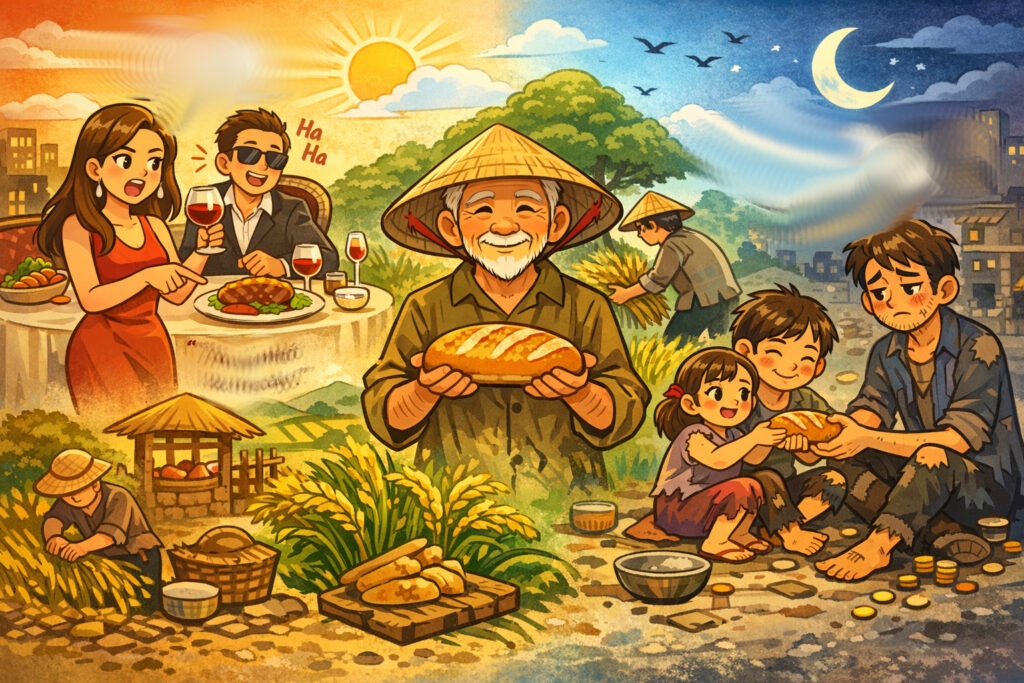
In the fast-moving current of modern life, people have grown increasingly accustomed to judging one another through what is immediately visible: clothing, phones, cars, or even the food placed on the table. A luxurious meal can easily earn someone the label of “classy,” while a simple piece of bread might become a reason for disdain. Yet, if we look more deeply, these very judgments become a mirror reflecting the depth—or shallowness—of one’s awareness and self-cultivation.
Eating, at its core, is merely a basic human need. No one can live without food. However, since ancient times, Vietnamese ancestors never regarded eating as a purely biological act. Within every meal, every grain of rice, they embedded moral lessons, gratitude, and a way of living. That is why the saying goes: “When eating fruit, remember the one who planted the tree.” It is a simple phrase, yet it carries an entire ethical foundation. It reminds us that behind every dish lies sweat, effort, and the quiet endurance of many lives.
Therefore, when someone speaks with contempt about food, they are not merely judging the dish—they are, in effect, dismissing the value of human labor. A piece of bread is not just baked flour. It is the result of an entire chain of work: from those who cultivate wheat, to those who grind it, to those who bake and sell it. If one truly understands this, it becomes difficult to utter words of scorn.
Yet in today’s society, many people still use material possessions as the sole measure of human worth. They believe that what one eats, uses, or displays defines one’s place in the eyes of others. From this distorted belief, arrogance begins to grow. A simple piece of bread becomes associated with poverty. A modest meal is dismissed as lacking “class.” Ordinary things are dragged into a skewed system of values.
The ancients warned clearly against this mindset. “Good wood is better than good paint.” True worth lies not in outward appearances, but in inner substance. A person may surround themselves with luxury, but without humility and understanding, such wealth is merely a hollow shell. On the other hand, those who live simply and appreciate small things often possess a quiet strength of character that commands respect.
Stories about contempt for food are not new. In Vietnamese folk wisdom, there have long been cautionary tales. There were once people of wealth who, accustomed to abundance, gradually developed a habit of waste. They left food unfinished, discarded it carelessly, even mocked those who lived simply. But as life turned, fortunes changed, and hardship arrived, they finally came to understand the true value of a single meal.
This is why our ancestors taught: “Even in hunger, remain clean; even in rags, remain fragrant.” Poverty is not shameful. What is shameful is losing one’s dignity, losing respect for life’s most fundamental values. A person who, regardless of circumstance, maintains integrity and gratitude is one who stands on solid ground.
In real life, it is not difficult to find examples of what might be called “consequences” for those who treat food with contempt. Some people, when prosperous, waste extravagantly, discarding leftovers without a second thought. But when circumstances shift—when work falters, when finances tighten—they begin to realize that even a simple meal becomes precious. These are not mystical punishments, but natural outcomes of a careless and ungrateful way of living.
The old saying goes: “A morsel when hungry is worth more than a feast when full.” This is not merely about material value; it reflects how human perception changes with circumstance. When life is abundant, small things are easily overlooked. When scarcity arrives, even the smallest things gain immense meaning. The change lies not in the food itself, but in the human mind.
What is worth reflecting on is why some people, even in abundance, remain humble, while others quickly become arrogant. The answer lies in self-cultivation. Those who understand the value of labor and the impermanence of life do not easily fall into contempt. They know that today’s comfort does not guarantee tomorrow’s security. That awareness keeps them grounded.
In contrast, those who view life purely through material lenses often fall into illusion. They believe their current possessions are permanent, and from that illusion grows a tendency to look down on others. But life never stands still. When circumstances change, external markers of status can vanish quickly. What remains is the person themselves—with all the wisdom and character they have (or have not) cultivated.
In Vietnamese culture, thrift and respect for food have always been deeply valued. It is no coincidence that in many families, finishing one’s meal is considered a virtue. This is not merely about saving resources; it is an expression of gratitude. Every grain of rice is the result of countless days under sun and rain. To understand this is to naturally avoid waste.
From this understanding came the ancestral warnings: those who squander food and treat it with disdain will eventually face hardship. This is not superstition, but a practical law of cause and effect. A person who becomes accustomed to excess will struggle to adapt when difficulties arise. Meanwhile, one who knows restraint and appreciation will be better prepared for life’s uncertainties.
In the age of social media, words travel faster than ever. A casual remark can quickly become a topic of widespread debate. But what matters is not how widely a statement spreads, but what it reveals. When someone uses arrogant language to belittle food or the choices of others, they do not elevate themselves—they expose the limits of their own understanding.
The ancients taught: “Words cost nothing—choose them wisely to please the heart.” This is not advice for insincerity, but a reminder of mindfulness in speech. A thoughtful person understands that every word carries responsibility. What we say affects others, but it also reflects who we are.
Looking more broadly, the story of a simple piece of bread is just a small fragment of a larger issue: how we define value. If society continues to prioritize outward glitter while neglecting inner depth, such incidents will keep recurring. But if individuals pause to reflect—to reconsider how they judge others—change becomes possible.
A person’s worth is not determined by what they eat, but by how they treat what they have. Someone who appreciates a simple meal often also values relationships, opportunities, and even hardships. They do not rush to judge or belittle, because they understand that everyone walks a different path.
In the end, what remains is not the most attention-grabbing words, but the way a person lives and treats others. Words of contempt may rise like foam on the ocean, drawing brief attention before dissolving. In contrast, kindness and humility, though quiet, endure over time.
A piece of bread, a simple meal, or any humble food carries no fault. What deserves reflection is how we perceive it. When we learn to appreciate small things, we begin to refine ourselves. And perhaps that is true “class”—something that cannot be bought, cannot be faked, but can only be built through time and sincere self-cultivation.

ARTICLES IN THE SAME CATEGORY
Knowing How to Say No in Order to Live in Alignment with What You Truly Value
Decluttering Digital Life to Regain Focus and Peace
Listening to Understand: The Skill That Changes the Quality of Every Conversation
When a Day Ends Properly, the Heart Feels Lighter
Knowing When to Change Your Mind: A Sign of Mature Thinking
Living Mindfully in an Age of Information Overload
ARTICLES IN THE SAME GENRE
Tam Cam Part 2: The Vengeful Spirits of the Palace
Tam and Cam: The Palace Intrigue and the Original Ending – Part 1
Stay Away from Foolishness: Seven Forms of Self-Deception and the Path to Awakening
Why Donald Trump is Repealing the “Endangerment Finding”: Where Will Humanity Go if Earth Exceeds Its Limits?
The Epstein Files and the Shadow of Power: When Dark Rumors Reflect Back Through Cinema
Seven Parts of Life Go Against Our Wishes, Clinging Only Deepens the Suffering