

 Tiếng Việt
 日本語
 한국어
 中文 (中国)
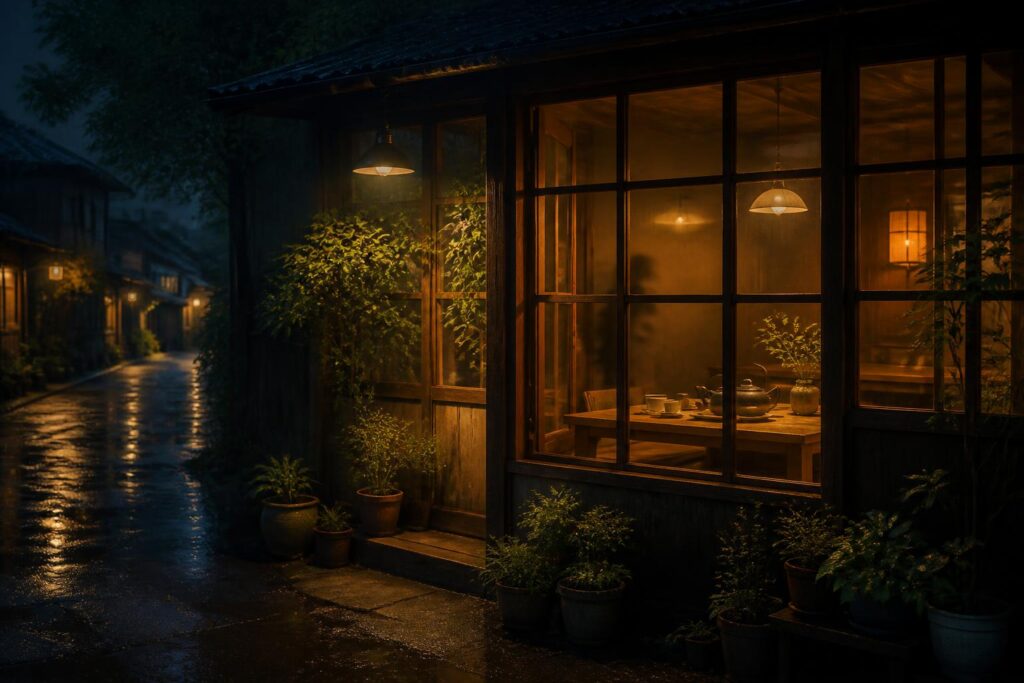
At the end of the street, there is a tea house with no sign, no advertising, and no fixed opening hours. During the day, the small house usually keeps its doors closed, with only a few green potted plants sitting on the front step. Passersby can easily walk past without knowing the place exists. But when the city begins to grow quiet, when the windows one after another turn off their lights, the tea house quietly comes alive with a single yellow lamp.
People in the neighborhood call it the night tea house. No one knows exactly when it first opened; they only know that whenever someone carries an unspoken thought, a sadness they have not yet found a name for, or simply does not want to return to the room waiting for them, they can come and knock on the door. The owner never asks where her guests have come from, nor does she pry into why they are sitting alone. She simply pours tea, places a small cup in front of them, and lets silence do the rest.
The Guest Who Arrived with the Rain
One night at the beginning of the rainy season, a young woman named An pushed open the wooden door and stepped into the tea house. Her coat was dark with rain, a few drops clung to her hair, and her hands were freezing. An stood in the doorway for quite some time, as though she still had not decided whether she should truly go inside.
The owner looked up from the clay teapot on the table. She was in her sixties, with silver hair neatly tied at the nape of her neck. She did not ask An what she would like. She only said:
“Sit down, dear. The chrysanthemum tea is just warm enough tonight.”
An pulled out a chair and sat down. She did not particularly like chrysanthemum tea, but she did not have the strength to refuse. Before long, a cup of tea with a gentle fragrance sat before her. An lifted it to her lips and took a small sip. The tea was nothing special, but its warmth traveled down her throat, making her unconsciously exhale.
“You can sit here as long as you like,” the owner said, her eyes still fixed on the rain falling beyond the porch. “Time is not counted here.”
Those words nearly made An burst into tears. For months, she had always felt as though time were chasing her. Work, appointments, unanswered messages, her family’s expectations, and plans that had fallen through made each day feel like a cramped room. She woke up exhausted, worked anxiously, and went to bed with the feeling that tomorrow would be even heavier than today.
An had grown used to saying that she was fine. She said it to her mother over the phone, to her colleagues at work, and to a friend she had once been close to. The more she said it, the emptier the words began to feel. Tonight, after an argument, An walked aimlessly through the rain and stopped in front of the tea house door.
“What if I don’t know where to begin?” An asked.
The owner added more hot water to the pot.
“Then begin by not needing to begin right away.”
People Who Did Not Need Introductions
Near midnight, two more guests arrived. One was a middle-aged man wearing a delivery uniform; the other was a young man with an old backpack. They sat in different corners, neither greeting nor looking at the other. The man ordered ginger tea, while the young man asked for a cup of warm water.
The small tea house had only four tables. There were no paintings on the walls and no clock, only a low bookshelf filled with books whose spines had become worn. Beside the window stood a round-leaved plant that trembled now and then when the wind slipped inside. Everything was so simple that people did not know what they were looking for there, but once they sat down, they usually did not want to get up too soon.
The man finished his first cup of tea and asked for more water. The owner poured it for him without asking any questions. After a while, he looked at An and said:
“You work in the office district across the street, don’t you?”
An nodded.
“I deliver there every day. Once, I saw you standing in the lobby for a long time, holding your phone but not calling anyone.”
An felt slightly embarrassed and did not know how to respond. The man immediately turned away, as if afraid his words had become an intrusion.
“I’m sorry. I didn’t mean to pry into your personal affairs.”
“It’s all right.”
He was silent for a while longer, then said that he often stopped by the tea house after his shift. His wife had died several years earlier, and his son worked far from home. During the day, he was busy and rarely had time to think. At night, when he returned to a room filled with nothing but the sound of a spinning fan, he realized he did not know whom to talk to.
The young man with the backpack continued to look down at his cup of water. The owner placed a small plate of cakes in front of him. He refused, but she only said:
“If you don’t want to eat them, just leave them there. You’ll eat them when you’re hungry later.”
It was nearly one in the morning when he finally spoke. He had just dropped out of a course halfway through and had not dared tell his family. He was afraid they would see him as a failure, afraid of having to return home, and even afraid of continuing along his current path. Those fears had sent him wandering through the streets on many nights, until he saw the light of the tea house.
No one offered any grand advice. The man only said that there were days when he did not want to get out of bed either. An said that she had once thought adults were supposed to always know what they were doing, but recently she had realized that no one could remain certain forever. The young man listened, nodding from time to time. Three strangers sat around a low table, sharing things they had never fully said to the people closest to them.
The Price of a Cup of Tea
When guests asked how much they owed, the owner usually replied that each person should leave behind one thing they wanted to let go of. Some laughed, thinking it was merely a joke. Others assumed she did not want to charge them and tried to place a few banknotes on the table. She never argued, only gently pushed the money back.
“This tea house isn’t free,” she said. “It’s just that the price isn’t paid in money.”
What needed to be left behind could be a grievance, a shame, the desire to please everyone, or a story that had been repeated in one’s mind for far too long. Not everyone could let go immediately. Many people simply sat outside the door for a while, wrote it down on a small piece of paper, and tore it up. Some took it home because they were not ready. The owner had never pressured anyone.
That night, An asked her why she had opened the tea house in such a strange way.
The owner looked at the lamp on the table and slowly explained that many years earlier, she had had a daughter who always seemed strong. She worked late into the night, often said she was fine, and did not want anyone to worry. One day, she left home after an argument. When she returned, she only said that she needed a quiet place to breathe.
“At that moment, she didn’t need her mother to solve the problem,” the owner said. “She only needed someone to sit beside her without pressing her with questions. But I didn’t understand. I kept asking what had happened, who had upset her, and what should be done to make things right. She stayed silent, while I talked too much.”
The daughter later moved to another city. Mother and daughter still kept in touch, but there was always a distance between them that was difficult to name. The owner had not opened the tea house to recover what had been lost, but to learn how to give others what she had not known how to give her daughter back then: a place to sit without judgment.
“Sometimes kindness isn’t about doing things for someone else,” she said. “It’s simply about not making them feel even more alone when they are suffering.”
Silence Can Also Be an Answer
The tea house closed when dawn was approaching. Before leaving, each guest received a small bag of tea. The owner told them to brew it when the house felt too quiet, though they did not necessarily have to wait until they were sad.
The delivery man bowed his head in thanks. The young man with the backpack stood on the porch for a long time before finally stepping down into the street. An was the last to leave. The rain had stopped, and the road reflected the pale lights of early morning.
“I still don’t know what to say to my mother,” An admitted.
“Then don’t say everything today,” the owner replied. “You can begin with a sentence more honest than ‘I’m fine.’”
An thought of many sentences, but in the end chose a simple one: “I’ve been a little tired lately, Mom.” Perhaps it was not the answer to everything. It did not make work any less stressful, instantly improve her relationships, or make the future any clearer. But it was the first sentence she had said without trying to hide herself.
A few days later, An returned to that street. The small house was closed, and there was no yellow light behind the window. She asked a nearby shopkeeper and learned that the tea house only opened when its owner wanted to, sometimes after a few nights, sometimes after an entire month.
An was not disappointed. She understood that the tea house had never promised to always be there to welcome anyone. What it offered its guests was not a permanent refuge, but a silence long enough for each person to hear their own voice. After that, they still had to return to their rooms, their work, and the conversations left unfinished.
From that day on, An kept a small teapot beside her window. Whenever she returned late, she brewed a cup of tea and sat quietly for a few minutes before picking up her phone. Some nights she was still sad, still anxious, and still did not know what to do the next day. But she no longer saw those feelings as signs of failure. They were simply things that were present, things that needed to be acknowledged before she could find a way to change them.
In a city that was always urging people to move faster, the unmarked tea house quietly reminded them that sometimes the most important step forward was to stop. Not to escape from life, but to return to it with a calmer state of mind. Some answers do not appear while we are desperately searching for them. They come when we sit down, wrap both hands around a warm cup of tea, and allow ourselves to be honest.
One night, a yellow light came on again at the end of the street. The wooden door stood slightly ajar. Inside, the owner placed another cup on the table, as if she knew that someone was passing by with a story they were not yet able to tell.

ARTICLES IN THE SAME CATEGORY
The Mailman at the End of the Hill and the Letters Without Addresses
The Watchmaker and the Room That Kept the Rainy Season
The Bridge Watchman Who Never Crossed the River
The Lamp Beneath the Station Eaves
The Sweet Soup Stall Under the Tropical Almond Tree and the Debt of Kindness
A Kind Person Is Not Someone Who Is Always There, but Someone Who Knows When to Stay
ARTICLES IN THE SAME GENRE
Stepmother and Stepchild