

 Tiếng Việt
 日本語
 한국어
 中文 (中国)
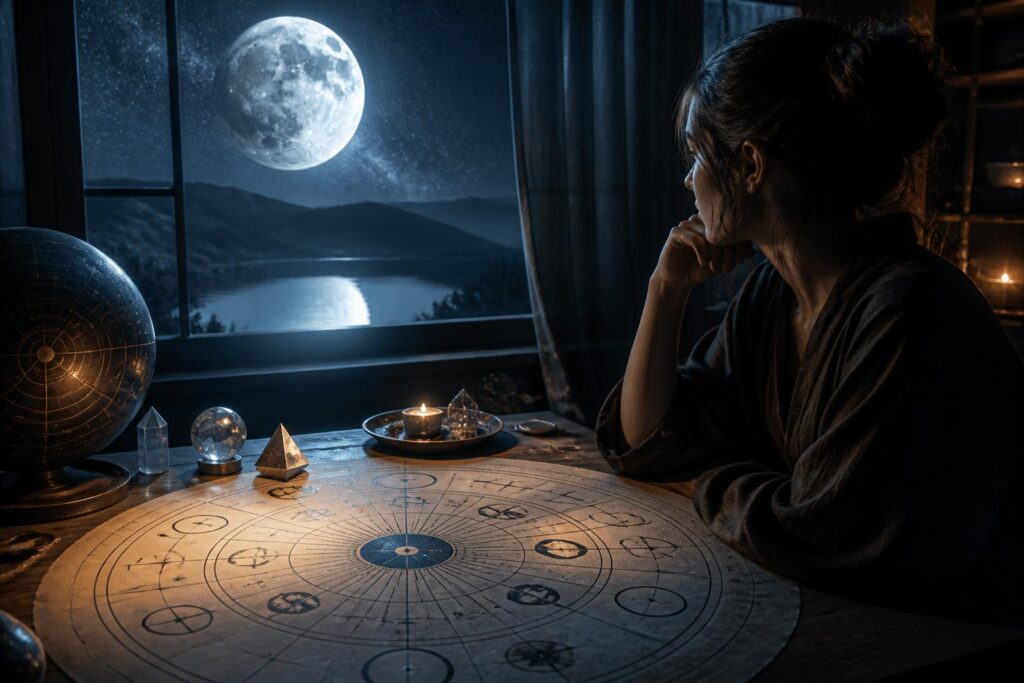
In a personal birth chart, the Moon often points to the least visible part of a person. If the way someone appears before society may be influenced by the ascendant, while the ego and sense of self are often associated with the Sun, the Moon directs attention to the inner world. It is where emotions, habits, memories, and needs that even we ourselves sometimes find difficult to name are stored.
Astrology is not a scientific tool for definitively determining personality or predicting fate. However, when used as a symbolic language, a birth chart can open up an opportunity for self-observation. The Moon’s position in the zodiac does not offer an unchanging conclusion about a person, but instead suggests questions worth considering: Where do we usually seek a sense of safety? How do we react when we are hurt? What makes us feel loved and that we belong?
What does the Moon represent?
In common astrological interpretations, the Moon is associated with emotional needs and instinctive reactions. This is the part that often acts before reason has had time to fully analyze a situation. When faced with an unexpected circumstance, each person may immediately withdraw, seek reassurance, try to control the situation, or take the initiative to care for someone else. Such reactions are often shaped by long-term experiences, the family environment, and the ways each person once learned to protect themselves.
The Moon is also associated with memory and a sense of familiarity. A scent, a dish, a room, or a melody can awaken a very old emotional state within us. Some people find peace in an orderly space, some need intimate conversations, while others only feel comfortable when they have enough private time. These needs are not always spoken aloud, but they clearly influence our choices and the way we maintain relationships.
At a deeper level, the Moon is often used to consider how a person cares for themselves. When tired, what do they need in order to recover? When anxious, whom or what do they turn to? When overwhelmed, do they tend to face their emotions or avoid them? These are practical questions with value even when the reader does not view astrology as a predictive system.
The Moon through the twelve zodiac signs
Each zodiac sign can create a different quality in emotional life. The interpretations below are for reference only, because a birth chart always consists of many factors that need to be viewed as a whole.
The Moon in the Fire signs
When the Moon is in Aries, Leo, or Sagittarius, emotions are often imagined as direct, energetic, and in need of movement. People with this placement may feel more at ease when they are able to act, make their own decisions, or pursue something that excites them. They generally do not want to remain in a stagnant state for too long. However, their outspokenness can also cause reactions to arise faster than their ability to consider the consequences, especially when they are disappointed or feel belittled.
The emotional needs of this group are often connected to feeling able to live authentically, receive recognition, and have room to express their individuality. They may recover better through physical activity, creative work, meeting inspiring people, or setting a new goal. An important lesson is distinguishing between being honest about one’s emotions and allowing temporary feelings to determine one’s entire course of action.
The Moon in the Earth signs
Taurus, Virgo, and Capricorn are often associated with the need for stability, practicality, and a sense of control over everyday life. People with the Moon in this group of signs may find reassurance in a clear schedule, work with concrete results, a reliable environment, or familiar habits. They do not necessarily express emotions intensely, but that does not mean they feel superficially.
Rather than speaking out immediately, they may demonstrate care through actions: fulfilling responsibilities, preparing a meal, solving a problem, or quietly staying beside someone who needs help. The limitation is that they may easily link safety to their ability to control everything. When circumstances change, they may become rigid, put undue pressure on themselves, or believe they are only allowed to rest after completing every task.
The Moon in the Air signs
Gemini, Libra, and Aquarius are often associated with the need to talk, exchange ideas, and view matters from multiple perspectives. For this group, naming emotions or sharing thoughts can be an important part of the balancing process. They may feel stifled when forced to remain silent, when a relationship lacks dialogue, or when they have no space to think independently.
Their analytical ability helps them understand problems quickly, but sometimes it also leads them to use reason to avoid their emotions. They may speak very persuasively about their sadness while still not truly allowing themselves to be sad. Therefore, the developmental need of this group is to learn to stay with their emotions long enough, instead of immediately turning them into a problem to be solved.
The Moon in the Water signs
Cancer, Scorpio, and Pisces are often described as placements that are sensitive to the atmosphere and emotional signals around them. People with the Moon in this group of signs may notice changes in another person’s tone of voice, attitude, or distance before any clear explanation is given. They often value intimacy, trust, and the feeling of being connected on a deep level.
This sensitivity can be a strength in empathy, caregiving, and creativity. On the other hand, without appropriate boundaries, they may easily absorb other people’s moods or interpret silence negatively. Building private space, checking one’s assumptions, and clearly stating one’s needs can help turn sensitivity into an ability to understand others rather than a source of anxiety.
The Moon and close relationships
In relationships, the Moon is often used to reflect on how a person gives and receives care. Two people may love each other while having very different emotional needs. One person may want to be checked on frequently, while the other expresses affection by respecting personal space. One person may need to talk immediately when conflict arises, while the other needs quiet time before being able to express themselves clearly.
These differences do not automatically mean that two people are incompatible. The issue often lies in whether each person recognizes their own needs and expresses them clearly enough. Instead of saying, “You never care about me,” a more specific way of communicating might be: “I feel more secure when we spend time checking in with each other at the end of the day.” This way of speaking turns an accusation into a sharing of needs, thereby creating an opportunity for cooperation.
Understanding one’s own Moon also helps avoid expecting others to correctly guess one’s feelings. No one can read an entire person’s inner world, even someone close to them. Emotional maturity does not mean eliminating every need, but recognizing them, taking responsibility for them, and expressing them in respectful language.
Viewing the Moon as a tool for self-observation
One useful way to approach the Moon as a symbol is to compare it with real-life experience. Readers can record the times when they feel safest, the circumstances that commonly trigger strong reactions, and the activities that help their bodies and minds recover. After some time, recurring patterns may become clearer than the general description of any zodiac sign.
For example, if you frequently become irritable after days without enough rest, the issue may not lie in a “hot-tempered personality” but in an unmet basic need. If you always agree to help others even when you are already exhausted, you may need to reconsider your personal boundaries rather than simply conclude that you are too sensitive. In this case, astrology should lead to understanding and practical adjustment, not become a label that limits people.
It is also important to avoid using the Moon’s position to justify hurtful behavior. A person may have strong emotional reactions, but they are still responsible for learning how to stop, apologize, and make amends. Understanding the origin of a reaction does not mean denying the impact that reaction has on others.
Conclusion
The Moon in a birth chart can be viewed as a symbolic mirror reflecting our need for safety, memories, and the way we seek a sense of belonging. Each zodiac sign offers a different emotional language, but no sign completely determines who a person is. Family, life experiences, relationships, and personal choices all contribute to shaping how we react and grow.
The greatest value of learning about the Moon does not lie in finding a fixed answer to the question, “What kind of person am I?” It lies in the ability to ask more honest questions: What do I need right now? Am I listening to my body and emotions? Can I care for myself without shutting myself off from others? When these questions are answered through patient observation, a birth chart can become a starting point for a journey toward deeper and kinder self-understanding.

ARTICLES IN THE SAME CATEGORY
The Moon in the Birth Chart: A Key to Understanding Emotional Needs and How We Seek a Sense of Security
What Is the Ascendant, and Why Does It Change How You Appear to the World?
The Moon in the Birth Chart: The Key to Understanding the Emotional World of Each Sign
The Moon in the Birth Chart: The Key to Understanding the Emotional Needs of the 12 Signs
What Is the Ascendant, and Why Does It Affect How You Appear to the World?
The Ascendant in the Birth Chart: How You Appear and Begin Every Journey
ARTICLES IN THE SAME GENRE
The 12 Zodiac Signs and the Art of Saying ‘No’: Setting Healthy Boundaries at Work and in Relationships
Career strategies for the 12 zodiac signs in the digital era: practicalities and application suggestions
About Zodiac