

 Tiếng Việt
 日本語
日本語 한국어
한국어 中文 (中国)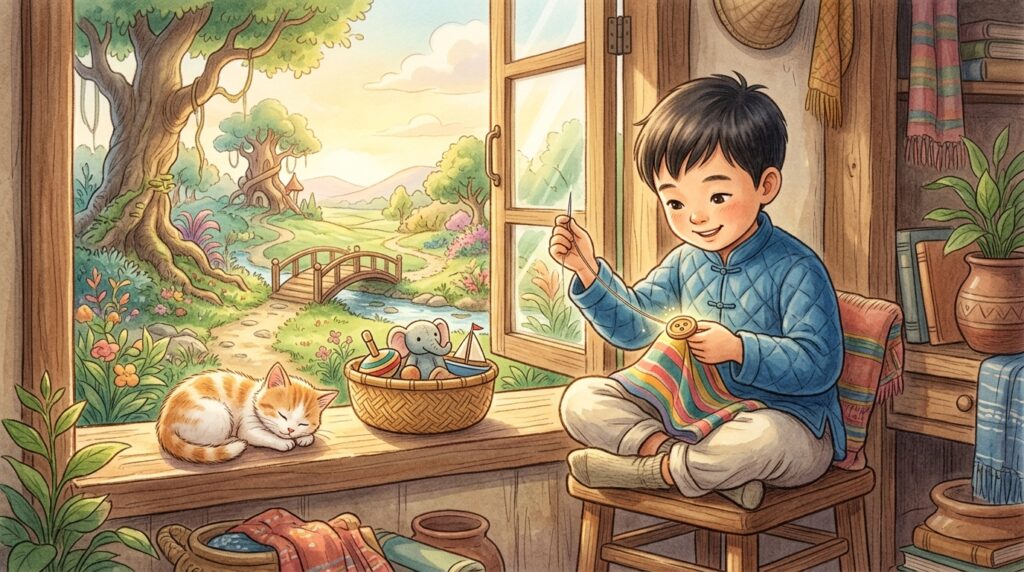
The Shiny Button
At the end of a small street stood a house painted pale yellow. In that house, little An lived with his mother and grandmother. An was a lively boy who liked running and jumping, listening to stories, and especially exploring the tiny things that adults often failed to notice.
One morning, Mother sewed An a blue jacket. There were four round buttons on it, each made of smooth, polished wood. The top button had a natural streak of light that looked like a smile. An named it Shiny Button.
Shiny Button was very proud to be in the first position. From there, it could see An’s cheerful face, hear Mother’s reminders before he went to school, and feel the warmth of the little hands that often pulled the jacket closed whenever the weather turned chilly.
But An had a habit that made Mother and Grandmother sad. He often made promises very quickly and forgot them just as quickly. An promised to put away his toys after playing, but by evening the toys were still scattered all over the floor. He promised to feed the cat, Mướp, but he got distracted playing soccer and left the bowl completely empty. He also promised Grandmother that he would bring her wool scarf inside, yet when she went looking for it, the scarf was still lying on the chair on the porch.
An was not a bad boy. Whenever he saw Mother having to tidy up his toys or heard Grandmother sigh, he felt guilty. However, only a short while later, An would forget what he had just intended to fix.
One evening, just as An took off his jacket and hung it on the hook, Shiny Button suddenly heard him say to Mother:
“Tomorrow I will definitely remember to feed Mướp before going to school.”
Shiny Button wanted to believe An. It also wanted that promise to come true. But inside, it felt a small worry, like a grain of sand caught beneath its foot.
Night fell. The whole house was silent. Wind slipped through the cracks in the door, gently stirring the blue jacket. Just then, the thread holding Shiny Button came loose. The button rolled off the jacket, fell to the floor, and slowly rolled through the doorway.
“Where should I go now?” Shiny Button wondered.
It looked up at the blue jacket one last time. The other three buttons lay still, round and snug. Shiny Button suddenly thought that if it could not find an answer to its worry, perhaps it would forever be merely a little object fastened to a jacket, understanding nothing about the promises An often made.
The Meeting Beside the Old Tree
Shiny Button rolled out of the yard and followed the stone-paved path leading to the neighborhood’s shared garden. The moon shone on the road, making it sparkle. After going a little way, Shiny Button met a yellow leaf caught between two paving stones.
“Do you know the way home for promises?” Shiny Button asked.
The leaf trembled as it replied:
“I only know the way home to the earth. I have never met any promises.”
Shiny Button thanked the leaf and continued on. Beside the old tree, it met a snail slowly crawling across the moss.
“You move so slowly. How will you ever reach where you need to go?” Shiny Button asked.
The Snail smiled:
“I do not need to go quickly. I only need not to turn back halfway.”
The answer made Shiny Button think. Perhaps a promise was like a road. It did not need to begin in a grand way, but whoever had set out had to try to keep going.
The Snail showed Shiny Button a small path leading to a pond. There was a wooden bridge there, and beneath the bridge ran a crystal-clear stream. When Shiny Button rolled closer, ripples suddenly spread across the water. An Egret stood on the bank, its long legs reflected in the stream.
“What are you looking for?” the Egret asked.
“I am looking for the place where promises are kept. I want to know why some people make promises so easily but do not do what they have said.”
The Egret tilted her head:
“Promises are not kept in any box. They lie in what people do after they have spoken. If you want to understand, look toward the opposite bank. There is a wooden house there. The person who lives in that house makes only one promise each day, but has never let a promise fall to the ground.”
The Carpenter’s House
Shiny Button rolled across the wooden bridge and stopped in front of the small house. Inside, a Carpenter was repairing a low chair for a neighbor’s child. On the table were pieces of wood, a hammer, and many ropes.
The Carpenter saw Shiny Button, picked it up, and placed it in his palm.
“A button that wandered away at night? What do you need me to help with?”
Shiny Button told him An’s story. The Carpenter listened for a long time and then said:
“Some promises are spoken because people truly want to do something good. But wanting to is not enough. People who keep their word usually find a way to turn what they say into a specific action.”
“What does ‘specific’ mean?”
“For example, if An promises to feed the cat before going to school, he can put the bowl beside the door and leave the food next to it the night before. If he promises to put away his toys, he can choose a basket just for them. When the task has a place in the day, the promise depends less on memory.”
Shiny Button felt warmth spread through it. It had once thought that An had to become a completely different boy before he could keep his word. It turned out that An only needed to learn how to begin with small things.
The Carpenter took a blue thread and carefully tied it around Shiny Button’s body so that the button would not roll too far away.
“You can go home right now,” he said. “But before you leave, remember one thing. When people accidentally forget a promise, they do not need to hide or pretend they never made it. They can admit their mistake, try again, and find a way to remember better next time.”
Shiny Button thanked the Carpenter. It said goodbye to the Egret, the Snail, and the yellow leaf, then began rolling back along the old path. This time, it no longer felt small. It carried a thought as clear as moonlight on the surface of the stream.
An Learns to Keep His Word
Near dawn, Shiny Button rolled back into the yard. It stopped beside the foot of the blue jacket. Just then, An woke up. He yawned widely, walked out of his room, and saw Shiny Button lying on the floor.
“Oh, my button!” An bent down to pick it up.
Mother heard the noise and came out. An was about to say that he would put the button in a box and remember to sew it back on later. But when he saw the blue thread tied around Shiny Button, he suddenly fell silent.
He remembered his promise to feed Mướp. He remembered the empty bowl beside the kitchen. He also remembered how tired Mother looked when she had to pick up his toys every evening.
“Mom,” An said, “I have made promises many times and then forgotten them. Today I want to do right away what I said I would do.”
An got food for Mướp, washed the bowl clean, and put it somewhere easy to see. Then he put his toys into the basket. He did not do it as quickly as the wind. He did each task one at a time, and at one point he even had to go back to pick up a toy car that had rolled beneath the table.
Mother did not praise him loudly. She only smiled and said:
“What matters is not that you have never forgotten. What matters is that you realized it and began to make things right.”
At noon, Mother sewed Shiny Button back onto the blue jacket. As the needle passed through the fabric, An sat beside her and watched very carefully. He asked Mother to let him try sewing an old button onto a scrap of fabric. An’s first stitch was crooked, and the second was tangled, but he did not give up.
From that day on, An placed a basket beside the door for putting away his toys, a small board in his room for writing down the things he needed to remember, and an alarm clock for Mướp’s mealtimes. Every night before going to bed, he asked himself what he had finished and what he still needed to continue the next day.
An still had days when he forgot. Once, he became so absorbed in reading a story that he left his books on the dining table. Another time, he played shuttlecock longer than he had planned, making Grandmother wait. But on those occasions, An did not say, “I forgot,” and simply let it go. He apologized, did what needed to be done, and found a way not to repeat it next time.
Promises Have Feet
Many days passed, and Shiny Button remained on the blue jacket. It watched An grow little by little. He no longer made lots of promises just to please everyone. Before speaking, he usually thought about whether he could carry them out. If he could, he clearly said what he would do. If he could not yet, he honestly asked for more time.
One afternoon, the neighbor’s little child dropped a wool scarf outside the gate. An saw it but was in a hurry to go to a friend’s house. He was about to walk on, then remembered the Carpenter’s words. An turned back, picked up the scarf, dusted it off, and returned it to the child.
“Thank you, An,” the child said.
An smiled:
“You’re welcome. I told your mother that I would keep an eye on you for a little while.”
When Shiny Button heard that, the streak of light on its surface suddenly seemed to shine more brightly. It understood that a promise was not a rope that tied people down and made them lose their freedom. A promise was like a pair of little feet. If cared for with honesty and action, it would bring people closer to one another.
That evening, An hung the blue jacket on the hook. Before turning off the light, he gently touched Shiny Button:
“Thank you for reminding me.”
Shiny Button could not answer aloud. But in the gentle moonlight, it seemed to be smiling.
From then on, whenever An was about to make a promise, Shiny Button would sparkle on the blue jacket. And An understood that beautiful words only truly had meaning when they knew how to find their way into action.
A Little Lesson for Children
Keeping your word does not mean that you must always be able to do everything immediately. What matters is thinking before making a promise, starting with something within your ability, reminding yourself proactively, and being honest when you accidentally forget. An apology accompanied by corrective action is always more valuable than a promise made only to make someone else happy for a moment.

ARTICLES IN THE SAME CATEGORY
The Lamp That Kept the Fire Burning at the End of the Slope
The Boy Who Heard Rain in a Bean
The Seedling Beneath the Veranda and the Little Watering Can
THE STORY OF SOWING SEEDS
The Power of Silence
Coconut Skull
ARTICLES IN THE SAME GENRE
Tam Cam Part 2: The Vengeful Spirits of the Palace
Tam and Cam: The Palace Intrigue and the Original Ending – Part 1
Tam Cam
Coconut Skull
Saint Giong
The Legend of the White Chrysanthemum