

 Tiếng Việt
 日本語
日本語 한국어
한국어 中文 (中国)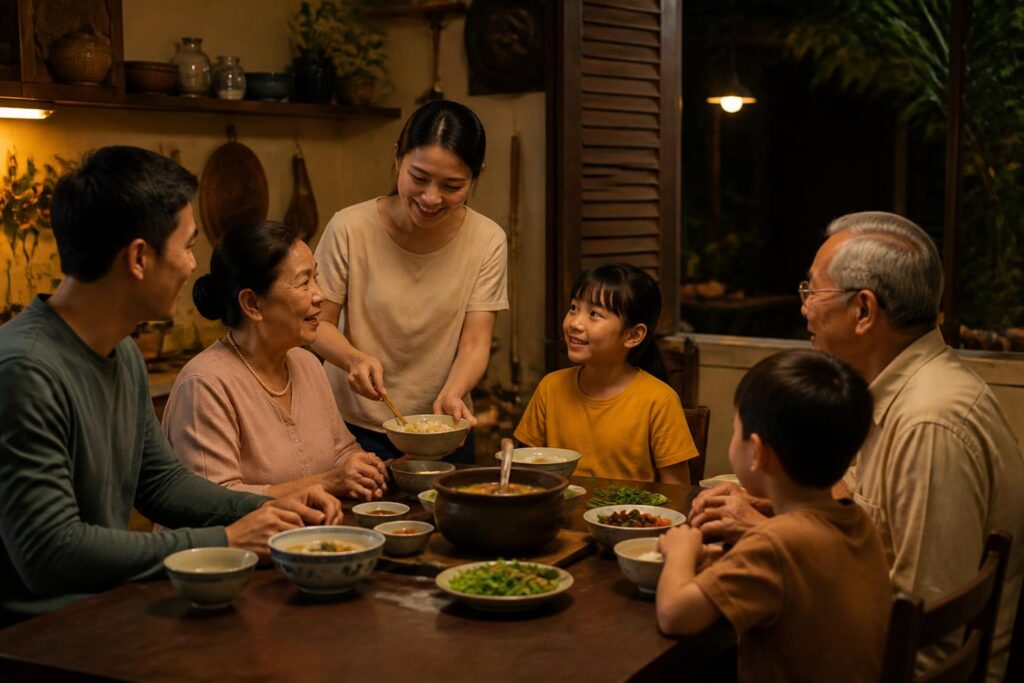
In many families, the kitchen is where the most familiar sounds are kept: the sound of a knife touching the cutting board, water running, bowls and chopsticks being placed on the table, and people calling out to one another while preparing a meal. But a kitchen may have its lights on every day and still lack warmth if the people living in it do not truly listen to one another. Family connection does not naturally appear simply because everyone lives under the same roof. It is created through small conversations, moments of knowing when to pause, and an attitude of respect for the feelings of those around us.
In the rhythm of a busy life, the family meal is sometimes treated as something that must be finished quickly. Those returning from work come home exhausted, children eat while thinking about their schoolwork, and the person preparing the meal may have already spent the entire day handling countless unnamed tasks. When everyone carries their own share of stress, simple questions like “How was your day?” can easily become merely perfunctory. Yet, as soon as one person genuinely waits to hear the answer, without rushing to judge or switching to talk about their own matters, the atmosphere in the family can change.
Listening Is Not Just Staying Silent Until It Is Over
Many people think that listening means sitting still while someone else speaks. In reality, listening also includes presence, attention, and the goodwill to understand what the other person is going through. A child talking about a conflict at school may not need their parents to immediately offer a solution. What they may need first is simply the feeling that their story matters. A spouse complaining about pressure at work may also not be looking for a lecture on how to manage time. They need acknowledgment that the day truly was not easy.
Listening also requires us to restrain the habit of predicting what someone will say, interrupting, or comparing. When a family member says they are tired, the response “Everyone is tired” can cause the conversation to close. When someone shares a worry, quickly saying “There is nothing to worry about” usually does not make the worry disappear. Such words may come from a desire to reassure, but they can unintentionally make the other person feel that their emotions are being dismissed.
A gentler way to respond is to ask further: “What is making you feel most tired?”, “Do you want me to listen or help you find a solution?” or “What can I do to help right now?” Questions like these do not make the problem disappear immediately, but they open up a safe space for loved ones to speak honestly. Sometimes, being able to say everything that has been weighing on someone is already the first step toward seeing the situation more clearly and becoming calmer.
A Family Meal Needs Everyone’s Presence, Not Merely Everyone’s Physical Presence
Some families still maintain the habit of eating together, yet each person is in their own separate world. One person eats while answering messages, another watches videos, and young children pay more attention to a screen than to the conversation at the table. Sitting together, therefore, does not necessarily create closeness. What gives a meal its meaning is mental and emotional presence—in other words, everyone has the opportunity to see one another, hear one another, and notice the small changes in one another’s lives.
Not every family can eat at the same time every day. Adults have different work schedules, children have their own school hours, and late shifts can also change daily routines. Therefore, connection should not be limited by a rigid model. If eating together is not possible, a family can still set aside another time to talk, prepare a weekend breakfast together, have a cup of tea, or take a walk around the neighborhood. What matters is not the form, but whether the members intentionally give one another their attention.
Kitchen tasks can also become opportunities to share responsibility. When one person is always cooking, cleaning, and caring for everyone, that sacrifice can easily be taken for granted. A word of thanks, an act of assistance, or taking the initiative to clear the table may not be grand gestures, but they send a clear message: your efforts are seen. In a family, gratitude does not need to be expressed in flowery words. It can begin with recognizing who has done what to make shared life more comfortable.
Arguments Do Not Necessarily Drive a Family Apart
A harmonious family is not a family that never disagrees. Differences in age, personality, habits, and viewpoints are unavoidable when many people live together. The issue is not whether there are arguments, but how people argue. An exchange can help family members understand one another better, while belittling or threatening words, or bringing up every old mistake, only allows hurt to accumulate.
When emotions are running high, taking a pause does not mean abandoning the other person. It can be a way of protecting the conversation from words that are difficult to take back. One person might say, “I’m too worked up right now. Let’s take a break and continue talking later.” That pause allows each side to calm down, identify what they truly want to say, and distinguish between the current issue and frustrations that have been lingering from before. Afterward, the conversation should resume rather than be forgotten.
During a disagreement, speaking about one’s own feelings is often more effective than labeling the other person. The statement “I feel lonely when all the household responsibilities fall on one person” opens up an opportunity for cooperation, while “You are always inconsiderate” can easily make the listener immediately become defensive. The way something is expressed does not change the truth of what needs to be resolved, but it can determine whether the two people will look at the problem together or turn against each other.
Small Rituals That Preserve Warmth Over Time
A family does not need to wait for a special occasion to create memories. Preparing breakfast together, spending a few minutes checking in before bed, making a habit of wishing one another a good day, or cleaning up together after a meal can all become rituals that nurture a sense of belonging. A ritual here does not have to be anything formal. It is a repeated action carried out willingly, helping family members know that they always have a place to return to and will be welcomed.
Families with young children need to pay even more attention to the quality of their conversations. Children learn how to care not only through instruction, but also through the way adults treat one another. When parents know how to apologize, give thanks, listen, and respect each other’s boundaries, children gradually understand that love is not only about material care. Love is also the ability to recognize others as individuals with their own feelings, thoughts, and needs.
For older people in the household, being listened to also has a special meaning. Stories they have told many times may still be a way for them to connect with their children and grandchildren. Instead of quickly assuming that it is an old story, younger family members can ask more about a detail, a memory, or the feelings behind it. Such patience helps older people feel that they still have a place in shared life and have not been pushed aside simply because of generational differences.
Family Atmosphere Is Created Through Many Small Choices
A warm kitchen does not depend entirely on the size of the home, the value of the meal, or the beautifully arranged household items. It begins with how people treat one another when no one from outside is watching. It is the choice to ask about one another instead of ignoring each other, the choice to speak clearly instead of allowing silence to build resentment, the choice to give thanks instead of treating care as an obligation, and the choice to repair things after hurting one another.
No one can listen perfectly at every moment. There are days when we are exhausted, impatient, or clumsy in our reactions. What matters is not turning one mistake into a reason to give up on the effort to connect. A sincere apology, a gentle touch, a meal cooked to make amends, or a conversation started again can all help a relationship find its way back.
Family warmth, therefore, is not something created in a single day. It grows from things that seem very small, repeated long enough to become a way of life. When each person knows how to make room for the voices of others, the kitchen is not merely a place where food is prepared. It is also a place where family members are seen, respected, and reminded that their presence matters in the shared home.

ARTICLES IN THE SAME CATEGORY
The Art of Closing Out the Day So the Mind Can Rest
The Quiet Between the Noise: Learning to Reclaim Our Own Attention
Creating a Home That Knows How to Listen, So Everyone Has a Place to Return To
Small Promises and How They Quietly Rebuild Trust
Family Meals and the Art of Preserving Peace in a Busy Day
Gratitude in Modern Life: From a Fleeting Emotion to a Sustainable Way of Living
ARTICLES IN THE SAME GENRE
The Wind Chime Finds Its Chime Again
Stepmother and Stepchild