

 Tiếng Việt
 日本語
 한국어
 中文 (中国)
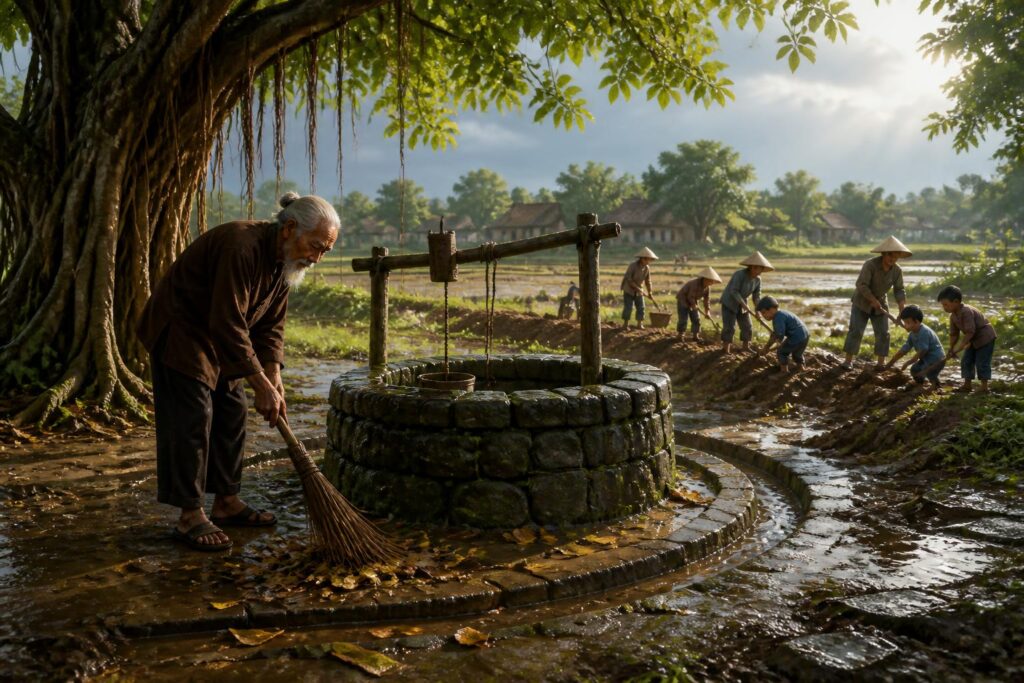
At the edge of Moc Village stood a stone well beneath an old banyan tree. The mouth of the well was built from smooth, weathered gray slabs, and a thin layer of moss covered its rim. The villagers called it Ngan Well, though no one remembered when that name had first appeared. Some said that long ago, the water in the well shone like silver beneath the moon. Others said it was simply a name adults had given to a place that once provided drinking water, before the stream changed course and the underground water veins gradually dried up.
For twenty years, Ngan Well had not held a single drop of water. At its bottom lay only dry leaves, a few rotting branches, and a layer of brown earth hard as fired clay. The village children often ran there to play hide-and-seek. Adults passing by did not even bother to look. Only Mr. Van still came by every morning.
He usually brought a bamboo broom, a bucket of compost, and a small hoe. He swept the leaves around the mouth of the well, pulled weeds growing between the stones, and used the hoe to fill in the cracks. The work brought him neither money nor drinking water. If anyone asked, he simply smiled and said that a well was like an old person: just because it had grown weak was no reason to abandon it.
Hearing this, the villagers would shake their heads. Aunt Tam, who sold tea, once said to a customer, “Mr. Van has lived alone too long and started acting strangely. The well is dry, so why bother tending it?” The children were more amused. They called him the well keeper, and sometimes even hid his broom to see whether he would get angry. He never scolded them. He would go look for the broom, and when he found it, he would dust it off and continue his work.
A Man Who Preserved What No One Needed
Mr. Van had not been born in Moc Village. In his youth, he had worked as a well digger with his father. The two of them traveled through many regions, listening to how the earth changed beneath the blade of the hoe to judge whether there was a water vein below. His father often told him that digging a well was not as difficult as preserving it as a place everyone could turn to in times of hardship.
When Mr. Van was in his thirties, a severe drought lasted so long that many wells in the area dried up. His father was already old by then, but he still agreed to dig a well for a small hamlet to the west. He worked for many days and finally found a weak water vein. There was not much water, only enough for a few families to use sparingly, but to people who were thirsty, every bucketful was as precious as gold.
On the night before the well was to be handed over, a sudden landslide occurred. His father never returned. After that, Mr. Van gave up well digging. He wandered for a while, then settled in Moc Village, where Ngan Well still held water at the time. He married, built a small house beside the fields, and made a living repairing farm tools. Years later, his wife died of illness, and they had no children. He grew even quieter, but he continued tending the well out of the habit he had formed when his father was still alive.
No one in the village knew that story clearly. Mr. Van had never told anyone, because he believed the things he did did not require anyone else’s pity. To him, Ngan Well was not merely a dry stone pit. It was a reminder that water had once flowed there, and that something which had once been useful should not be erased from people’s hearts simply because it no longer provided a benefit in the present.
The Dry Season Comes Early
That year, the rainy season arrived late. Clouds passed across the sky, then quickly dissolved above the hillsides. The rice fields cracked into long lines. The stream to the north was reduced to a thin, muddy, warm ribbon of water. The villagers began locking the wells that were still usable, preventing outsiders from taking too much water.
At first, everyone believed the drought would soon pass. They continued sowing rice seedlings, repairing the field banks, and saying that every year the weather had its unpredictable spells. But by the second month, the jars in their homes were gradually running low. Buffaloes and cattle had to be led farther away to find pools of water. Children were no longer allowed to bathe in the stream. Adults began arguing over a bucket of water.
The village chief gathered everyone beneath the communal house and scheduled hours for drawing water from the large well. Each household was allowed only a certain amount. The rule was necessary, but it did not ease their anxiety. Large families had to rise before dawn to stand in line. The elderly sat beside their jars, quietly calculating how long the remaining water would last.
Meanwhile, Mr. Van continued going to Ngan Well. But instead of merely cleaning it as he had every day, he began digging a small trench leading from the hillside down to the ground around the banyan tree. He cut dry branches, wove them into barriers, and covered the ground with decaying leaves. Someone passing by asked what he was doing. He replied that if it rained, the water would not run away but would gradually seep into the earth.
When Aunt Tam heard about it, she laughed. “It hasn’t rained for so many months, and you’re still preparing to catch water. You really are the well keeper.”
Mr. Van was not angry. He only said, “I don’t know when the rain will come, but if the ground can’t hold the water when it does, it will be as if it never rained at all.”
The Unexpected Night of Rain
Near the end of the month, the sky suddenly turned dark one afternoon. Wind blew down from the mountains, carrying the scent of damp earth that the villagers had long forgotten. The first raindrops fell sparsely on the roof of the communal house, then quickly became heavy and thick. Everyone rushed into the yard. Some laughed, some held out their hands to catch the water, and others hurried home to cover their piles of grain.
But the heavy rain also sent water rushing down from the hillside. Because the ground had dried hard, the water could not seep in quickly; instead, it carried mud and soil straight toward the houses on lower ground. The newly built field banks eroded. Part of the road turned into a small stream. The villagers panicked and used sacks, earth, and stones to block the water.
Mr. Van ran to the banyan tree. The small trenches he had dug over many days guided the flow of water toward the ground around Ngan Well. The barriers made from branches held back decaying leaves and mud, slowing the current. The water seeped through layers of earth instead of flowing entirely out into the fields. Part of the flow was also directed into the old pond behind the banyan tree, which for years had been used only for dumping grass.
As he worked, Mr. Van called on the nearby people to help. At first, only three children heard him. Then Aunt Tam brought a hoe. The village chief called for more people to shovel earth and build up the banks. Nearly the whole village came, some holding sacks, some cutting bamboo, and others clearing the trenches. It was past midnight before the rain finally eased. The village was covered in mud, but it had not been swept away and destroyed by the water as everyone had feared.
The next morning, something remarkable happened. A layer of clear water had collected in the old pond behind the banyan tree. There was not much, but it was enough for the villagers to give their livestock to drink and water their small vegetable plots. At the bottom of Ngan Well, the dry earth had also darkened. No one had yet seen the water vein return, but when Mr. Van lowered the bucket, it touched a layer of wet mud.
What the Well Taught the Entire Village
After the rainstorm, the villagers no longer called Mr. Van the well keeper as a joke. They called him that as a sign of respect. In the days that followed, everyone worked together to dredge the old pond, repair the drainage trenches, and plant trees around the banyan tree. The children were told not to throw rubbish into the well. The families agreed to collect rainwater in large jars instead of relying only on the central well.
Ngan Well did not immediately fill with water. At first, each day people saw only a little dampness at the bottom. On some days, not a single additional drop appeared. But this time, no one abandoned it. The villagers took turns cleaning it, covering its mouth when strong winds blew, and checking the water channels. They understood that a water source could not be created overnight. It required patience, care, and the awareness of many people.
A year later, at the beginning of the rainy season, Ngan Well could hold a few buckets of water. It was still not enough for the entire village, but it was clear and cool. Mr. Van was the first to draw a bucketful. He gazed at the water’s surface for a long time, then handed the bucket to Aunt Tam.
Aunt Tam said awkwardly, “I once said you were doing something useless.”
Mr. Van smiled. “Sometimes we look at something from too close and see only that it hasn’t produced anything yet.”
Aunt Tam fell silent, then drew a bucket of water and poured it at the foot of the banyan tree. From then on, whenever someone asked who the well keeper was, she always replied that the entire village was the well keeper. For a source of life is truly protected only when everyone regards it as their own responsibility.
Things That Have Not Been Completely Lost
The story of Ngan Well was retold through many rainy seasons. The storytellers often emphasized that Mr. Van had done something that seemed useless, but the more important point was not whether the well had regained its water. What mattered was that he had preserved its possibility of revival when everyone else could see only its depletion.
In life, quite a few things are like a dry well. A once-close relationship that has fallen silent. A good habit that has been forgotten. A dream that seems too late to begin. A person who was once strong but now has enough strength only for small tasks each day. If we look only at the immediate result, we can easily conclude that everything has ended. But life sometimes does not disappear completely. It merely withdraws to a deeper place, waiting to be cared for and waiting for the right season.
Caring for something that has not yet shown results is not always stubbornness. Sometimes it is faith expressed through concrete action. Someone who knows how to preserve a well cannot prevent every dry season, but can help the community suffer less when drought arrives. Someone who knows how to preserve a kind word cannot change another person’s entire life, but may create a source of support when that person is feeling weak.
In the end, Ngan Well did not become the largest water source in Moc Village. It was only a small well, dependent on rain, earth, and human hands. But after it came to be, the villagers understood that valuable things do not always appear in brilliant forms. Sometimes they are simply an old man quietly sweeping leaves beside the mouth of a dry well, patiently doing work that no one yet believed would one day be useful.
And perhaps there is such a well within each of us. It holds beautiful things that have been forgotten, hopes that have not completely gone out, and the ability to begin again after long dry seasons. What we need to do is not ask when the water will be full, but ask what we can do today to keep the bottom of that well from being buried.

ARTICLES IN THE SAME CATEGORY
The Meal with an Empty Chair
The Clock That Stopped at the Small Station
The Unsent Letter and the Art of Closing an Old Season
The Keeper of Seeds by the Front Porch
The Seed Keeper by the Dry River
The Tin Box That Held on to the Scent of Rain
ARTICLES IN THE SAME GENRE
Stepmother and Stepchild