

 Tiếng Việt
 日本語
 한국어
 中文 (中国)
The Paper Bags by the Front Porch
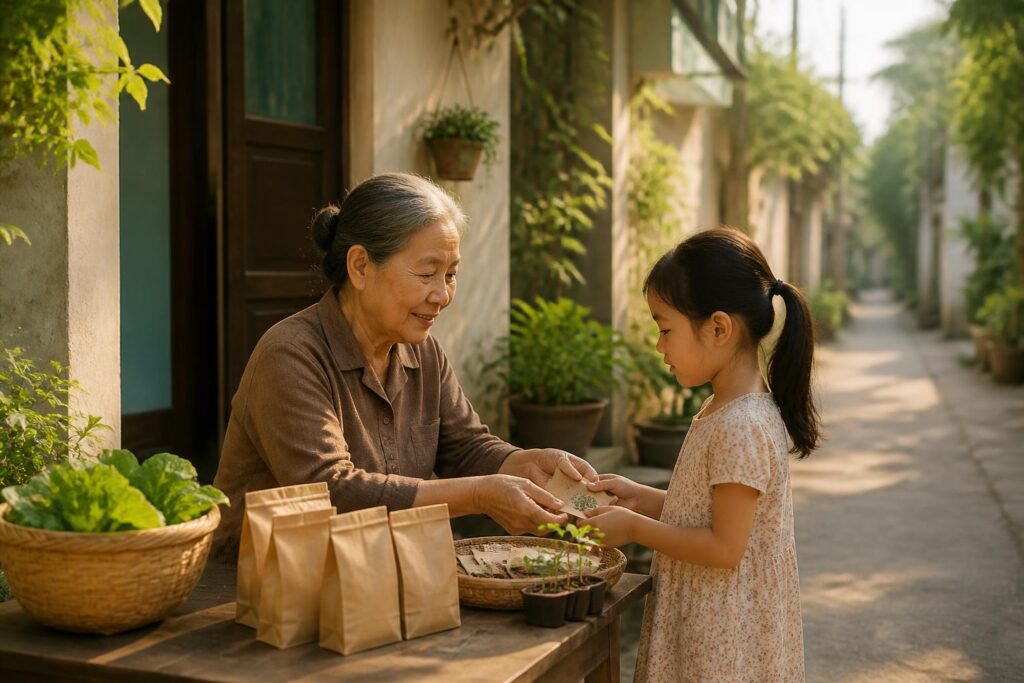
At the end of the alley stood a low-roofed house, where several bamboo baskets and neatly folded small paper bags were always placed on the front porch. None of the bags had labels or words on them, only a dot in a different color. Blue dots were for herbs, yellow dots for beans, and brown dots for flower seeds that the homeowner often said bloomed most beautifully when no one impatiently waited for them.
The owner of those bags was Mrs. Nam. She had lived alone for many years, but her house was rarely without the sound of people. In the morning, a little girl would stop by to ask for some morning glory seeds to plant in a foam box on her balcony. In the afternoon, the motorcycle repairman passing by would often stop to ask which kind of bean should be planted that season. One day, a woman who had just moved into the alley stood outside the gate for a long time before timidly knocking, only to ask Mrs. Nam how to save a wilting basil plant.
Mrs. Nam never handed over seeds right away. She would usually pour a cup of tea and ask whether the person had a plot of land, when they could water the plants, and whether there were young children or pets in the house. Only then would she choose a suitable paper bag. If the person had nothing more than a narrow windowsill, she would give them a few mustard-green seeds. If they had a sunny yard, she would give them yardlong beans or loofah. She said that seeds were like promises. Given to the wrong place, a promise would have difficulty surviving.
A Habit That Began with Loss
Mrs. Nam had not always loved gardening. When she was young, she used to think that slow tasks such as collecting, drying, and sifting seeds were only for people with too much time on their hands. She worked far from home, busy with early-morning trips and evenings spent returning after everyone in the house had turned off the lights. Her mother in the countryside often sent her a few pumpkins, some mature beans, or a bunch of herbs, but she used only the edible portions and threw the seeds into the trash.
After her mother died, she found a wooden box full of small packets of seeds in the old kitchen. Her mother had carefully dried them, wrapped them, and stored them there over many seasons. Some packets had faded, and some contained only a few seeds, but all of them were tied with thin strands of thread. On the outside of several packets were brief notes: seeds taken from a drought-resistant plant, seeds from a sweet fruit, seeds that should be sown after the first rain of the season.
She brought the box back to the city. At first, it sat untouched on top of a cabinet, covered in a thin layer of dust. One day, while cleaning the kitchen, she opened the box and saw the tiny seeds resting quietly in the palm of her hand. There was nothing remarkable about them. They had no vivid colors or fragrance, and they could not reveal how tall the plant inside them would grow or on what day it would flower. Yet her mother had believed that they deserved to be kept.
From that day on, Mrs. Nam began paying attention to seeds. She saved seeds from fully ripened tomatoes, separated pumpkin seeds from the pulp, dried bean seeds in gentle sunlight, and placed them in paper bags. She did not keep everything. She kept only healthy seeds, dried just enough, and taken from plants that had grown well in the conditions around the house. Each time she finished, she arranged them on the shelf by the front porch, where they could receive the morning sun and avoid driving rain.
Giving Without Needing to Know the Outcome
During the first few years, people in the alley thought Mrs. Nam was simply looking for something to fill her time. Some people accepted seeds and then forgot to plant them. Some planted them but watered them too much, causing the seedlings’ roots to rot. Others grew plants for a while, then abandoned them when they did not develop as hoped. Mrs. Nam never blamed them.
When someone came back and said that the seeds had not sprouted, she first asked where they had placed the pot, whether the soil drained well, and whether the seeds had been soaked for too long. If the person did not want to try again, she would simply nod and hand over another bag. She did not see her care as a debt that others had to repay with results.
“Some seeds need to fail once before they learn how to lie still in the soil,” she often said. “The same is true of people who grow plants.”
The words sounded simple, but many people in the alley remembered them for a long time. A young man who had lost his job once came to ask for herb seeds to grow on the rooftop. He said he did not know what else to do besides wait for the phone to ring. Mrs. Nam gave him a small tray, showed him how to mix the soil, and reminded him to water it just enough each day. A few weeks later, he brought over his first bunch of basil. She did not accept it. She told him to sell it to the eatery at the end of the alley, because that bunch of herbs was not just herbs; it was also a sign that he had begun doing something with his own hands.
Another little girl once sowed an entire bag of flower seeds in a small pot. The plants grew crowded together and weak, and several were even broken after a heavy rain. Sadly, the girl said that she had ruined everything. Mrs. Nam led her to the porch, took one healthy seedling, transplanted it into a wider pot, and told her that caring for something did not always mean leaving everything where it was. Sometimes, for a sprout to survive, we must be willing to gently pull it up and place it somewhere more suitable.
Seasons of Plants Change the Alley
The change came so slowly that at first no one noticed. A pot of vegetables placed in front of one door was gradually joined by another pot of vegetables. Bare walls acquired more hanging baskets of plants. One family repurposed an old wooden crate to grow scallions. The house opposite no longer had to buy herbs whenever they cooked noodle soup, because a lush cluster of perilla had grown on the windowsill.
The people in the alley also began exchanging things with one another. Someone with plenty of chilies would trade for a few sprigs of spearmint. Someone who grew loofah would share seeds with the neighboring house. The paper bags by Mrs. Nam’s front porch were still there, but they were no longer the only place where seeds were kept. Each house now had its own little corner for preserving what the previous season had saved for the next.
Mrs. Nam did not stand in the middle of the alley to receive thanks. Nor did she tell anyone that the idea had begun with her. Whenever someone mentioned it, she would only smile and say, “Seeds are born to travel farther than the parent plant.” To her, keeping seeds did not mean storing them so carefully that no one was allowed to touch them. Keeping seeds meant giving them the chance to meet another patch of soil.
Perhaps that was why she was not saddened when some plants died. She knew that not every season was favorable, not every plot of land was fertile, and not everyone who received something entrusted to them had the strength to care for it right away. What mattered was not that every seed had to sprout. What mattered was that there were still people willing to keep them after seasons of failure.
What Remains After a Season of Planting
One year, toward the end of the year, Mrs. Nam’s knees began to hurt, and she could no longer bend down for as long as she used to. The people in the alley took turns coming over to help her dry seeds, replace soil, and move the pots into sunny places. The little girl who had once broken the flower plants had grown up and now carefully marked the color on each paper bag. The young man who had once sat waiting for the phone to ring built an additional wooden shelf for the seedling trays.
Mrs. Nam sat on a low chair by the front porch and watched everyone work. Someone asked her who would keep those seeds in the future. She was silent for a while, then said that there did not need to be just one person. If everyone kept a little, the seeds would not depend on a single porch, just as kindness should not exist only in one person’s hands.
Her answer left the whole group silent. They suddenly understood that what she had given them all this time was not merely vegetable or flower seeds. She had given them a different way of seeing beginnings. A small act might not immediately change someone’s life, but it created a possibility for tomorrow. Patient guidance might not solve all of someone’s difficulties, but it could help them believe that they were still capable of trying again. A tiny bag of seeds might not guarantee a bountiful harvest, but it opened up an opportunity that had not existed before.
That afternoon, as the sunlight slanted across the porch roof, Mrs. Nam gave the little girl a paper bag marked with a brown dot. Inside were seeds from small, pale-yellow flowers that she had saved from the previous season. The girl asked when the flowers would bloom. Mrs. Nam shook her head and said that no one knew for certain. It might be in a few months, or they might have to wait until the next season. But if she planted them that day and cared for them consistently, at some point she would see something she could not have seen on the day she began.
On the way home, the girl held the bag of seeds in both hands. The alley was just as it was every day, with its old walls, low roofs, and the sound of vehicles passing along the main road. There was only one difference: from that day on, whenever she saw a sprout emerging from the soil, she no longer thought of it as a coincidence. She understood that behind every green shoot there was always someone who had once waited patiently, a season that had passed, and a belief kept alive long enough to be given to someone else.
Life, too, has dry seasons, sudden rainstorms, and times when planting does not succeed. We cannot decide what weather a seed will encounter, nor can we know exactly where what we give will flourish. But we can choose to preserve a small part of what is good, care for it with patience, and pass it on when it meets the right soil.
Who knows, perhaps a very small act of kindness today will become shade for someone else on a day when we no longer remember that we were the ones who planted it.

ARTICLES IN THE SAME CATEGORY
The Seed Keeper by the Dry River
The Tin Box That Held on to the Scent of Rain
When Someone in the Family Falls Silent: How to Listen to What Has Been Left Unsaid
The Watch Repair Shop That Does Not Accept Money on Saturday Afternoons
The Ferryman and the Seed That Never Bloomed
The Keeper of the Bell at the Old Ferry Landing
ARTICLES IN THE SAME GENRE
The Lamp Beneath the Station Eaves
The Things No One Applauds Still Make a Decent Life
When the Meal Slows Down, Family Grows Closer
Gratitude in Everyday Life: From an Emotion to a Sustainable Way of Living
Grateful for mother’s hands