

 Tiếng Việt
 日本語
日本語 한국어
한국어 中文 (中国)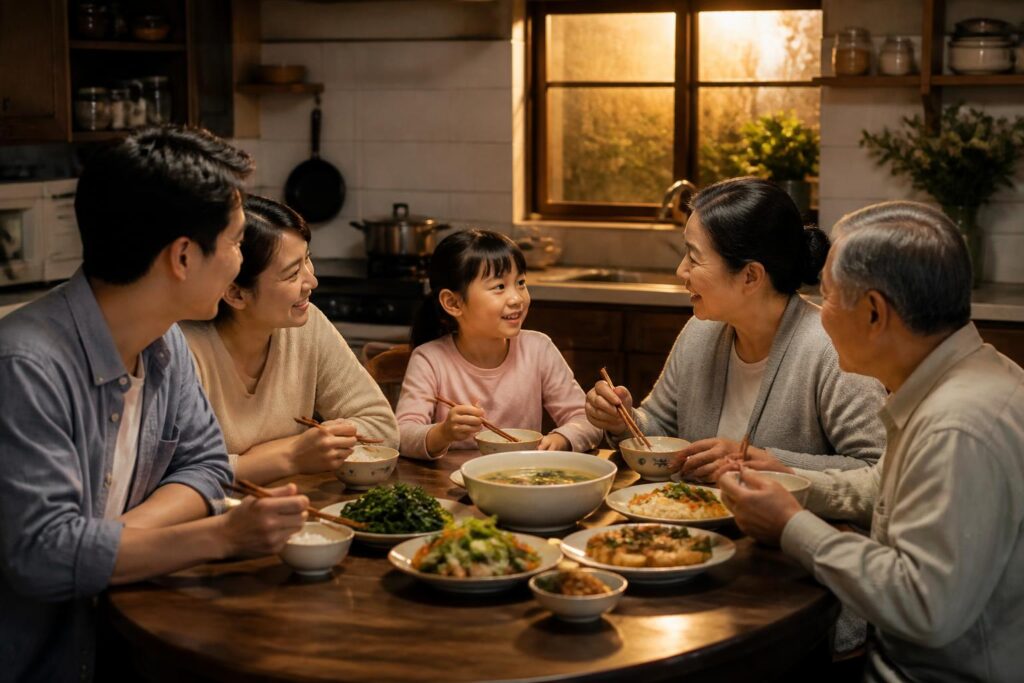
In many families, dinner used to be the most natural time for everyone to come together. Those returning from work, young children coming home from school, and someone preparing the food while recounting a trivial story from the day. The table was not always full, and the conversation was not always cheerful, but the presence of each family member made the house feel alive. Over time, daily routines changed. One person eats first because they are busy, another eats later because they are tired, and someone may look at a screen while having a meal. A family may still live under the same roof, yet sometimes lack those moments of truly being together.
Reflecting on family meals is not about criticizing a way of life or forcing everyone to return to an old pattern. Every family has its own work, schedules, and difficulties. More importantly, we can view a meal as a small opportunity to connect, rather than merely something that has to be completed. As life continues to move faster, slowing down for a meal can help people see one another more clearly.
A Meal Is About More Than Eating
In the simplest sense, a meal provides the body with energy. But in family life, it carries many other meanings as well. When someone asks, “Were you tired at work today?” they are not merely seeking information. The question may be their way of saying that they care. When a child tells a story about school, even if it seems very small, they usually do not just want adults to hear the details. They want to know that what they have experienced matters to their loved ones.
Conversations like these are usually not prepared in advance. They emerge while someone is serving more food, pouring a bowl of soup, or reminding someone else to slow down while eating. It is this ordinariness that gives a meal its strength. No one has to dress formally, say especially eloquent things, or tell a remarkable story. Simply setting work and personal concerns aside for a while gives intimacy a chance to return.
In a household, there are things that can be difficult to say if they begin with a serious conversation. But they may be brought up gently around the dinner table. A child may talk about pressure at school after saying a few words about the food. A father may share his exhaustion after a day at work without feeling that he is complaining. A mother may say that she needs to rest instead of silently enduring everything. A meal does not immediately solve every problem, but it creates space for problems to be seen.
Presence Matters More Than a Perfect Menu
Many people think that, to have a family meal, they must prepare many dishes, keep the table neat, and ensure that everyone has enough time. This way of thinking can easily turn gathering together into a burdensome task. If someone has to cook an elaborate meal every day, they may become exhausted. Then what was meant to be a time of closeness becomes another source of pressure.
In reality, the value of a meal does not lie in the number of dishes. A simple pot of soup, a plate of boiled vegetables, or food bought ready-made can all become the center of a warm evening if everyone truly sets aside time for one another. On some days, a family may only have the energy for a quick meal. What needs to be preserved is not the form, but the willingness to sit down together and not turn a few minutes with one another into a race.
Being present also does not mean that everyone has to be cheerful all the time. Family members may sit together on a very tiring day, speak less than usual, or simply listen to someone else tell a story. Silence in a safe space is not necessarily distance. Sometimes, knowing that one does not have to face a difficult day alone is already a significant comfort.
Phones and Invisible Distances
Electronic devices are not the enemy of the family. They help people work, study, communicate, and relax. However, when a phone is always within reach, people’s attention can easily become divided. A message, a video clip, or a notification can interrupt a conversation. The person telling a story gradually falls silent after realizing that no one is truly listening.
Putting phones aside during a meal should not be turned into a rigid rule for controlling one another. A family can begin with a gentle agreement, such as spending fifteen or twenty minutes without screens, except when an urgent matter needs to be handled. That amount of time is short enough not to create a feeling of being deprived of one’s habits, but long enough for everyone to look at one another and hear a whole story.
What matters is that adults set an example. It is impossible to ask children to put away their phones while their parents continue checking work at the dinner table. When adults willingly put their devices down, children will understand that giving one’s attention to the person in front of them is an expression of respect. From there, the meal can become a place where everyone relearns how to listen without needing a lecture.
Listening Without Rushing to Fix Things
One reason family members may hesitate to share is that they fear being judged or immediately receiving advice. When a child says that a friend misunderstood them, an adult may be quick to say that they need to be stronger. When an adult talks about difficulties at work, a loved one may quickly offer a solution. Such advice may come from good intentions, but if it arrives too soon, it can make the speaker feel that their feelings have not truly been received.
Listening does not mean agreeing with everything that is said. First and foremost, it is an effort to understand the other person’s feelings and circumstances. A question such as “What upset you the most?” or “How can I help you?” often opens up more possibilities than a conclusion. Sometimes loved ones do not need an immediate solution. They simply need a place safe enough to put into words what is weighing on them.
A meal is a suitable setting for practicing this kind of listening because it takes place at a familiar, unhurried pace. The speaker may not tell everything in one sitting. The listener does not need to force them. Patience repeated over many days will build more lasting trust than a conversation arranged with excessive formality.
Creating a Manageable Habit
Not every family can eat together every day. Some people work shifts, some frequently travel for work, children may have different school schedules, or someone in the household may need special care. Therefore, the appropriate goal is not to imitate an idealized image, but to find a routine that can be maintained over the long term.
A family can choose one or two days a week to eat together. If evenings are too difficult to arrange, a weekend breakfast can also be meaningful. If they cannot sit together for very long, everyone can agree on a short period to check in with one another. Someone who is away can still be remembered through a phone call or a question about how they are doing after the meal. What creates a habit is not its scale, but its consistency and sincerity.
The preparations should also be shared. The person who cooks should not automatically become the servant of the entire family. Young children can do manageable tasks such as bringing out bowls and chopsticks, setting the table, or putting things away after the meal. Adults can take turns cooking or take the initiative to buy a simple meal. When responsibilities are distributed fairly, the meal is no longer one person’s invisible labor but becomes a shared family activity.
What Remains After a Meal
We may not remember exactly what we ate on an ordinary evening. But we may remember a loved one’s voice while telling a funny story, the look in the eyes of someone trying to hide their exhaustion, or the relief of being asked how we were after a long day. Family memories are often formed from small details like these—not loudly, but firmly enough to return to us when we are far from home.
Sharing a meal also reminds us that a family is not sustained by responsibility alone. Money, housework, and caregiving duties are all important, but relationships also need time spent together. If people only live beside one another without knowing whether the other person is happy or sad, family members may gradually become strangers in the same house.
For that reason, starting again does not have to involve a grand plan. Perhaps tonight, all we need to do is invite a loved one to sit and eat with us, put our phones away for a few minutes, and ask a question whose answer we genuinely want to hear. The meal may not go perfectly, and the conversation may sometimes feel awkward. But each time people choose to return to one another, the house gains another thread that has been reconnected.
Slowing down for a meal does not make time stand still. It simply helps us use some of the time we have in a more meaningful way. Amid busy days, closeness sometimes does not need to be sought far away. It begins with a chair being pulled up beside us, with a gaze unobstructed by a screen, and with the simple presence of the people who still call one another family.

ARTICLES IN THE SAME CATEGORY
The Unextinguished Lamp at the End of the Alley
The Silence Between Two Moments of Haste
When Old Things Remind Us That We’ve Grown Up
The Basket Weaver by the Old Riverbank
The Bell Keeper and the Season of Low Water
The House with a Door Opening into Dawn
ARTICLES IN THE SAME GENRE
Brown Squirrel’s Raincoat
The Wind Chime Finds Its Chime Again
Stepmother and Stepchild