

 Tiếng Việt
 日本語
 한국어
 中文 (中国)
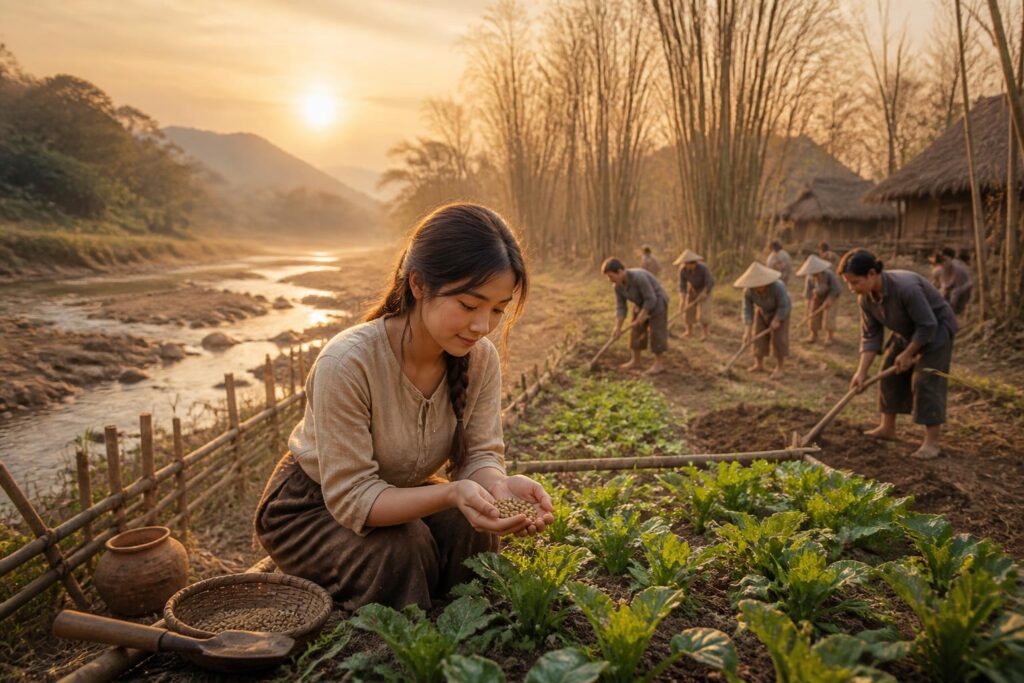
At the end of a red dirt road, where the houses grew fewer and the fields stretched all the way to the foothills, there was a village once called Bai Mat. The name came from a small river that flowed around the village. In the old days, the river was full of water year-round, its surface glittering in the sunlight, while the bamboo groves along its banks often leaned down to gaze at their reflections. The villagers grew rice, beans, and corn. Every harvest season, the yard of every house was golden with straw and fragrant with the smell of freshly gathered grain.
But then a season of drought arrived. At first, people thought it was simply a spell of heat that lasted longer than usual. The wells gradually dried up, and the farmland cracked into deep fissures. By the middle of the season, the river had become nothing more than a strip of white sand with a few muddy pools scattered here and there. The rice plants did not have time to flower. The rows of beans were scorched beneath the sun. The entire village fell silent, because even the crowing of roosters had grown infrequent, and the millstones had stopped turning.
In the village lived a girl named An. She lived with her mother in a small house near the riverbank. An’s father had died long ago, leaving the two of them a small plot of land—not large, but enough to support them through ordinary years. An was not wealthy, nor did she possess anything of significant value. The one thing she was good at was recognizing seeds.
An knew which rice grains were firm and which had been damaged by termites. She could tell varieties of beans that could withstand dry soil from those suited only to places with plenty of water. She knew how long corn seeds had to be dried and how they should be stored in jars so they could still sprout the following season. She had learned these things from her father, who had once told her that a seed was not only food for today, but also a promise to tomorrow.
The Jar Beneath the Floor
That year, after the failed harvest, many families in the village sold whatever they still could. Some sold their buffaloes, some their bronze pots, and some took their children to the town to look for work. During their meager meals, everyone talked about leaving. No one still believed the river would return, and even fewer thought about planting crops in the coming season.
One afternoon, while her mother was boiling a pot of thin porridge, An took an oil lamp into the old kitchen. She lifted the plank laid beneath a corner of the house and dug into the soft earth below. Before long, her hand touched the mouth of a small jar. Her father had buried it many years earlier, and inside were cloth bags that had faded with age.
An opened the bags one by one. There were golden-brown rice grains, mung beans, millet, and a small amount of pumpkin seeds. There were not many, but they were all dry, firm, and intact. She sat beside the jar for a long time, listening to the firewood crackle in the kitchen and remembering her father’s words: “When you do not know what to do, keep whatever will help tomorrow begin.”
An’s mother looked at the seeds and shook her head. She understood what her daughter wanted to do, but she also understood that the drought was not over. If they planted them, the seeds might die in the dry soil. If they kept them, the two of them would have food for a few more days. In the end, she said only:
“If you have made your decision, then you must take responsibility for it.”
An nodded. She took some of the seeds, put them into small bags, and stored them in different places around the house. She left the rest untouched in the jar. She told no one. An was afraid that if the news spread, the last remaining seeds would be divided into portions too small to plant even a single row.
The Merchant’s Offer
A few days later, a merchant from the town came to Bai Mat Village. He traveled in a cart loaded with sacks of rice and drinking water. He offered a very high price for any seeds people had managed to preserve. Many brought him the last handfuls of seed in their homes. They needed rice to survive the days immediately ahead.
Hearing that An knew about seeds, the merchant went to her house. He placed a sack of white rice on the table and said that if An handed over all the seeds she was keeping, he would add a jar of water. For the two of them, that might be enough to last several weeks.
An looked at the sack of rice. She thought of her mother, of the thin porridge they ate, and of her mother’s shoulders growing thinner by the day. She also thought of the cracked fields behind the house. If she sold the seeds, at least the two of them would not have to worry about hunger for a while. But when the water in the jar ran out, when the rice in the sack dwindled, what would they have left?
She asked the merchant:
“Where will you plant the seeds you are buying?”
The man laughed and said it did not matter. Seeds were merchandise, and whoever paid the highest price had the right to own them. An did not argue. She simply shook her head and pushed the sack of rice back toward him.
“I will not sell,” she said.
The merchant grew angry, thinking An was too arrogant. He went all around the village saying that the girl was hoarding her own goods while everyone else was starving. The rumor spread faster than the wind across the dry fields. Some people began to look at An suspiciously. Some even said she should immediately distribute the seeds among the entire village.
The First Row of Soil
An did not blame them. She knew that hunger and thirst could make people see only the present day. She did not want to keep the seeds for herself either, but hurriedly dividing them equally would not produce a harvest. So she went looking for people who still had the strength and invited them to dig a row of soil in the lowest area near the dry riverbed.
At first, only An’s mother came to help. Then a boy named Loc brought his father’s small hoe. After that, old Mrs. Man, who had farmed all her life, came leaning on a cane and showed them how to build embankments to retain every drop of water. Three people became five, and finally more than a dozen took part. They used dry branches to cover the ground, dug small trenches, and led water from a deep pool that remained beneath the riverbed.
An divided the seeds into portions. She did not give each person a handful to take home; instead, she planted them together with everyone in a shared plot. Each family took turns caring for it. Whoever had kitchen ash brought kitchen ash. Whoever found decaying leaves brought them to cover the bases of the plants. At first, these small tasks made many people feel awkward, because they were accustomed to everyone looking after their own household. But then they realized that in a drought, one person saving water for the entire vegetable plot was also saving water for himself.
During the first few days, the ground showed no sign of change. The seeds lay still beneath the thin layer of soil. Some people began to lose patience. They said An had thrown the precious seeds into dead earth. An herself sometimes felt anxious. Every night she went out to the field and bent down to touch the soil, as though she might hear something from beneath it.
On the morning of the tenth day, Loc ran throughout the village to spread the news. A small green shoot had emerged at the edge of the plot. Then came a second, and a third. No one knew who had cried out first, but within moments everyone working nearby had gathered. They watched the slender shoots tremble in the hot wind. Some people burst into tears. Others silently removed the scarves from their heads and wiped their faces.
A Season Comes Back to Life
The first plot did not produce much. But it gave Bai Mat Village something more important than food: the belief that the soil was not dead. Using the remaining seeds, the villagers continued planting in patches of lower ground. They dug shallow wells, put up screens to shade the crops, and took turns guarding the water at night.
The merchant returned after several weeks. He was surprised to see patches of green appearing beside the dry riverbed. He offered to buy all the vegetables and newly produced seeds, but this time the villagers refused together. They sold only the surplus, while the seeds were stored separately in jars marked with the signs of each family.
An did not become the village leader. She did not want to. She simply helped everyone remember how to preserve seeds, how to share water, and how to set aside part of the harvest for the next season. Knowledge that had once been considered insignificant gradually became a shared asset. The children in the village were taught how to recognize a good seed. The adults began repairing the neglected earthen embankments.
At the end of that year, clouds gathered after many months of clear skies. The first rain fell one afternoon—not heavily, but enough to make the dust rise with a warm, earthy scent. The villagers stood beneath their eaves, and no one said a word. When the first stream of water flowed through the riverbed, Loc ran along the bank, laughing until he was hoarse.
An’s mother looked at her daughter and said that her father had been right. A seed truly was a promise to tomorrow, but that promise became real only when someone was patient enough to preserve it and had enough faith to plant it.
Many years later, Bai Mat Village still experienced droughts. At times, the river once again shrank into a strip of sand. But no one any longer thought that a dry season could take away their entire future. In every kitchen stood a jar of seeds. The villagers called it the jar of tomorrow.
As for An, whenever she walked along the riverbank, she still bent down to pick up the small plant seeds blown across the ground by the wind. She took them home, dried them, stored them in cloth bags, and gave them to the village children. She told them that not every seed would sprout, but that did not mean they should stop planting.
Because sometimes, what saves a village is not a full granary, a great river, or a hero who appears at exactly the right moment. It may simply be an ordinary person who knows how to preserve what is necessary, how to share at the right time, and how not to let today’s fear determine the shape of tomorrow.

ARTICLES IN THE SAME CATEGORY
The Keeper of Seeds by the Front Porch
The Tin Box That Held on to the Scent of Rain
When Someone in the Family Falls Silent: How to Listen to What Has Been Left Unsaid
The Watch Repair Shop That Does Not Accept Money on Saturday Afternoons
The Ferryman and the Seed That Never Bloomed
The Keeper of the Bell at the Old Ferry Landing
ARTICLES IN THE SAME GENRE
Bông the Bunny and the Raindrop That Kept Its Promise
The Wind Chime and Brown Squirrel’s Promise
The Boy Who Gathered Laughter for a Wind Chime
The Wind Chime That Awakened the Garden
The Button That Went Looking for Someone Who Keeps Their Word
Tam Cam Part 2: The Vengeful Spirits of the Palace