

 Tiếng Việt
 日本語
日本語 한국어
한국어 中文 (中国)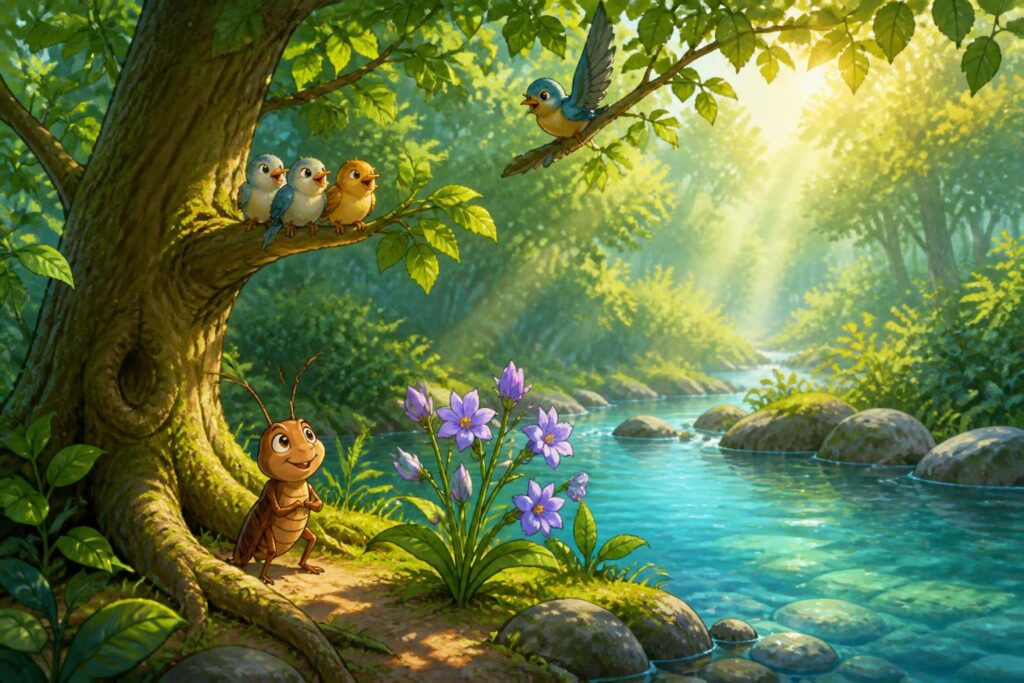
At the edge of the White Cloud Forest, where the tall tree trunks reached up to touch the early morning mist, there was a small patch of ground beside a crystal-clear stream. The patch had no brightly colored flowers, nor did the birds choose it as a place to sing loudly each morning. Yet beneath the soft brown soil, a tiny seed lay fast asleep.
The seed did not know what kind of tree it belonged to. It could only hear the gurgling water, the rustling leaves, and the animals talking above the ground. Whenever it heard a tall tree speak of its broad branches and leaves, the seed felt a vague worry prick at its heart.
The old oak nearby had a trunk so large that even three rabbits holding hands could not encircle it. The willow by the stream had long, supple branches that could reach down to the water’s surface. And the clump of wildflowers needed only one rainy night to bloom with masses of bright yellow petals.
The seed thought to itself: I surely can’t become as big as the oak, nor can I be as graceful as the willow. Perhaps I won’t be able to do anything worthwhile.
The Voice Beneath the Ground
One early spring morning, a light drizzle fell. Drops of water slipped through every gap in the soil and touched the seed’s dry, hard shell. Suddenly, it felt as though something inside it was stirring.
The seed asked in alarm:
What is happening?
From deep beneath the ground, a slow voice rang out. It was the voice of Mother Earth, who had cradled the seed for many months.
You are beginning to grow.
But I don’t know what I will become. What if I can’t grow as tall as the oak? What if I don’t have beautiful flowers like the wildflowers?
Mother Earth chuckled kindly. Her laughter sounded like loose soil crumbling beneath the tiny feet of a hedgehog.
A seed does not need to know right away what kind of tree it will become. First, you only need to listen to what is happening inside you.
The seed fell silent. It listened for a very long time. It heard a small white root slowly pushing itself downward. It heard its shell crack ever so softly. It heard drops of water soaking into its body and heard the first rhythm of life awakening.
Those sounds were so faint that, above the ground, no one could have noticed them. But beneath the ground, they were as clear as bells ringing in the morning.
The seed felt less afraid. It used its young root to cling to the soil, then tried to push a green shoot upward.
The Friend Who Always Asked Questions
The next day, a brown cricket found the patch of newly raised earth. The cricket lived in a burrow near a clump of grass and had a habit of asking everything questions. It asked the pebble why it lay still all day, asked the ant why it was always in such a hurry, and asked the cloud why it kept drifting across the sky.
When it saw the green shoot, the cricket bent down and asked:
What are you?
I don’t know.
Do you know how tall you will be someday?
I don’t know that either.
Then do you know what color your flowers will be?
I know even less about that.
The cricket thought for a while, then nodded thoughtfully:
How interesting. I have never met anyone who knew so little about themselves as you.
The seedling felt a little sad, but the cricket quickly continued:
Don’t be sad. Perhaps because you don’t know yet, you have so much to discover.
From that day on, the cricket visited every day. It told the seedling stories about the world above the ground. It said that that morning, a flock of sparrows had fought over a ripe strawberry. It said that Uncle Hedgehog had a dry leaf stuck to his back without realizing it. It also told of a new path the ants had opened behind the fig tree.
The seedling liked listening, but it still could not talk much. It was busy growing roots, busy reaching upward, busy learning how to stand firm against the first winds.
Whenever the seedling stayed silent for too long, the cricket would ask:
What are you listening to?
The seedling replied:
I’m listening to the roots touching a pebble. I’m listening to the water flowing closer. I’m listening to the wind calling the leaves above.
The cricket smiled. From then on, it too began sitting still more often to listen.
The Harsh Heat
Then summer arrived. The sun beat fiercely down on the forest. The stream, once full of water, was now only a thin flow winding between the stones. The grass along the bank turned yellow. The wildflowers folded their petals at midday.
By then, the seed had become a young tree with a few small leaves, and it felt its entire body grow dry and burning. Its roots stretched out in search of water, but the surrounding soil grew harder by the day. The young tree tried to endure, yet each day it felt itself growing weaker.
It looked at the old oak. Although the oak leaves drooped slightly, they still cast a large patch of shade. The young tree thought to itself: If only I had broad branches and leaves like that.
It looked at the willow. The willow branches still touched the stream lightly, as though comforting the water. The young tree thought again: If only I could reach as far as you.
One afternoon, the young tree could bear it no longer. It whispered for Mother Earth:
Mother, am I not strong enough? All the other trees can get through the summer, but I am about to dry up.
Mother Earth did not answer at once. She let the young tree’s roots reach into deeper layers of soil. There, the earth still held a little moisture from old rains.
You do not need to be strong like the oak. You do not need to reach as far as the willow. Listen to your roots and find the path that suits you best.
The young tree did as she said. It no longer tried to push its roots forward as quickly as possible. It listened to each patch of soil, noticing which places were softer, which still held more moisture, and which offered a firm hold. Slowly, the roots found a small underground stream.
That was how the young tree survived the summer. It did not grow quickly, but each day it became steadier and stronger.
The Rainy Night and the Nest Swept Away
By the end of summer, dark clouds gathered. After many months of scorching sunshine, a heavy rain poured down on the forest. Water rushed from the hillside across the patch of ground, carrying dry branches, decaying leaves, and small pebbles along with it.
The brown cricket was sheltering in the grass when it heard cries for help. A nest of baby birds had been knocked down by the wind near the stream. Three nestlings huddled together, trembling, while their mother flew in circles overhead because she could not land in the swiftly flowing water.
The young tree looked at the water. It was still small, and its trunk was not yet strong enough to withstand a flood. But its roots had sunk deeply into the soil. A dry branch became caught against its trunk, creating a small barrier. The water changed direction, flowing around it instead of straight into the nest.
The cricket saw an opportunity. It ran as fast as it could to call Uncle Hedgehog, the squirrels, and the mother bird. Uncle Hedgehog used his snout to push large stones toward the tree’s roots. The squirrels dragged dry branches and arranged them into a barrier. The mother bird swooped down and carried her young out of the wet nest one by one.
By the time the rain stopped, the three nestlings were safe inside a hollow in the oak. The young tree had scratches on its trunk and had lost a few leaves, but it was still standing firm.
The cricket ran over, speaking between breaths:
You saved the baby birds!
The seed, now a young tree, gently rustled its leaves:
I was only standing here.
The cricket shook its head:
Standing firm at the right moment is also very important.
The Secret of Every Living Being
Autumn arrived. The young tree continued to grow. New leaves emerged with unusual shapes that no one in the forest had ever seen. The old oak gazed at them for a long time, then said:
You are not an oak, nor are you a willow. Perhaps you are a special kind of tree.
The young tree asked:
What does special mean?
The old oak replied:
It means that you have a way of living that no one else can replace.
When spring came the following year, the young tree bloomed with clusters of pale purple flowers. The flowers were not large, but they gave off a gentle fragrance. Their scent drifted across the patch of ground on the wind, drawing swarms of bees. The bees drank the nectar, then carried the pollen throughout the forest. Beneath the tree’s shade, the crickets had a cool place to shelter. The young birds often perched on its branches to practice hopping from branch to branch. When the fruit ripened, the squirrels and field mice had more food to eat.
The young tree suddenly understood that it did not need to become the tallest or most beautiful tree. It only needed to grow in its own way, listening to the soil, listening to the water, listening to the wind, and listening to the needs of the friends around it.
One afternoon, the brown cricket asked:
Do you know what kind of tree you are now?
The tree smiled by gently rustling its leaves:
I am a purple-flowered tree. But that is not the most important thing.
Then what is important?
That every day I can learn something new, help someone with my abilities, and not need to be like anyone else.
The cricket sat still. For the first time, it did not ask another question. It simply watched the purple flowers swaying in the afternoon sun and listened to the peaceful forest around it.
From then on, the patch of ground beside the stream was called the Listening Garden. New seeds were often carried there by the wind. Whenever a seed was afraid because it did not know what it would become, the purple-flowered tree would tell it its story.
The tree said that no one needs to see the entire forest from the very beginning. A small root can still find a water vein. A tiny trunk can still shelter a nest. And a living being that seems the quietest of all may still be quietly preparing for the day it will cast shade and bloom in its own way.
If one day you feel that you are slower than others or have not yet found what you are good at, you can remember the seed beneath the patch of ground beside the stream. Patiently listen to yourself, care for each small step, and do not be quick to think that you are of no use. Some beautiful things need a great deal of time to grow, but once they have matured, they will bring shade to an entire forest.

ARTICLES IN THE SAME CATEGORY
Brown Squirrel’s Raincoat
The Wind Chime Finds Its Chime Again
The Seed That Knew How to Listen to the Rain
The Button That Went Looking for Someone Who Keeps Their Word
The Lamp That Kept the Fire Burning at the End of the Slope
The Boy Who Heard Rain in a Bean
ARTICLES IN THE SAME GENRE
The Button That Went Looking for Someone Who Keeps Their Word
Tam Cam Part 2: The Vengeful Spirits of the Palace
Tam and Cam: The Palace Intrigue and the Original Ending – Part 1
Tam Cam
Coconut Skull
Saint Giong